
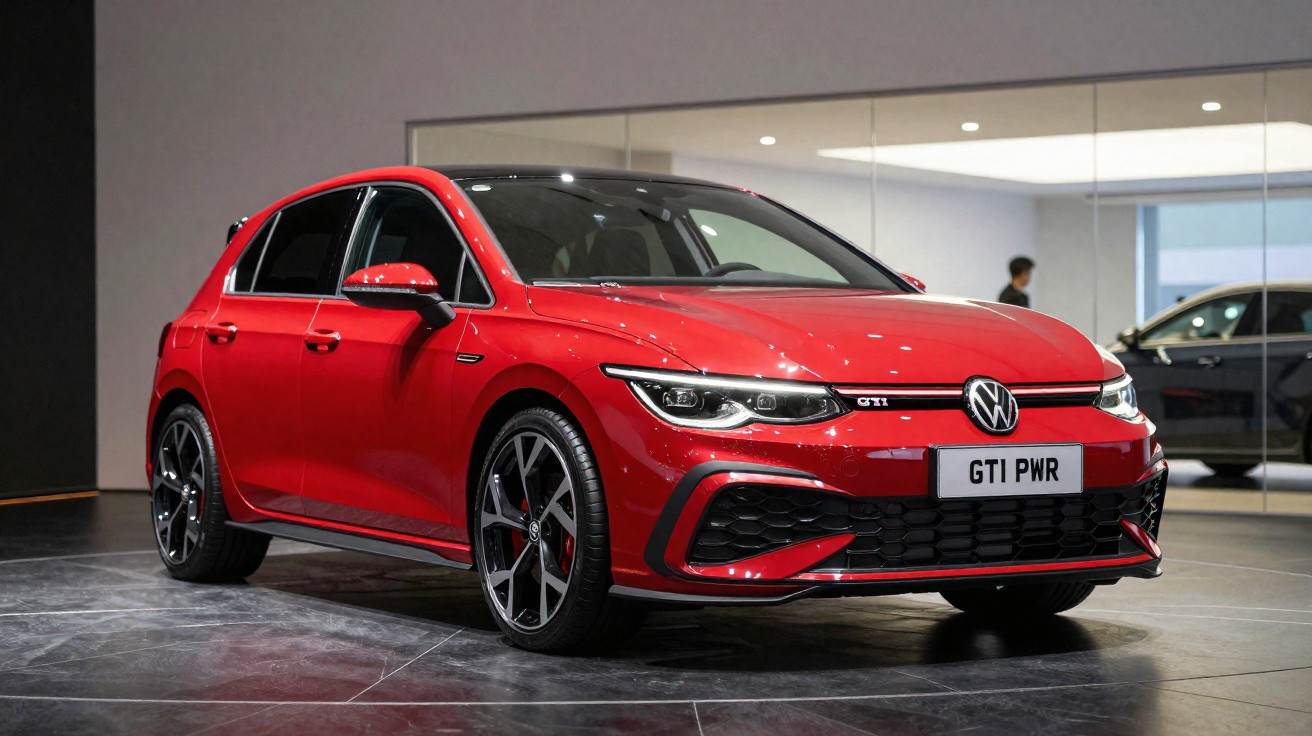
"One hell of a car!" is the most politically acceptable, publishable line that came to mind after threading my way through a tight, twisty and damp private stretch of road at rather more… enthusiastic(!) pace in the Volkswagen Golf GTI.
Any lingering doubt that the Volkswagen Golf GTI has the ammunition to take on the latest competition - the Hyundai i30 N, SEAT Leon Cupra 300 or Renault Mégane RS, for instance - vanished in just a handful of kilometres of tarmac.
Let’s be honest: just because its newer rivals bring more horsepower to the argument doesn’t mean the Golf GTI suddenly goes from brilliant to rubbish. On paper, spec sheets may point to quicker alternatives, but despite a 30–35 hp shortfall - the Golf GTI Performance, the only version on sale in the country, delivers 245 cv in total - out in the real world, where you can’t always indulge your right foot, the gap isn’t nearly as obvious.
"The only issue - if you can even call it that - is that to really ‘feel’ the car, you have to be travelling at illegal speeds, because the grip it offers is so high."
Fast and effective, but not boring
The pace the Volkswagen Golf GTI can sustain through any sequence of bends borders on the criminal, staying utterly composed and inspiring confidence when driven hard in a way very few can. It’s predictable, no question - yet it’s a long, long way from dull. Its dynamic abilities come across as natural and flowing, even if it isn’t the sort of car that throws shapes with lively or exaggerated reactions. At times, I missed that…
The steering isn’t the most talkative, but it’s accurate and pleasantly light - in Sport it gains a bit of weight, which suits me better - and the front end is sharp, responding instantly to inputs. Credit, too, to the ESP - with the road still damp, I didn’t risk switching it off - which never became intrusive enough to spoil the driving.
The only issue - if you can even call it that - is that to really ‘feel’ the car, you have to be travelling at illegal speeds, because the shared chassis (also used by models such as the Audi RS3 and SEAT Leon Cupra) allows such high levels of grip.
Personally, I’ll admit the more extrovert - though no less effective - dynamic character of the new Renault Mégane RS suits me better. I had the chance to test it properly both on the road and on track back in February. All I’m missing now is some proper “quality time” with the Hyundai i30 N to confirm its chameleon-like personality - Guilherme insists it’s brilliant, but I simply didn’t have enough time behind the wheel.
There’s an engine here
There’s always a “but” in any story. No, it isn’t the engine - which is arguably one of the best I’ve had in my hands in this class. All 245 cv are genuinely there. It pulls everywhere - 370 Nm available from 1600 rpm - with strong top-end shove, even if it doesn’t really spin much beyond 6000 rpm, low inertia and lag you can’t perceive. At times, it feels like you’re commanding a large-capacity naturally aspirated unit rather than a “mere” 2.0-litre turbo.
The soundtrack won’t set your soul alight, but in this era of politically correct turbo engines there are no miracles - and it’s still better than the Mégane RS’s bits-and-bytes effect, which is far too noticeable.
OK, not everything is perfect…
The big “but” here is the gearbox. The ubiquitous seven-speed DSG, widely praised across many Volkswagen Group models, left me craving the manual and that extra layer of interaction. In everyday driving it’s hard to fault - it always seems to pick the right ratio, it doesn’t hesitate, and its shifts are smooth.
When you’re going full “knife between the teeth”, and you need the maximum from its supposed intuition, it’s less convincing. In Sport, it allows the engine to run to higher revs before shifting up (which is absolutely fine), but on corner exits there were far too many times it got itself in a muddle: downshifting when it should have held the gear, ending up at higher revs without any real benefit.
I also gave up on manual mode quickly. The paddles behind the steering wheel are small and they rotate with the wheel - so you’re never quite sure where they’ve gone.
Using the gear lever instead - and maybe it’s just me… - I never got used to having to push the lever forwards to upshift and pull it back to downshift. Isn’t the norm exactly the opposite? It isn’t… but it should be.
Five driving modes… what for?
In today’s world of configurable cars, the Volkswagen Golf GTI is no exception. Even so, there are simply too many options, and they aren’t always clearly distinct from one another.
With five driving modes available, you could easily cut it down to two - all right, three, if you keep the Individual mode that lets you tailor things parameter by parameter. Eco, Comfort and Normal could be rolled into one, leaving Sport for those “knife between the teeth” moments - more choice doesn’t automatically mean you gain more from it, or that the product becomes better…
It’s a GTI, but it’s also a Golf
In more ordinary use, the GTI shows the familiar Golf strengths - despite the performance on tap, it remains a package with very little to criticise. It’s still one of the segment’s benchmarks for materials and build quality, solid as few are, roomy enough, with good visibility - and this particular car even had five doors, which makes the family role easier.
“Our” GTI came with a few options, including the Discover Pro navigation system - the digital instrument cluster is standard on the GTI Performance - and 19″ Brescia wheels. The wheels unquestionably add visual punch, but I’d struggle to recommend them. Comfort takes a small hit, with too much sharpness over certain imperfections, plus more road noise, and it’s far too easy to “mark” them - which I ended up discovering the hard way.
Fuel consumption? Let’s change the subject…
A brief word on fuel use. If you look at Spritmonitor, where the figures are supplied by real users, you’ll find averages of 8,55 l/100 km across 76 users - a number that seems perfectly achievable with a more restrained driving style.
A long way from the 10,8 l I recorded, thanks not only to plenty of urban driving but also the effort I put into exploring the Golf GTI… Performance’s dynamic and performance talents - all in the name of science, of course… Driven hard on the twisty roads I covered, the Golf GTI Performance even returned averages above 14 l/100 km. It really isn’t difficult, believe me.
Somewhat on the expensive side
But while you can always improve consumption by mixing “foot to the floor” moments with more measured driving, the price is harder to swallow. The Volkswagen Golf GTI Performance, here with five doors and DSG, starts at 50 995,63 euros - choosing the manual saves 1760 euros - then you add 1840 euros in optional equipment, bringing the total to 52 829,63 euros.
At this level you’re in Honda Civic Type R (GT) territory, which serves up 75 cv more, and despite its far more controversial image, there’s not much debate. It arrives with mechanical and dynamic strengths - though not sonic ones - that outdo the Golf GTI.
The closest rivals, such as the Hyundai i30 N and the Renault Mégane RS, on the other hand - and looking purely at the spec sheet - are also (slightly) more powerful and quicker, but subjectively more engaging from behind the wheel. They’re also far more affordable, with differences that can reach 10 thousand euros.
It’s difficult to recommend the Volkswagen Golf GTI Performance when today there are rivals of the calibre I’ve mentioned. The GTI’s qualities are all still present, undeniably, but at this price point the Volkswagen Golf GTI Performance only really makes sense if, above all else, what you value most is onboard technology and build quality over outright fun.
Not that the others are poor on that front, but the Volkswagen Golf’s infotainment system and the Golf’s material choices remain the best you’ll find among mainstream brands. And you pay for it, of course!
Comments
No comments yet. Be the first to comment!
Leave a Comment