
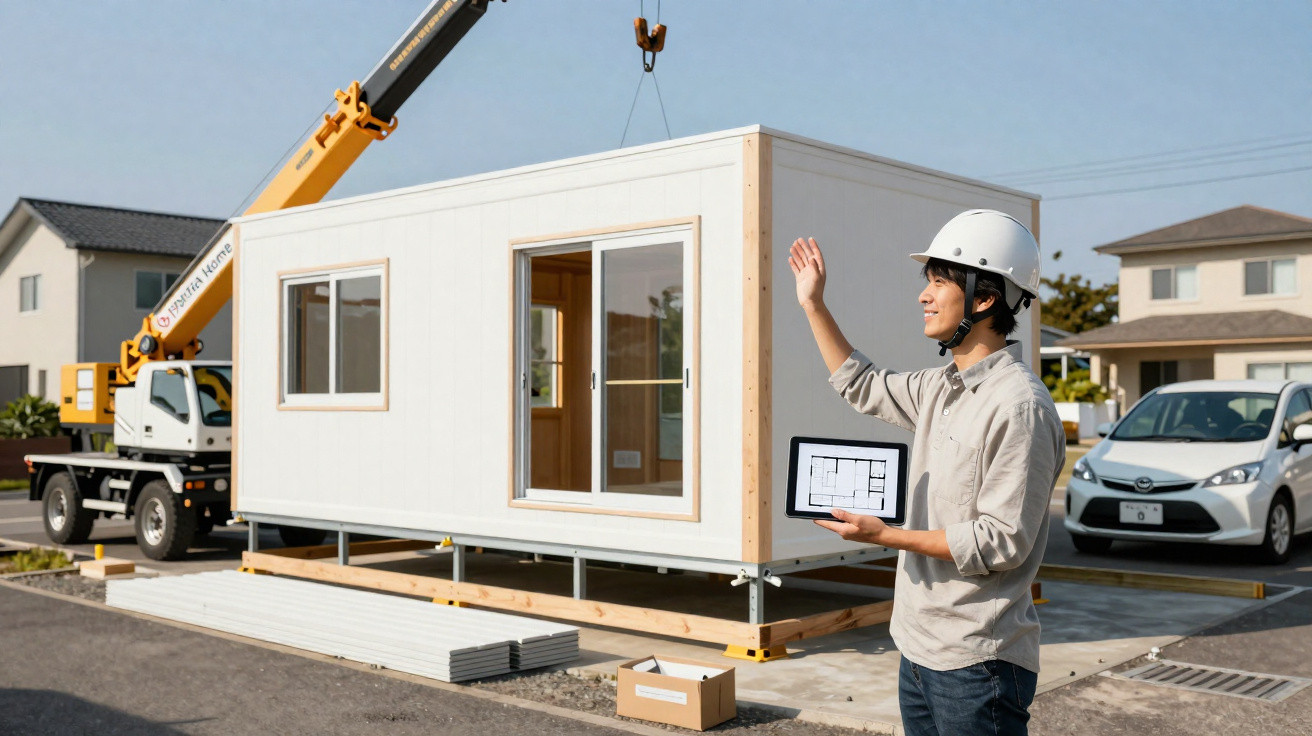
Owning a Toyota and keeping it in the garage is fairly commonplace - the brand has topped global sales charts for decades. Having a garage built by Toyota, however, is another matter. In Japan, it is possible to do the full set: park a Toyota in a Toyota-built garage. It sounds odd, but it makes sense once you know the back story.
The reason is simple: Toyota also builds houses - and it has done for a long time. The Japanese giant has been producing modular homes since 1977.
At first glance, it may seem strange for a car manufacturer to branch out into property. In practice, though, the underlying industrial processes are closely related to those used in vehicle production. Toyota’s houses are not traditional brick-and-mortar builds (brick and cement); they are modular steel homes. In other words, they rely on the same core material Toyota has been working with for more than 90 years.
This arm of the group is called Toyota Home, and around 85% of the work happens in the factory, which means a house can be finished in just 45 days. The company also advertises a warranty that can extend to 60 years.
Where did the inspiration come from?
Toyota’s move into housing was no accident. The roots of the idea can be traced back to the outlook of Kiichiro Toyoda, the founder of the company’s automotive division.
On a visit to Ford’s plants in Detroit, Toyoda was struck by the efficiency of the Ford Model T assembly line. He realised the real value of the system was not limited to building cars, but lay in its ability to turn steel into complex products quickly, consistently, and under tightly controlled conditions.
Decades later, that same logic was carried across into homebuilding. Toyota Home was created to bring the same principles that define Toyota’s automotive manufacturing into construction: industrialisation, quality control, reduced waste, and high-precision manufacturing.
“Toyota Home aims to deliver a lifetime of total satisfaction. We strive to achieve the highest level of customer satisfaction,” the company says on one of its websites. And if you are already thinking about buying one of these homes, note that they are not available on the UK market.
How are they built?
Much of the work is completed before the house ever reaches the plot. Rather than constructing on-site using conventional methods, the brand manufactures three-dimensional steel “cubes”, each measuring about 14 m². These modules leave the factory almost complete - with walls, windows, plumbing, and electrical installation already in place. From there, they simply need to be transported and assembled on location.
The influence of the automotive industry goes well beyond the production method. Before they reach the customer, the modules undergo testing that simulates earthquakes, in a process comparable to the crash tests carried out on cars.
Using steel structures and anti-corrosion techniques developed for the car industry also supports a structural warranty of up to 60 years. That timeframe is roughly double the average service life often attributed to many homes in Japan.
A business that remains small
Even with nearly five decades of experience, Toyota Home still accounts for only a small share of Japan’s housing market.
According to figures released by the company, in 2019 the division produced around 15,000 units, in a market where more than 40,000 prefabricated single-family homes were sold. As noted, Toyota Home manufactures exclusively for the Japanese market.






Comments
No comments yet. Be the first to comment!
Leave a Comment