
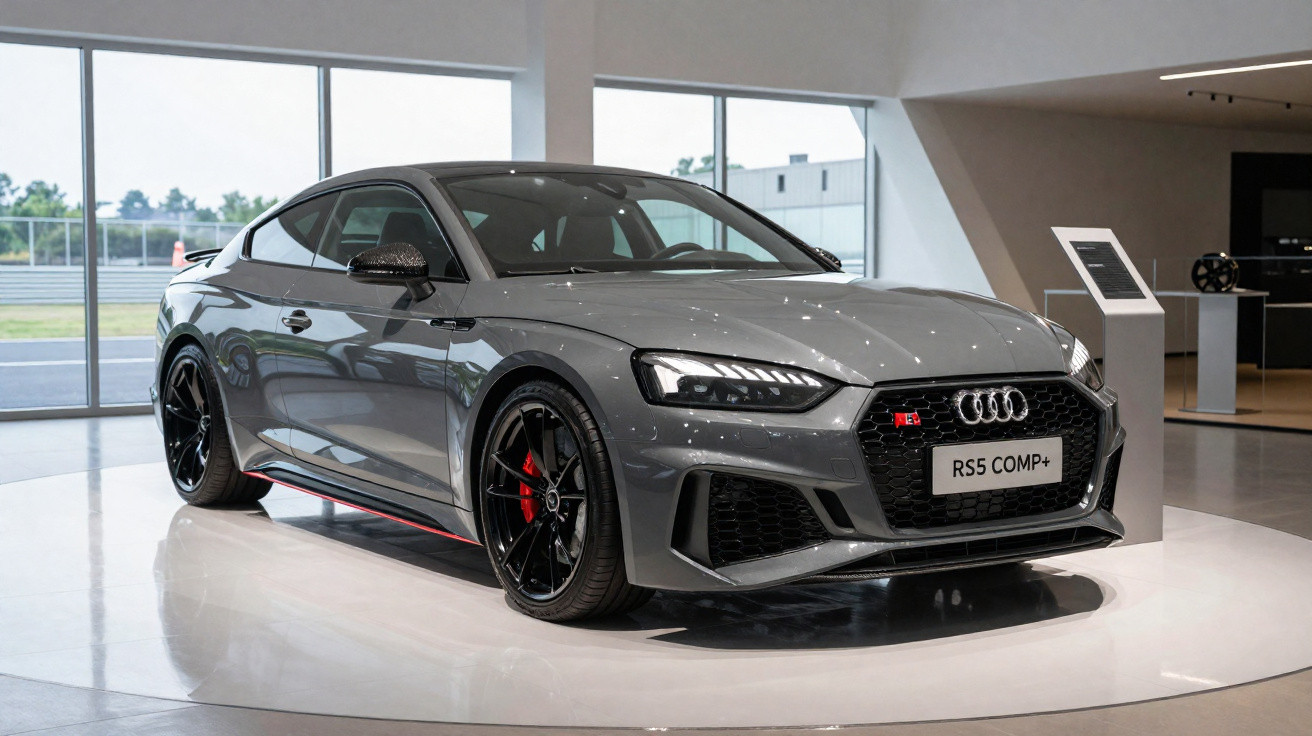
The Audi RS 5 Competition Plus was created with one straightforward mission: to satisfy everyone asking for an (even) more sporting take on the RS 5.
Audi listened so closely to customer feedback that it developed two flagship versions - Competition and Competition Plus - not only for the RS 5 but also for the RS 4, as Florian Mair, Head of the Audi Sport model range, explained to us.
As we walked up to the RS 5 Competition Plus in the pit lane at the Ascari circuit, Mair told us: “There was a group of customers who told us the RS 4 and RS 5 should be more track-focused, and when we launched the current-generation car in 2020 we decided to develop the Competition and Competition Plus versions”.
He then outlined what sets them apart from the ‘standard’ RS versions: “the steering ratio is fixed (on the Competition Plus), there’s a new calibration for the quattro locking differential, the gearbox ratio is quicker and it’s possible to manually adjust the suspension”.
Improving how it connects to the road
The Audi Sport engineering team developed a coilover set-up (called “RS sport suspension pro”) so owners can tune it by hand and find a strong balance between comfort and performance.
On the RS 4 and RS 5 Competition Plus, ride height drops by 10 mm compared with the RS versions, and owners can lower it by another 10 mm. In other words, that’s 27 mm lower than an A4 and 20 mm lower than a ‘normal’ RS 4 or RS 5.
Andrei Filip, lead chassis development engineer, told us that “this kind of customer can work underneath the car, remove the wheels, open the bonnet and set the configurations they want, changing rebound, compression and ride height”.
RS Competition Plus models come with a booklet (including calculations and general guidance) and dedicated tools to make the job easier.
Other key suspension changes for the Competition Plus include stiffer springs, three-way adjustable dampers and firmer anti-roll bars, all intended to sharpen the car’s responses and make it feel more agile.
Each tyre is 10% lighter (around 2 kg per tyre), with Filip saying: “We asked Pirelli to develop a tyre specifically for track use, but also for everyday public roads, in different kinds of weather conditions, except snow”.
Unlike the Competition version, which uses a variable steering ratio, the Competition Plus uses a fixed ratio to keep the front axle’s reaction to the driver’s inputs as consistent as possible.
Last but not least, the sport quattro differential was recalibrated to boost agility and driving enjoyment, given that the “electronic brain” now directs more torque to the rear wheels.
Audi’s engineers also say the braking system has been refined and that, with Pirelli P Zero Corsa tyres, updated ABS software and optional RS ceramic discs, the car needs 2 metres less to come to a stop from 100 km/h.
Subtle changes
Given the mechanical changes on the Competition and Competition Plus versions of the Audi RS 4 and RS 5 are evolutionary rather than revolutionary, it makes sense that the visual updates follow the same approach.
Outside, the overall look is darker thanks to a gloss-black finish for the four rings on the bonnet, along with the model lettering, plus the new “Sebring Black” detailing.
Optional styling packs - covering door mirrors, the front blade and side flaps, as well as the extended side sills and the rear diffuser in matte carbon or gloss carbon - dial up the sense of theatre.
For those after an even more assertive stance, there’s also the option of 20” wheels with a gloss finish which, at the customer’s request, can be paired with high-performance Pirelli P Zero Corsa tyres suitable for both road and track.
Inside all three models - RS 4, RS 5 Sportback and RS 5 Coupé - the new Competition and Competition Plus packages bring changes too.
You get a mix of Dinamica microfibre (45% made from recycled PET fibres) and leather with a honeycomb pattern, RS logos embroidered into the seats with strengthened side bolsters, controls finished in black Alcantara, and black seat belts with red edging.
To help separate these new range-toppers from the rest, there’s also a new RS sports exhaust (with matte black tailpipes) that fills your ears in a more forceful way.
That comes not only from the exhaust itself, but also from less sound-deadening material between the engine bay and the cabin. This change translates into an 8 kg reduction in overall vehicle weight.
Less weight, better performance
The weight saving may be modest, but combined with an updated software calibration for the 8-speed Tiptronic transmission control unit, it delivers slightly stronger acceleration.
The 0 to 100 km/h sprint takes 3,9s in the RS 4 Avant (0,2s quicker) and 3,8s in the RS 5 Sportback and Coupé (0,1s quicker).
At the same time, the top-speed limit rises from 250 km/h (or 280 km/h with the Dynamic RS option) to 290 km/h, as the Competition versions are likely to see regular track use - especially the Plus.
Finally behind the wheel
With the differences between the Competition and Competition Plus versions covered, it’s time to describe what it’s like to drive the most hard-edged Audi RS 5.
With our time at the entertaining Ascari circuit limited to six laps, the first three were spent following Audi’s driving instructor. The final three were completed solo.
There are no surprises from the 2.9-litre twin-turbo V6 (mounted within the V) with 450 cv: it feels relentless and reacts rapidly at any engine speed, helped by a 600 Nm torque peak from 1900 to 6000 rpm.
However, where an RS 4 or RS 5 starts to hint that you’re nearing the limit as understeer becomes noticeable in tighter corners (despite quattro traction), here you can feel the rear of the car moving around substantially more.
That not only improves agility, it also makes the front end feel far more anchored to the tarmac. The result is a clear increase in confidence for any driver, whether in fast bends or slow corners.
Filip explained how the car was made more precise: “we modulated the throttle body in a different way so that it opened and closed faster and, that way, we send more weight to the front when we lift the pedal and more weight to the rear when we press it, creating a body movement that benefits sporty driving”.
Across the six laps at Ascari, I couldn’t verify the promised reduction in stopping distance, but I also didn’t detect any sign of brake fade whenever I pushed the braking system hard.
Driving on public roads mainly confirmed that the RS 5 Competition Plus fits everyday use perfectly.
Anyone keen to avoid attracting too much attention should avoid ‘waking’ the V6 in the “Dynamic” drive mode, which amplifies the engine’s deep note by holding it at 2000 rpm rather than the 1500 rpm of ‘normal’ RS models, and uses dedicated software to generate exciting “pops and bangs”.
Even when the road surface is nowhere near as flat as a snooker table, “Comfort” mode helps the suspension absorb bumps and potholes.
How much will it cost?
In Portugal, the Audi RS 5 Sportback starts at 122 810 euros, and the national importer is still negotiating with head office while deciding whether there’s sufficient interest to bring this more sporting version to the country.
To get an approximate sense of what it could cost, it’s worth noting that in Germany the Competition pack adds 7875 euros to the bill, while Competition Plus increases it by 11 875 euros.
That means the final total would never come in below 135 000 euros here. Is the extra outlay worth it? There’s no single right answer: it depends on how important it is to a driver (with more than a few racing instincts) to be a few seconds quicker over a lap (depending on circuit length), and how often these RS models will genuinely spend time on track.
What is certain is that, for now, these are the fastest and most capable RS 4 and RS 5 models ever built - at least until the first electrified cars (plug-in hybrids) arrive, which should happen over the next two years.
On that point, Florian Mair said: “there’s no need to fear any loss of emotion, because electric propulsion can be great fun, as Audi has already proven with the RS e-tron GT. And if we do it with more than 4 cylinders the final result will definitely be better…”.
Technical specifications
| Audi RS5 Competition Plus |
|---|
| Engine |
| Architecture |
| Layout |
| Capacity |
| Power |
| Torque |
| Transmission |
| Drive |
| Gearbox |
| Chassis |
| Suspension |
| Brakes |
| Performance |
| 0 to 100 km/h |
| Top speed |


Comments
No comments yet. Be the first to comment!
Leave a Comment