
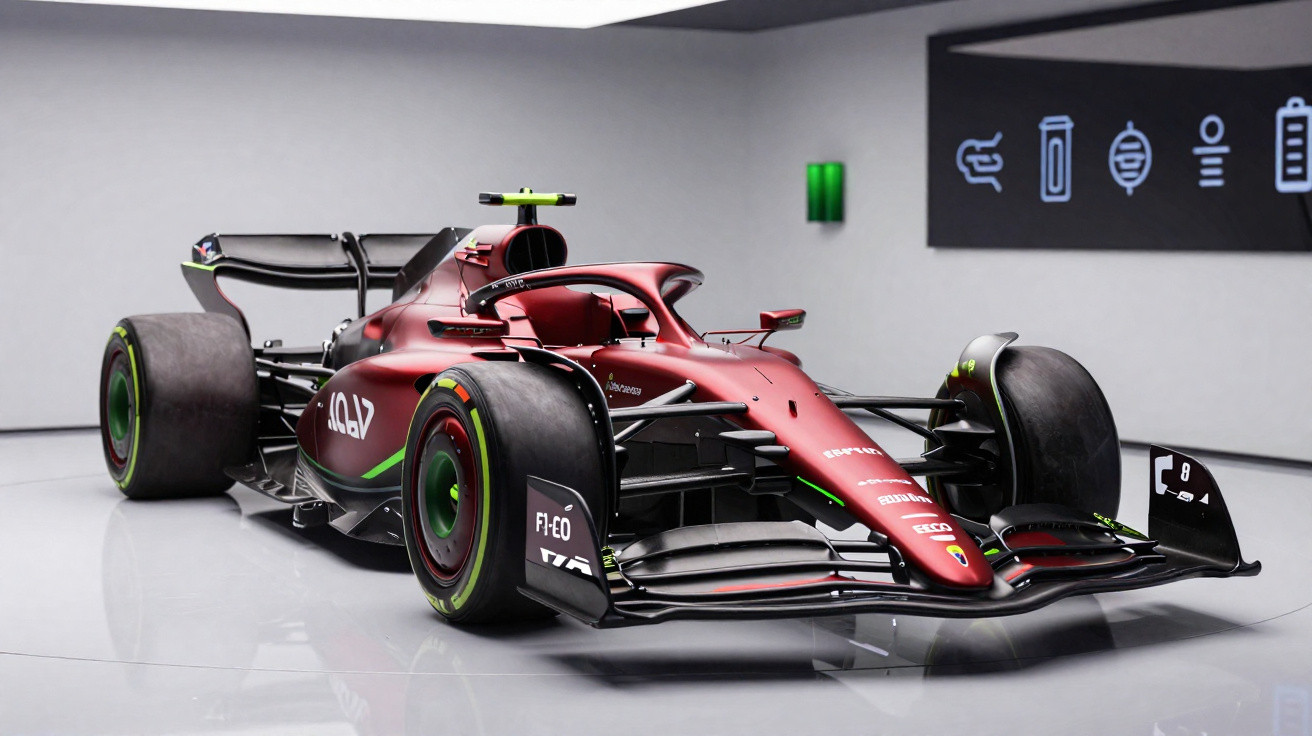
On 16 August, the FIA World Motor Sport Council (finally) signed off the new Formula 1 engine regulations that will come into force in 2026.
On the surface, the recipe looks familiar - it still relies on a combustion engine paired with an electric machine - yet there are plenty of major changes.
Those changes will make the next generation of Formula 1 cars more efficient (less energy used) and CO₂-neutral at the tailpipe, while still delivering the performance you would expect. Here is what is new.
Goodbye fossil fuels…
In 2026, Formula 1 single-seaters will continue to run 1.6-litre V6 Turbo power units, but the fuel feeding them will no longer be of fossil origin.
The new sustainable fuel will be produced from non-food sources, from biomass, and even using CO₂ captured from the atmosphere (one of the ingredients used to make synthetic fuels).
This sustainable fuel - developed in partnership with ARAMCO - is expected to ensure CO₂ neutrality in exhaust emissions. Its use should also be capable of being extended to road cars, which could further accelerate the uptake of these fuels.
…but they won’t be allowed to burn as much fuel
Formula 1 cars will still be powered by a 1.6 V6 Turbo, but there will be a cap on maximum energy flow, and the total amount of fuel permitted per Grand Prix will also be reduced.
If, in 2013, a car could use 160 kg of fuel per race, that figure was cut to 100 kg in 2020 - and in 2026 it will drop again to somewhere between 70 kg and 80 kg.
That will mean the V6 Turbo will not produce as much power as it does today, but the FIA says outputs above 1000 hp will remain the norm - because…
…the electric machine will have (almost) three times more power
At present, a Formula 1 car’s electric system is made up of an MGU-H (Motor-Generator Unit – Heat) and an MGU-K (Motor-Generator Unit – Kinetic).
For 2026, only the MGU-K will remain. The MGU-H - which converts thermal energy from the exhaust gases and the turbo into electrical energy - will be removed due to its complexity and cost. One consequence of dropping it could be the return of turbo-lag.
And while the combined output of today’s MGU-K and MGU-H adds up to 120 kW (the equivalent of 163 hp), in 2026 the MGU-K alone will be able to deliver 350 kW - the equivalent of 476 hp. To reach that figure, more energy will be recovered under braking.
The MGU-K will also be integrated into the chassis alongside the battery and electronics, keeping all high-voltage equipment within the safety cell and helping to make the car safer.
Lower costs
Banning the MGU-H and certain other materials, along with using a higher number of standardised components sourced from a single supplier, is intended to reduce costs. A maximum number of hours on the dyno will also be enforced.
As is the case today, Formula 1 in 2026 will continue to limit teams to three engines per car per season.
Recycling batteries
Formula 1 says it is committed to a more responsible environmental approach and, as in the wider automotive industry, it needs clear answers on what happens to batteries when they reach the end of their useful life.
From 2026, recycling options must be available not only for the batteries, but also for certain end-of-life raw materials used by the MGU-K, such as cobalt.





Comments
No comments yet. Be the first to comment!
Leave a Comment