
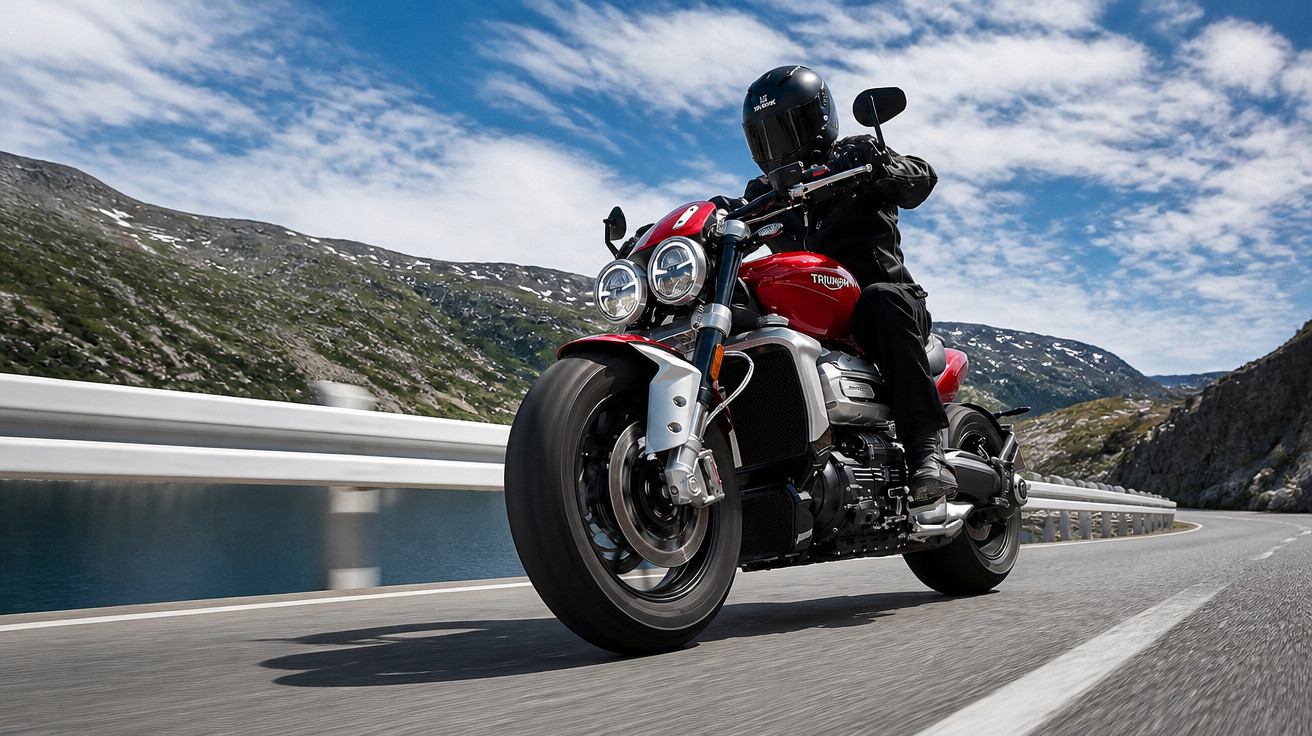
What in the name of suck, squeeze, bang, blow is that?
Meet the Triumph Rocket 3 R. And no, that isn’t some wishy-washy badge dreamed up by a marketing department. The name fits because this two-wheeled colossus currently owns the 0–60mph production bike record, ripping through the sprint in only 2.73 seconds.
And that’s merely the opening line of a ridiculous CV. Much like the Dodge Demon, it’s a machine built from ‘firsts’, ‘mosts’, ‘biggests’ and ‘fastests’ – essentially the ultimate card to slap down during a game of pub Top Trumps.
As well as being the quickest production bike off the line, the Rocket’s 2,500cc engine makes it the biggest-capacity production motorbike on sale. It’s also the torquiest production bike you can buy, which pretty much guarantees it’ll feel like a monster.
That sense of menace is helped by the fact it’s absolutely massive. Dry weight is 291kg, and it’s over 320kg once it’s full of fluids. For a motorbike, that’s a lot.
The Triumph Rocket 3 R in numbers
Two and a half litres! That’s bigger than most car engines.
Correct. While plenty of people think a 1,000cc sportsbike is the point where things become “big”, the Triumph takes one look, shrugs, and goes “that’s cute” before barging through with an inline three-cylinder engine that’s roughly one-and-a-half times the capacity.
To put 2.5 litres into context, that’s the same displacement you’ll find in a Porsche Cayman S. Except this is bolted into a motorbike. Take a moment and let that settle.
Where it came from: Rocket history and R vs GT
When did this madness begin?
The urge to stuff huge engines into small(ish) things is about as old as humanity itself. There’s probably a cave drawing somewhere in Australia of someone ‘hot rodding’ a shrub.
As for the Rocket specifically, the seed of the idea dates back to 1998. A production model didn’t turn up until 2004, when Triumph launched a 2,294cc cruiser that promptly grabbed the title of the world’s largest-capacity production bike.
That original concept sat awkwardly between audiences. So, with the modern Rocket 3, Triumph went harder: more power, more speed, 40kg less weight – and, importantly, two distinct versions.
There’s the ‘R’, a naked roadster aimed straight at Ducati’s Diavel. Then there’s the ‘GT’, a touring-flavoured option with a more laid-back riding stance (the handlebars are pulled back by 125mm, while the foot controls are positioned further forward), plus a seat that’s 23mm lower, a screen, heated grips, and a back brace for whoever you decide to perch on the rear. Believe us, they’ll appreciate it.
How it rides, costs, and the verdict
Looks cool.
It does. The Rocket has an industrial-chic vibe: everything appears big, brutalist and muscular, but it’s rounded off by sweeping curves and those sculpted, triple-header exhausts.
It rides on specially developed Avon Cobra Chrome tyres, and the 240mm-wide rear makes it very clear you mean business (and that you’ve got oceans of torque to attempt to put down). Add in the single-sided swingarm with monoshock suspension, plus excellent aluminium detailing scattered across the whole bike, and it looks every bit as serious as the spec sheet suggests.
What’s it like to ride?
Initially, it’s intimidating – largely because there’s simply so much motorbike beneath you. The engine throws out heat and heft, and the wheelbase is long. At low speeds, it’s a handful to manoeuvre. And it’s nerve-racking, because unless you’re Popeye, if you tip it over you’ll need a small crowd to haul it upright again. Which, naturally, means even more people available to point and laugh at the moment you dropped it.
The surprise is what happens once it’s moving. As soon as the tyres are rolling, it seems to shrink, and the whole imposing vibe fades away. It’s a bit like watching a gym hardo sip a gin and tonic and get invested in a rom-com.
A lot of that comes down to weight distribution and, frankly, my limited grasp of physics. Still, Triumph clearly put the work in. The Rocket 3 uses a completely new frame made from two aluminium sections bolted around the engine (rather than welded), leaving the central core hollow. That, in turn, lets Triumph use the bike’s central spine as an airbox.
It’ll also turn in more eagerly than you’d expect. One glance at that engine and you’d assume it’s a straight-line torpedo that only wants to launch itself at the horizon while you cling on, sobbing for help. But it isn’t. It actually wants to find corners and get involved.
That’s helped by Triumph putting the engine on a serious diet compared with the old one: 18kg saved, reduced rotating mass, a 7,000rpm ceiling unlocked, and a new peak power figure of 164.7bhp – an 11 per cent jump over the previous generation. Even so, it’s the 163lb-ft of torque that really rearranges your world…
Why’s that?
If you’ve ever experienced an electric car pinning itself out of the lights, you’ll know the stomach-turning hit that torque can deliver. Now picture that instant shove arriving with a crack of throttle while you clamp your thighs around a tank that’s completely exposed to the elements, as the induction noise under your gussets ramps up. It’s chaos, and it somehow never stops being funny.
On the TFT display, the speed readout starts climbing like you’ve hit the jackpot. Then reality arrives: you don’t fancy prison, and you don’t fancy dying. So you back it off.
We do wish it sounded better across the rev range, though. With an engine this huge you want it to throb and howl, yet it comes across as restrained and gentle. The EU and its emissions regulations can take a fair bit of the blame for that.
Still, even in ‘R’ trim, the Rocket isn’t a one-trick pony. It’s genuinely comfortable when you’re just cruising. Pick one of the calmer riding modes and, because it’s got torque for days, you can sit in pretty much any of the taller gears in the six-speed gearbox and it’ll pull cleanly without fuss. If you’re feeling especially lazy, it even has cruise control.
How much is it?
Plenty. The Rocket 3 ‘R’ costs £19,500, while the sledgehammer cruiser comes in at £20,200. You’ll also want to squirrel away some extra cash for petrol: if you’re generous with the throttle, it’ll drain whatever’s in the 18-litre tank at a fair old rate.
But if your goal is to be the king of Top Trumps at the pub, that’s the price of entry – and for some people, that alone is reason enough.
8/10
Comments
No comments yet. Be the first to comment!
Leave a Comment