
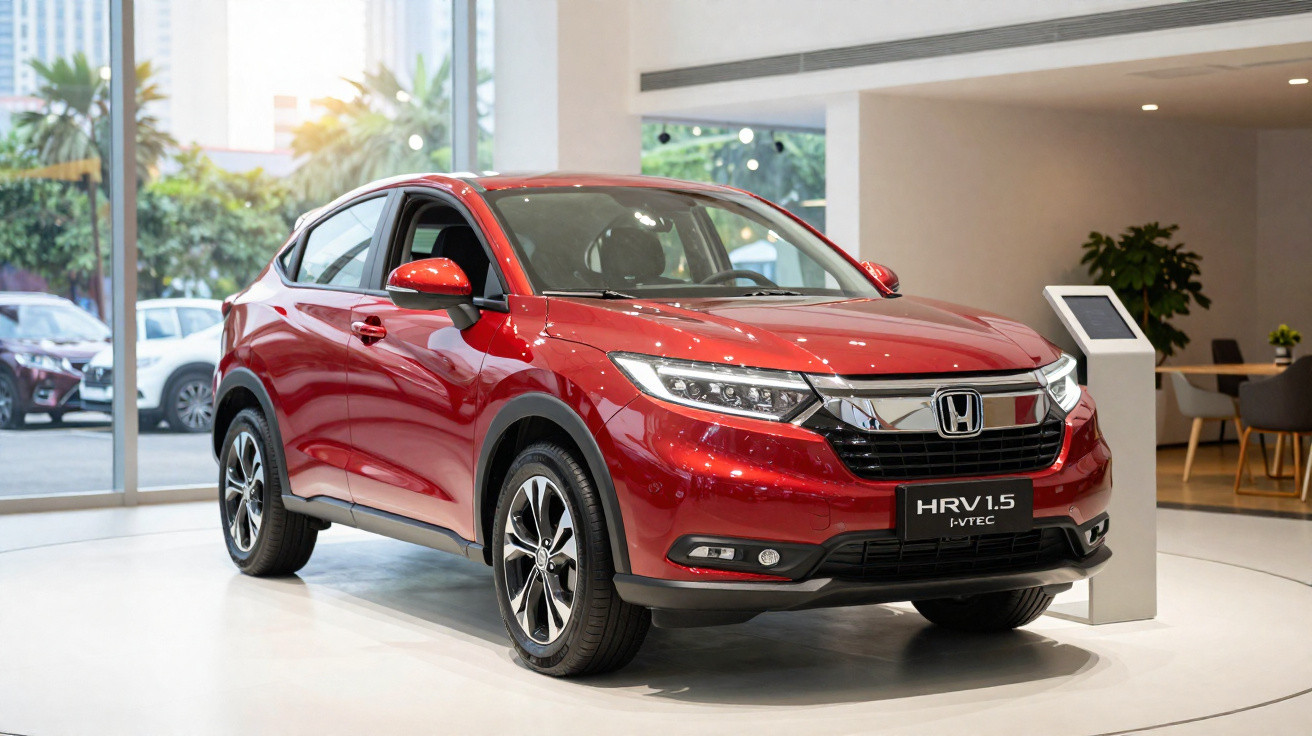
The Honda HR-V remains a major success story for the Japanese brand in markets such as North America and China, but that has not been the case in Europe.
In Europe, the HR-V’s journey has been defined by… discretion. The “old continent” is, as a rule, one of the toughest places to make a name for yourself and, in a segment as packed as the B-SUV class - with around two dozen models to choose from - it’s easy for several contenders to slip under the radar, even when they are every bit as credible as more popular rivals.
So is the Honda HR-V being unfairly overlooked by Europeans… and, more specifically, by the Portuguese? Time to find out.
Not much sex appeal, but very practical
A refreshed HR-V arrived in Portugal last year, with light tweaks to the exterior styling and, inside, new front seats and revised materials. Most of the attention went to the introduction of the HR-V Sport fitted with the 1.5 Turbo producing 182 cv - an engine I remember fondly from my time with the Civic - but that is not the HR-V under test here. This one is the naturally aspirated 1.5 i-VTEC in Executive trim, one of the best-equipped versions.
Personally, I don’t find it especially striking. It feels as though Honda’s designers couldn’t quite decide whether to be bold or to please “everyone”, leaving the overall look without a clear statement. Still, what it lacks in sex appeal, it more than makes up for in day-to-day usefulness.
Because it shares the same technical foundations as the smaller Jazz, it also benefits from that car’s excellent packaging. The result is impressively generous cabin space - among the roomiest in the segment, enough to make a small family car from the class above blush - along with strong versatility.
Worth highlighting is the 470 l boot capacity (once you include the space under the movable floor), and the flexibility enabled by the “magic seats” - as Honda calls them. You don’t get sliding rear seats like those in the segment leader, the Renault Captur, but the ability to flip the seat base up towards the backrest opens up a whole range of options.
In the front seats
If the rear bench and boot are among the HR-V’s most persuasive selling points, the front row is where its competitiveness fades somewhat. The main issue is usability, particularly when you need to operate the infotainment system and the climate-control panel.
Why is that? In places where you’d expect physical controls - rotary knobs or proper buttons - you instead find haptic inputs, which can be frustrating to use and ultimately undermine ease of operation. The infotainment system itself also trails several rivals, both due to graphics that look a bit dated (they already did when the system was new) and because the interface could be more intuitive.
These complaints are familiar across more than one Honda model, but we’ve also seen the Japanese brand take steps to address them. Physical buttons have started to return - we saw it with the Civic facelift, and again with the latest-generation Jazz, which also brings a new infotainment system. It’s hard to understand why the HR-V received such a recent update without benefiting from the same kind of improvements.
Even with these weaker points, the Honda HR-V’s cabin makes up ground with better-than-average build quality. Most of the materials are hard plastics and not always the nicest to the touch - with the exception of the various leather-trimmed elements.
Behind the wheel
It took me a while to settle on a comfortable driving position, even though the steering wheel and seat offer plenty of adjustment range, but I got there in the end. The steering wheel itself stands out for its quality - the right diameter and thickness, with pleasant-feeling leather - whereas the seat, while comfortable enough, ultimately doesn’t provide sufficient lateral support or thigh support.
The HR-V’s dynamic set-up is clearly tuned with comfort in mind. There’s a general softness to how the controls feel (they’re still accurate), and that same approach is reflected in the suspension response.
Perhaps because of this, most road imperfections are dealt with competently, helping to create a good level of comfort on board. The trade-off for that “softness” is some body movement, though it never becomes excessive or uncontrolled.
If you want something sharper dynamically in this segment, you have other choices: the Ford Puma, SEAT Arona or Mazda CX-3 are more satisfying in that respect. The HR-V shows its strengths (dynamically) more as a comfortable long-distance cruiser, with convincing stability even at higher speeds - aerodynamic noise is, however, intrusive, while tyre roar is better suppressed.
On the plus side, the Honda HR-V comes with an excellent manual gearbox - among the best, if not the best, in the segment - delivering a wonderfully slick, mechanical feel that’s a joy to use - why don’t we see more gearboxes like this? Its main drawback is the long gearing - not as long as what I experienced in another SUV from the segment above, the CX-30 - a decision clearly aimed at keeping fuel consumption at acceptable levels.
Speaking of fuel consumption…
… the gearbox’s long ratios do seem to do the job. The naturally aspirated 1.5 i-VTEC returned a modest appetite: just over five litres (5,1-5,2 l/100 km) at 90 km/h, rising to somewhere between 7,0-7,2 l/100 km at motorway speeds. In urban/suburban driving it sat at 7,5 l/100 km, a very respectable figure given the kind of driving this engine tends to require.
You’re “forced” to use the (long) gearbox more often than you might expect, and to work the engine harder than you would with an equivalent turbo unit, because the 155 Nm only arrives at a relatively high 4600 rpm. If it were a more enjoyable experience, I wouldn’t criticise it as much.
However, when you increase the load, the 1.5 i-VTEC becomes quite noisy, and it also felt a little reluctant to climb through the revs - despite the limit being close to 7000 rpm, beyond 5000 rpm it didn’t seem particularly worthwhile to keep pushing.
Some of that may be down to the fact the car had covered less than 400 km, and it did feel slightly “tight”. With a couple more thousand kilometres on the clock, it might respond with a bit more energy, but you wouldn’t expect a dramatically different character. In this case, it seems to us that the Civic’s 1.0 Turbo would clearly be a better match for the HR-V and its intended use.
Is it the right car for me?
Although it feels a little unfair that the Honda HR-V has been overlooked by the market, the reality is that it’s hard to recommend it with this 1.5 engine when there are competitors offering far more pleasant, more flexible engines that better suit the car’s purpose.
And today, the 1.5 i-VTEC is the “only” engine available in Portugal for the HR-V - the 1.6 i-DTEC is no longer sold, and the excellent 1.5 Turbo sits at a… “social distance” of 5000 euros, which is a hefty jump to treat it as a realistic alternative.
Even harder to justify is the fact Honda has had, for several years, a much-liked 1.0 Turbo in its line-up that would “fit like a glove” in this model - shouldn’t it have made its way into the HR-V too?
I think so… just as I was expecting a more thorough revision of the interior during the facelift to improve usability. These are all factors that end up undermining the appeal of this model. It’s a shame… because the Honda HR-V is one of the B-SUVs I’ve found best suited to family use (not least because it most clearly seems to have an… MPV-like character), offering excellent space, accessibility and versatility.
This is one of today’s most hotly contested segments, and nobody can afford to relax. The second generations of the “heavyweights” Renault Captur and Peugeot 2008 have raised the bar and stripped cars like the HR-V of their edge, because they now also provide more competitive interior space - while adding to the advantages they already had in engines or even… sex appeal.
Comments
No comments yet. Be the first to comment!
Leave a Comment