
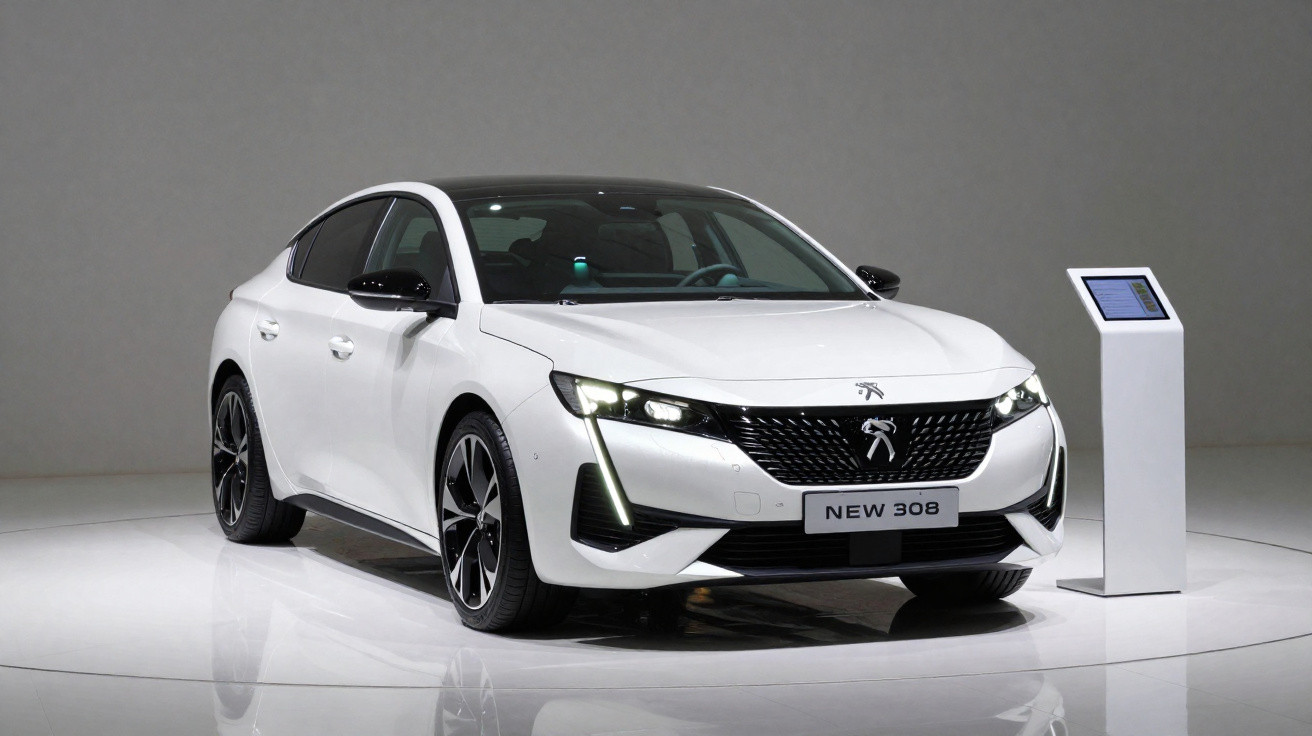
Even if SUVs are the “in” choice right now, C‑segment saloons still have a substantial customer base - whether in hatchback form or as an estate. That is exactly why the highly successful Peugeot 308 has now reached its third generation, extending Peugeot’s winning record in a class it first entered with the 309 back in 1985.
The EMP2 platform remains in service - with MacPherson struts at the front and a torsion‑beam rear axle - but the wheelbase has been stretched by 5.5 cm compared with the previous generation. As Agnès Tesson-Faget, product manager for the 308 range, explained to us, the change came because “customers of the five-door version complained that second-row space was a little tight compared with the estate, which had an extra 11 cm of wheelbase”.
As a result, the hatchback now sits just 5.5 cm short of the estate’s wheelbase; the estate carries over that longer measurement into the new generation and is also due to arrive in autumn. Interestingly, rear legroom is identical in both body styles because the project team prioritised boot volume in the estate (to achieve this, the rear seats in both versions are mounted in the same position).
That said, there have still been gains in cabin usability, because the floor tunnel in the rear - in the footwell area for the middle passenger - is far lower than before, which noticeably improves freedom of movement.
Put another way, three rear passengers will fit as long as they are not particularly broad, and the middle occupant feels less restricted than previously thanks to improved foot space. They also benefit from direct air vents, dedicated USB connections, and very generous storage pockets in the rear doors.
To match the lower roofline, the seats have been positioned lower too, so occupants up to 1.85 metres tall should not feel cramped. On the other hand, boot capacity is slightly down on the predecessor (412 vs 420 litres) because the Peugeot 308 is 2.2 cm lower overall, even though it is 5 cm wider.
Longer and wider, but lower
Having already touched on the new Peugeot 308’s interior, it is worth turning to the exterior, which is more contemporary and feels like a “more grown-up” car. It is 11 cm longer than before and features LED headlights front and rear, plus an imposing radiator grille - first introduced by Peugeot on this model, alongside the brand’s new badge.
At the back, the full-width light signature stands out, but it is not used on the estate. According to Benoit Devaux (project director for the 308 SW), “the idea was to create greater differentiation between the saloon and the estate and, on the other hand, to increase the sheet-metal area on the tailgate (which can now be electric) to suggest it was hiding a very large boot”.
Modernised dashboard
Back inside the new Peugeot 308, the biggest step forward in this generation is clearly the infotainment system. Previously, the central touchscreen was far too slow to respond and its graphics and resolution lagged behind most rivals.
That has now been addressed, and there is also an audible “blip” each time a touch command is registered on the 10” central display (now wider and more panoramic than before), so you know the system has received the input. The digital instrument cluster (there is no analogue setup, even on entry versions) has been updated with the same modernisation in mind, and on higher trim levels it can offer a 3D presentation - helping to refresh the entire driving experience.
Between the front seats sits a console carrying either the six-speed manual gearlever or the selector for the eight-speed automatic, depending on the version. On plug-in hybrids, the familiar P (Park), R (Rear), N (Neutral) and D (Drive) positions are joined by a B button (to increase energy recuperation under braking). On petrol or diesel cars, that same button is labelled M and is used to force manual control of the gearbox (via the paddles behind the steering wheel).
The steering wheel remains the brand’s small “mini” design, flat at the top and bottom. Now, however, it includes sensors to detect whether the driver’s hands are on the rim, allowing driver-assistance systems to issue the appropriate alerts if they are not.
Too much information?
It is clear Peugeot listened to owners who said they could not see the lower part of the instrument cluster, because the coloured warning icons have been moved to the top. Even so, the French brand has arguably gone too far with the amount of information it tries to display, leaving the cluster looking overloaded - to the point where certain items obscure others.
The clearest example is with navigation active: as you approach a manoeuvre, map graphics appear in the instrument cluster and overlap the display for the drive modes when you try to change them - meaning you simply cannot see what you are selecting. It is worth noting that the first 308s we drove were still pre‑production prototypes, but it may not be easy to change this detail before cars start rolling off the production line.
The infotainment upgrade is also reflected in the ability to perform remote over the air software updates (avoiding trips to dealers for that purpose), to run two apps at the same time, to accept voice commands, and to store up to eight user profiles simultaneously.
Elsewhere, there are more digital controls and fewer physical ones, particularly on higher-spec versions that use i-toggles rather than the physical switches first introduced by Peugeot on the 3008. At the same time, there is a clear push to improve perceived quality in materials and finish - such as door pockets with a velvety lining at the base and a properly trimmed glovebox (as you would expect in premium models and higher segments).
Even so, some hard-touch plastics remain on the upper dashboard (near the instrument binnacle), and there are plenty of metallic-look trims that tend to creak under lateral acceleration. On the plus side, the heated windscreen and reinforced acoustic side glass reinforce the sense of a step up in quality.
Powertrain choice
Peugeot is keen to highlight the breadth of its powertrain line-up. There are the familiar 1.5 four-cylinder diesel units (130 cv, with a 6-speed manual or 8-speed automatic), the 1.2 three-cylinder petrol engine with 110 or 130 cv (manual gearbox, or automatic for the more powerful version), plus plug-in hybrids - a first for the 308 range.
These pair a 110 cv electric motor with a 1.6-litre four-cylinder petrol engine producing 150 cv (for the e-EAT8 with a combined maximum output of 180 cv). There is also a version using the same petrol engine tuned to 180 cv, delivering a combined maximum of 225 cv (those maximum outputs give the two versions their names).
The lithium-ion battery is rated at 12.4 kWh - a little higher than in the PHEV SUVs - because energy density has been slightly increased. Electric range is 59 km for the 180 e-EAT8 and 60 km for the 225 e-EAT8.
The on-board charger is a 7.4 kW single-phase unit, allowing a full charge in 7h05m from a standard domestic socket, in 3h50m from a reinforced domestic socket (16A), and in 1h55 from a 7.4 kW wallbox.
Behind the wheel of the 1.2-litre 130 cv
Although dynamic testing of the new Peugeot 308 is only scheduled for September - right before it reaches the market - Razão Automóvel had an initial (and exclusive) opportunity to drive several pre‑series cars in the immediate area around the Mulhouse factory, the birthplace of the new model.
Because this was the best-selling configuration in the previous generation, we focused on the 1.2 with a manual gearbox and 130 cv, which remains a particularly well-balanced choice. That is easy to understand because, despite the larger body (11 cm longer, 5 cm wider and yet 2 cm lower), weight is up by only 15 kg. The new proportions also help stability, which shows through in the limited lateral movement in corners, while comfort remains thoroughly satisfactory.
The small steering wheel and the manual six-speed gearbox - with a quick, quiet and precise shift (mounted high, close to the steering wheel) - help the driver feel closely connected to the car’s main job, even if the steering itself is not especially direct (2.9 turns lock-to-lock).
The drive-mode selector, meanwhile, is still rather slow. In this manual version it matters less, because in practice it mainly changes steering weight and little else (you could almost forget it is there…). However, on automatic and hybrid models, switching between Eco, Normal, Sport, Hybrid and Electric takes around 2.5 seconds to register.
It is also worth remembering that the Peugeot 308 still does not offer electronically variable damping, which significantly limits how different the drive modes can feel. Nor is any form of four-wheel drive available - neither a Haldex-type setup nor a simpler electronic traction-control solution - omissions that could deter certain buyers (the second point being particularly relevant in Northern European countries where rain and snow are more frequent).
As for the engine we drove - the 1.2 with 130 cv - it shows the familiar eagerness to pick up revs just above idle (partly thanks to the inherently low inertia of a three-cylinder unit), with more punch from 1800 rpm onwards, though never enough for the turbo’s arrival to pin you to the seat.
Improved sound insulation helps smooth out the typical three-cylinder thrum, with the note only becoming more abrasive close to the redline. When brisk acceleration is needed, dropping “one gear down” is a pleasure with such an enjoyable shift action.
Technical specifications
| Peugeot 308 1.2 PureTech | |
|---|---|
| Engine | |
| Position | Transverse front-mounted |
| Layout | Inline 3-cylinder |
| Capacity | 1199 cm³ |
| Valve gear | 2 a.c.c.; 4 valves per cylinder (12 valves) |
| Induction | Direct inj., Turbo, Intercooler |
| Power | 130 cv at 3750 rpm |
| Torque | 300 Nm from 1750 rpm |
| Transmission | |
| Drive | Front-wheel drive |
| Gearbox | 6-speed manual |
| Chassis | |
| Suspension | Front: Independent MacPherson Rear: Torsion beam |
| Brakes | Front: Ventilated discs; Rear: Discs |
| Steering/No. of turns | Electric assistance/2,9 |
| Turning circle | 10,5 m |
| Dimensions and capacities | |
| Length x Width x Height | 4367 mm x 1852 mm x 1444 mm |
| Wheelbase | 2675 mm |
| Boot capacity | 412-1323 litres |
| Fuel tank capacity | 53 litres |
| Wheels | 225/45 R17 |
| Weight | 1254 kg |
| Performance and economy | |
| Top speed | 200 km/h |
| 0-100 km/h | 10,9s |
| Combined consumption | 5,5 l/100 km |
| CO₂ emissions | 125 g/km |
Comments
No comments yet. Be the first to comment!
Leave a Comment