
Add us to your favourites on Google
Why bother? You will see the latest updates from Zona Militar directly in your Google feed.
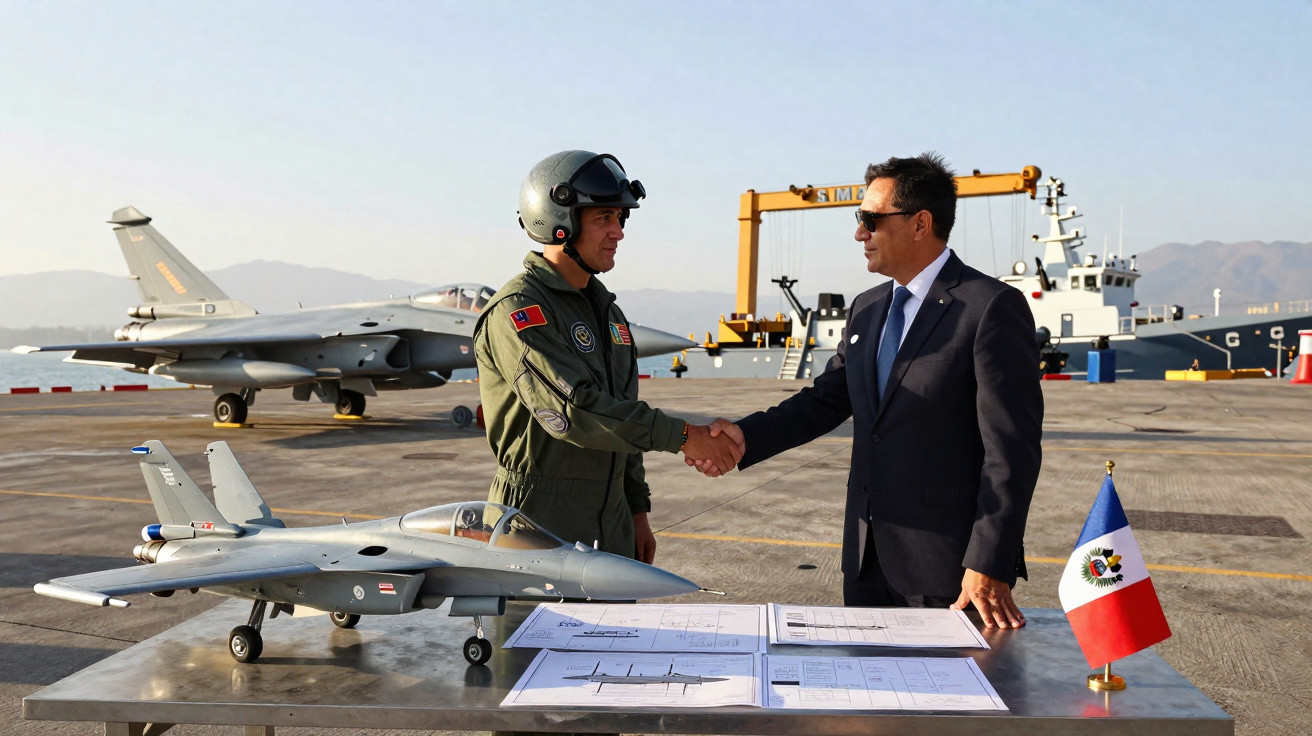
Fredrik Gustafson, Head of Group Business Development at Saab AB, visited Lima for a series of meetings aimed at strengthening the company’s profile across several areas, including defence. Alongside Saab’s involvement in the Peruvian Air Force’s fighter renewal effort, the firm is also a partner of SIMA in naval vessel production.
Business Sweden, Saab and the Sweden–Peru relationship
Does the opening of Business Sweden offices in Peru have any relation to Saab, through the Gripen, taking part in the process to renew the FAP’s fleet of combat fighters?
The launch of Business Sweden’s presence is not a direct consequence of the Gripen campaign. Instead, it reflects a broader deepening of trade ties between Sweden and Peru. Several Swedish companies have operated in Peru for more than a century, underlining that the relationship is long-standing and robust. From Saab’s perspective, the new office is an encouraging signal that Sweden views Peru as a priority partner for cooperation and joint development. It also supports working as “Team Sweden”, helping to advance initiatives not only in defence but also in innovation and sustainability.
At what point is the defense industry in Latin America in general, and in Peru, in particular?
Across Latin America, progress is not uniform. Naval shipyards are among the most mature parts of the sector, with genuine export capacity and demanding programmes focused on submarine and frigate modernisation. By contrast, capability in sensors and electronic systems differs widely from one country to another. In aerospace, Brazil is particularly prominent through Embraer, while Peru has pursued notable efforts such as the KT-1 line. At the same time, the drone and unmanned-systems market is expanding quickly, creating additional scope for cooperation.
How do you see the future of the defense industry in the region? Which products or solutions will be most in demand? Which sectors offer the greatest opportunities for working on projects with Sweden?
Many of the region’s pressures mirror those now faced in Europe. Traditionally, countries have tended to build capabilities on their own; in today’s environment, it would be more effective to pool effort at a regional level. Demand is expected to increase for drones, sensors, naval modernisation and surveillance solutions. Outside defence, there are also sizeable opportunities in mining, telecommunications, cybersecurity and pharmaceuticals-areas where Swedish firms already operate. The relationship is not solely about bringing Swedish technology into Peru; it also includes the potential for Peruvian industry to add value in Sweden.
Saab Gripen E and the Peruvian Air Force (FAP) fighter renewal
How is that process going, and in what way will it impact relations with Peru in other defense fields that also seek to modernize?
Saab is taking an active role in the process and remains in regular contact with the Armed Forces. The company understands that a budget is in place and is waiting for the next stage. Should Saab be chosen, it would encourage wider cooperation in other defence areas that need modernisation. Even if Saab is not selected, the partnership would not end: Saab has worked with Peru for many years, particularly alongside SIMA, which already builds Saab patrol boats in Callao and in Chimbote. Saab expects its relationship with the Armed Forces to continue over the long term.
Why do you consider that the Gripen is the best option to be used in the region compared to other systems such as the F-16 and the Rafale?
Gripen E was designed for an environment where threats are sophisticated but budgets are constrained, resulting in a platform that is highly modern, adaptable and cost-effective. It is an entirely new aircraft and supports ongoing improvements via software, without being dependent on the manufacturer for each update. In addition, day-to-day running and maintenance costs are lower. For countries such as Peru, which need advanced capability while keeping operations sustainable, it is presented as an especially suitable option.
SIMA, CB90, technology transfer and Saab’s wider solutions for Peru
Years ago, SIMA and Docksta Shipyard, a subsidiary of the Saab group, carried out the local production of Combat Boat 90 patrol boats. How was that experience, and how is the project progressing to date?
According to Saab, the cooperation has delivered very strong results. The first four CB90 patrol boats were built in Callao and have performed to a high standard both along the coast and in the Amazon. More recently, a further contract was agreed to build additional units-this time at the Chimbote shipyards. Saab and SIMA have built a durable partnership centred on technology transfer, enabling Peru to manufacture these vessels independently.
Has the experience with the CB90 patrol boats been the only one you have had in Peru, or are there others?
Saab has produced roughly 300 CB90s worldwide and has supported local construction in several countries. One example highlighted is Mexico, where the IC-16-described as a “sister” of the CB90 with closely comparable characteristics-was also produced. In Peru, the principal collaboration has been the CB90 programme with SIMA, while Saab’s experience elsewhere is used to show that joint-production arrangements can work effectively across different markets.
Part of Saab’s differential advantage in this type of contract is the model of technology transfer and industrial cooperation or offset. Could you explain what it consists of and what the advantages are for countries that contract with you?
Sweden’s relatively small size means Saab relies on partnerships to create leading-edge technology. For that reason, Saab says its proposals routinely include local industrial cooperation. The aim is for the buying nation to gain control and autonomy, along with the ability to maintain, operate and further develop the systems it acquires. Saab states that it starts by listening to national requirements and then develops joint approaches that can include universities, domestic industry and even civilian sectors. Drawing on Sweden’s business network, Saab positions itself as able to provide end-to-end, sustainable solutions that build national competence and support technological independence.
What other needs have you identified in Peru that could be solved with the technology that Saab currently offers?
Saab points to major Peruvian initiatives such as SIVAN (Amazonian and National Protection and Surveillance System), as well as international surveillance needs. In these areas, Saab says it can contribute capabilities including ground-based radars, airborne early-warning radars, electronic warfare systems, communications, command and control, and anti-air missile systems. With a portfolio of more than 400 products, Saab argues it can support Peru in strengthening national surveillance and advancing Armed Forces operational capability. It also notes that Peru is currently assessing requirements for a future short-range air defence system, where Saab is offering the RBS 70 NG paired with a Giraffe 1X radar and a Mobile Short-Range Air Defense System (MSHORAD).
How do you handle the high regional competition, especially compared to defense-sector suppliers from the U.S. and Asia?
Saab describes competition as a normal part of the market and says cooperation sometimes occurs even with firms that are, in other contexts, rivals. In defence procurement, the company stresses that choices are not purely commercial, but also political. A fighter acquisition programme, for instance, sets the tone for a strategic relationship that can span at least 30 years. Saab therefore views mutual trust and a shared long-term development outlook between countries as essential.
How are you responding to new global threats such as cybersecurity, drones, and conflicts?
Saab characterises innovation as central to its identity. The company says 20% of its profits are reinvested into research and development, supporting progress in key areas such as software, cybersecurity, unmanned systems and electronic defence. It also underlines the importance of international cooperation: as a smaller country, Sweden has built alliances that allow global expertise to be incorporated into new solutions.
What has been Saab’s role regarding the war with Ukraine? What products have you placed in the country?
Saab frames Ukraine as a sensitive subject and emphasises the need for accuracy. It states that it has not made many direct deliveries so far. However, it notes that some countries that previously operated Saab equipment have chosen to donate those systems to Ukraine within their support packages. In such cases, Saab says its involvement has been indirect, supporting those nations as they replenish or modernise their own capabilities. With regard to Ukraine itself, Saab indicates that what has reached the country has largely been support systems and equipment intended to strengthen defence, delivered through third parties.
You may also like: ZM at UNITAS 2025 – The Multinational Exercise UNITAS LXVI through the Eyes of Rear Admiral Carlos Sardiello, Commander of the U.S. Fourth Fleet




Comments
No comments yet. Be the first to comment!
Leave a Comment