
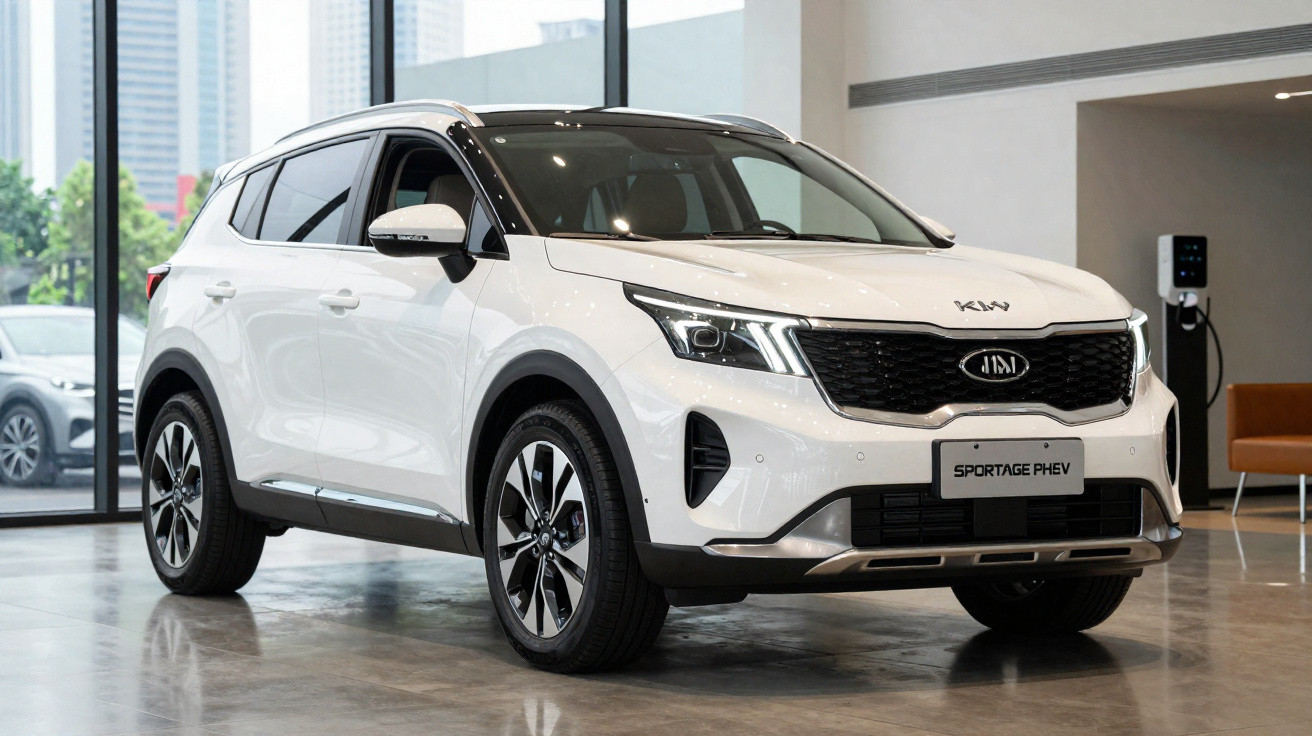
The Kia Sportage plug-in hybrid (PHEV) sits at the top of the Sportage range for both price and performance, yet it is also the version that claims the greatest potential for saving fuel.
After driving the most affordable Kia Sportage of the lot - the petrol model with a manual gearbox - it is time to head to the opposite end of the line-up, where prices peak.
The South Korean SUV’s range is one of the broadest when it comes to powertrains - there genuinely seems to be an option for almost every preference - spanning petrol, hybrid, and plug-in hybrid variants.
Compared with the entry-level option we have already tested, this Kia Sportage stands out thanks to its plug-in hybrid system (meaning it can be charged from the mains) and its claimed electric-only range of up to 70 km. It also adds all-wheel drive and a more generous equipment specification.
From the outside, there is nothing to set it apart from other versions, aside from the PHEV (Plug-in Hybrid Electric Vehicle) badge on the tailgate and an additional flap on the right-hand side of the bodywork for access to the charging port.
The gap between trim levels (Drive and Tech) is signposted by the 19-inch alloy wheels and by the black exterior details, which on this version are finished in gloss black rather than left as unpainted plastic.
Beyond that - paint colour aside - the two Kia Sportage units that visited Razão Automóvel are, for all intents and purposes, identical.
A more polished look inside (Kia Sportage PHEV)
While the exterior changes are minimal, the cabin reveals more clear differences versus the cheaper Sportage. The instrument cluster, for instance, is fully digital too, but it looks notably more upmarket and closer in style to what we are used to seeing in the Kia EV6.
Because this is a plug-in hybrid paired with an automatic gearbox, the centre console layout is different and accommodates a dedicated rotary selector, identical to the one used in the Kia EV6. Slightly further down sits the drive mode selector.
With the Tech equipment level on the test car, you can keep the key in your pocket, and the front seats are adjusted electrically. On colder days, both the seats and the steering wheel are heated.
In all other respects, this Kia Sportage retains the model’s well-known strengths: plenty of room in the cabin for front and rear passengers alike, a high comfort level, and a finish quality that does not disappoint.
The only real drawback is that the hybrid system takes away some boot space, as the battery is mounted beneath the floor. Even so, there are still 540 litres on offer - a generous figure that should cover most family needs.
A bit more of everything
As you would expect, the biggest differences versus the previously tested base version are most apparent from behind the wheel - starting with the engine. Under the bonnet is still the 1.6 T-GDi petrol unit, but here it is tuned to 180 cv (+30 cv compared with the petrol-only Sportage).
Alongside it sits an electric motor contributing 91 cv. Together, the two deliver 265 cv and 350 Nm of torque, making the Sportage PHEV the most powerful Sportage of them all.
Those are appealing figures for an SUV of this size, even with kerb weight approaching two tonnes. And whereas the cheapest Sportage drives only two wheels, this one comes with all-wheel drive.
In (barely) electric mode
Power for the electric side of the hybrid system comes from a 13.8 kWh battery, enabling Kia to quote a maximum 70 km electric range (combined cycle). However, this test began with the electric range showing zero kilometres - right in the middle of rush hour.
Even so, setting off was completely silent, and the combustion engine stayed off during the first manoeuvres. At lower speeds, when coasting downhill, under deceleration, or while stationary, it was rare to hear the petrol engine cut in.
On the other hand, in town and in heavier traffic, the lack of a true 100% electric mode meant the consumption we recorded was far from impressive, at times climbing beyond 9 litres. Naturally, once we reached open roads, the numbers dropped straight away.
With the battery empty and on a route mixing city driving, main roads and motorway stretches, the Kia Sportage PHEV returned an average a little above the seven-litre mark.
With the battery fully charged
After leaving the Kia Sportage PHEV plugged in for a few hours and charging the battery to 100%, I could finally take advantage of the real ace up this plug-in hybrid’s sleeve: driving in 100% electric mode.
In this setting, the South Korean brand’s SUV seems keen to prove it “hates” asking the petrol engine for help.
Running purely on electricity, the Kia Sportage has no trouble keeping up with the “pace” of other cars. That is true in the city and on the motorway, though, unsurprisingly, it feels even more convincing in urban use.
With a little restraint on the accelerator, it becomes possible to do a normal home-to-work commute, for example, without waking the combustion engine - which can translate into a meaningful saving. Without much restraint, however, and with the petrol engine kicking in under various circumstances, the average we recorded did not even reach five litres.
As for range, Kia’s quoted 70 km is rather optimistic and depends on ideal driving conditions. Even so, it is not difficult to exceed the 50 km threshold before needing to charge the battery again.
If that process - charging the battery often - still feels too limiting for your use case, then the plug-in hybrid version does not make much sense. In that scenario, the conventional hybrid (HEV) is the better choice, as it does not need plugging in. The saving potential is not as great, but fuel use will still be lower than in the petrol-only version.
Very limited choice
Buying a new car is the moment when you typically get to tailor the model you will live with for the longest time to your own tastes.
With the Kia Sportage PHEV, aside from selecting the exterior colour, there are no further options. There could be more flexibility in trim selections or optional extras, as is the case in other markets.
For instance, for the PHEV version, what would the Kia Sportage look like with the sportier styling of the GT Line rather than Tech, given that Tech is the only one available in the configurator? And if you are more demanding, why not offer the chance to add a panoramic glass roof or a better sound system, even if that meant paying extra?
Comments
No comments yet. Be the first to comment!
Leave a Comment