
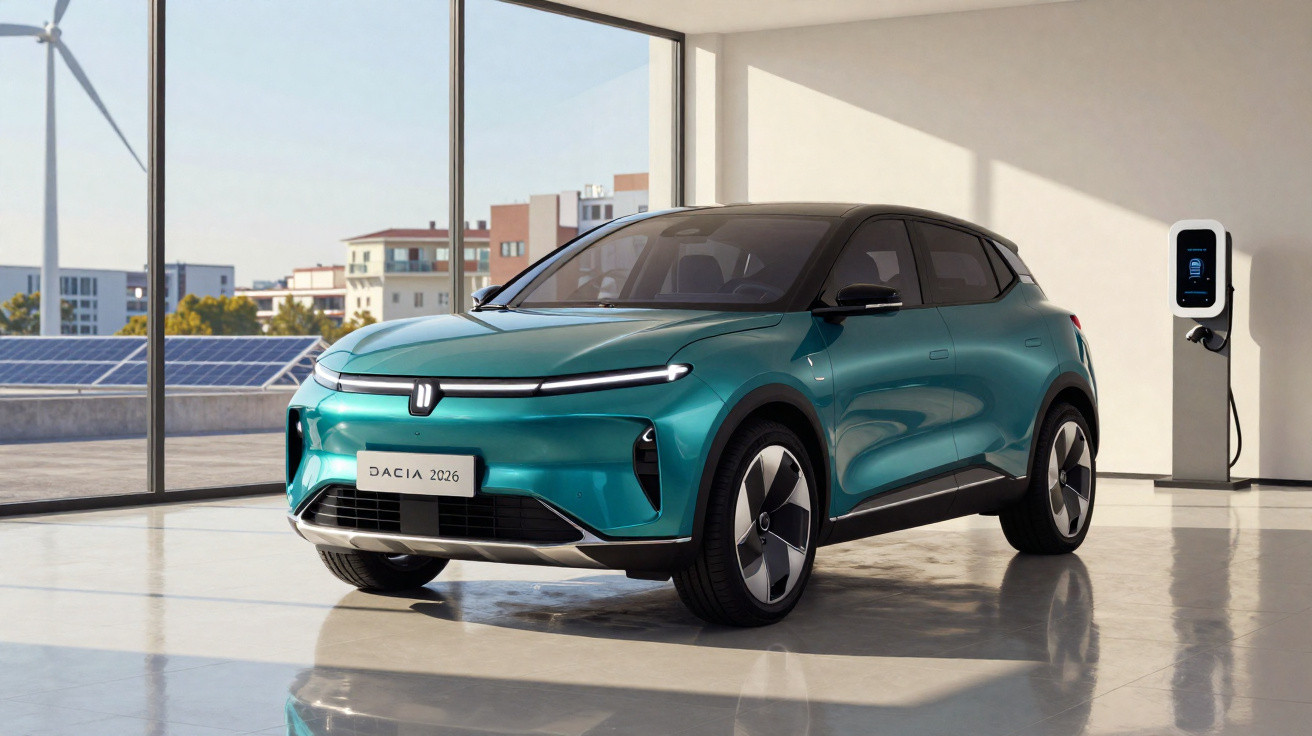
For years, Dacia has thrived on a formula that was almost immune to market swings: straightforward cars, keen pricing and low running costs. But Europe’s rapid shift towards electric vehicles has exposed a weakness for a brand that still has only one model designed to meet that demand.
That reality is already visible in the figures. In the first half of 2026, Dacia sold 327 077 cars worldwide, down 8,1% compared with the same period last year - roughly 29 000 fewer units.
In Europe, where the bulk of the brand’s sales are made, the fall was slightly steeper: down 8,7% to 284 021 units. Even so, the second quarter brought early signs of stabilisation, with 181 729 registrations - only 0,3% below the year-on-year result.
During a round-table discussion with European journalists attended by Razão Automóvel, Frank Marotte, Dacia’s Vice-President for Marketing, Sales and Operations, acknowledged that the lack of electric models directly weighed on this performance.
“Q2 came in below what we managed in Q1, again due to the strong presence of battery electric vehicles in the market,” he said. “In the B, B+ and C segments we don’t have an offer that can respond. We had more limited access to the market during Q2 and that affected our ability to generate orders.”
Electric vehicles surged - and Dacia was left out
Across the first six months of the year, the European market shifted quickly. Between January and June, 1,6 million 100% electric cars were registered in Europe, representing growth of 35,1% versus the same period in 2025. Over the same timeframe, the overall market rose by just 6,1%.
In June alone, electric registrations jumped 51%, taking market share to 25,6%. This acceleration did not have a single cause. Stronger incentives in certain countries and a broader range of electric cars - including models close to 25 000 euros - helped to lift demand.
There was also an unexpected driver: higher oil and fuel prices caused by instability and conflict in the Middle East. As petrol and diesel became more expensive, the running costs of electric cars looked more appealing, pushing energy efficiency back to the centre of many purchase decisions.
For Renault, already selling the Twingo, 5 E-Tech, 4 E-Tech and Scenic E-Tech, this shift represented an opportunity. In the first half, electric vehicles already accounted for 26,6% of the brand’s European sales. For Dacia, it was mainly a problem.
The Spring remains the only 100% electric vehicle in the line-up. There is no electric alternative to the Sandero, Duster, Jogger or Bigster - precisely the segments where Dacia concentrates most of its volume.
“The speed of growth of battery electric vehicles is impressive at the moment,” Marotte admitted. “The forecast we can make for next year is still very difficult.”
The effect has also reached the Duster. According to Marotte, the SUV’s decline is not the result of customers switching to the Bigster. More intense competition in markets such as France, Spain and Italy has played a part, but the rise of electric vehicles again appears as one of the main explanations.
“Battery electric vehicle sales increased significantly in Q2 and that affected our potential volume for the Duster,” he stated.
Four new electric models by 2030
Dacia is preparing four new 100% electric models by 2030, to be added to the current range. However, the brand does not want to rush launches simply to keep pace with the market. The priority is to ensure each proposal delivers the same price-to-product balance that defines its petrol, LPG and hybrid models.
“We are planning launches based on how costs and technology evolve, to ensure that, when we come to market with an electric proposal, we once again present the best price-to-product ratio,” explained Frank Marotte.
The goal is that, by 2030, two thirds of Dacia’s sales will be electrified models, including hybrids and 100% electric vehicles. The split between the two technologies is still undecided, however. In the first half, hybrids grew 30,2% and accounted for one in every four Dacias sold.
To develop the next electric models, the brand may draw on platforms already used within the Renault Group. The new Spring will share its technical base - RG EV Small platform, the new name for AmpR Small - with the Twingo, but that platform is still being assessed for future models equivalent to the Renault 5 E-Tech and 4 E-Tech.
“We are positioned at a lower price point than Renault and we need to achieve that in the electric world as well,” Marotte reiterated. The decision will therefore depend on whether those platforms can be adapted to Dacia’s cost targets and positioning.
The recovery has already begun
An immediate response will not come from the four future electric cars. Instead, Dacia’s second-half 2026 recovery will rest on three new arrivals with very different roles.
For the first time, the Sandero will gain a hybrid powertrain. The Striker will enable the brand to strengthen its presence in the C segment (where the Bigster already competes), while the new Spring will aim to win back ground among affordable electric cars.
The next-generation Spring will be built in Europe - the current version is produced in China - and will have a starting price below 18 000 euros. According to Marotte, it is a clear example of how the brand intends to approach electric vehicles: “We want to enrich the range, but that will happen at the right time, when we can respect the price promise we want to keep for our customers.”
Among the three launches, Dacia expects the Striker to deliver the highest sales volume and to match the Bigster’s results. Even so, Marotte concedes that the new Spring could come close if European demand for electric cars continues to grow at the current pace.
Comments
No comments yet. Be the first to comment!
Leave a Comment