
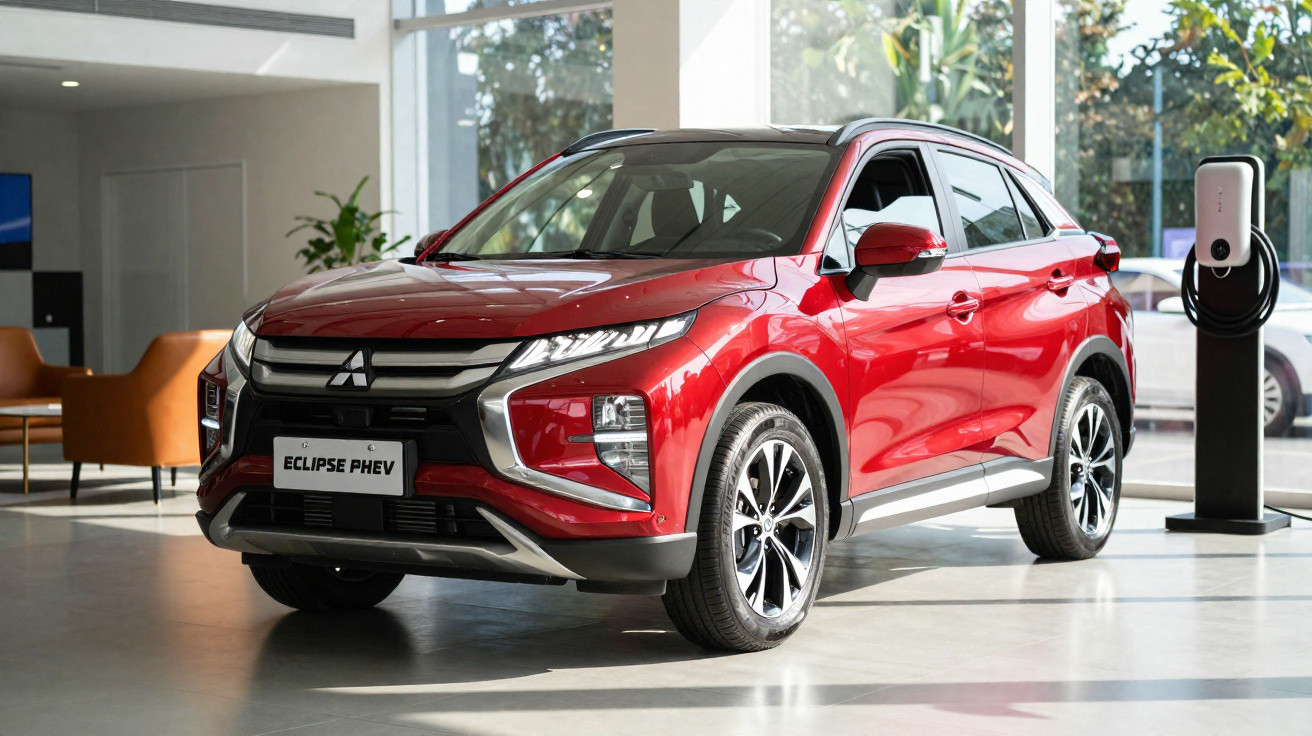
The recently refreshed Mitsubishi Eclipse Cross hasn’t just moved to a more conventional look (particularly at the rear); in our market it has also dropped the pure combustion options, adopting an all-new plug-in hybrid powertrain - the same recipe that delivered plenty of success for its bigger “brother”, the Outlander.
The only “issue” is that, while the Outlander faced little to no competition when it first arrived, the Eclipse Cross PHEV now finds itself up against an outright “army” of rivals, ready to make life difficult in one of Europe’s most hotly contested segments.
With that in mind, did this update give the Eclipse Cross enough ammunition to take on the competition? Or is the Japanese model “destined” for a low-profile existence on the UK market?
It could offer more space
Inside - where the changes are more modest than outside - one of the headline updates is the new 8" screen. Set in a good position, it houses an infotainment system backed up by genuinely useful physical buttons. It’s very, very comprehensive (especially when it comes to displaying how the hybrid system is operating), though the graphics already look a little dated next to newer rivals.
The materials, on the other hand, deserve praise: most surfaces are soft to the touch. In fact, the overall ambience in the Eclipse Cross PHEV surprised me in a positive way, with controls that feel nicely weighted and an impressively solid build that lives up to the reputation of Japanese brands.
Still on cabin ergonomics, it’s worth highlighting the decision to keep plenty of physical switches - something some will call old-fashioned, but which I see as a real usability win. The only drawback is the odd placement of the controls for the not-very-comprehensive trip computer.
If overall quality is an area where the Eclipse Cross PHEV can go toe-to-toe with its rivals, passenger space is where the Japanese contender falls a little short.
Rear legroom in the second row is merely acceptable (although the central floor hump is almost non-existent), and the boot is among the smallest in the segment, offering just 359 litres. For instance, plug-in hybrid versions of competitors such as the Opel Grandland (390 l), Citroën C5 Aircross (460-600 l) or Ford Kuga (411 l) all provide larger luggage compartments.
Efficiency is the rule in the Mitsubishi Eclipse Cross PHEV
Using the same plug-in hybrid setup we already knew from the Outlander PHEV - and which remains unusual in the way it operates - the Eclipse Cross PHEV stands out for the smoothness with which it coordinates the combustion engine and the two electric motors (one on the front axle and another on the rear).
In town, and particularly with a charged battery, the petrol engine stays almost entirely “silent”, which makes it easy to save a significant amount of fuel.
In fact, the electric bias is so strong - with the system automatically switching between EV (electric), Series (only the electric motors drive the car while the combustion engine acts as a generator) and Parallel (combustion engine and rear electric motor working together) - that in the first kilometres I covered at the wheel, the trip computer was showing a tiny 1.5 l/100 km.
Running in full electric mode, I managed around 35 km, which is below the claimed 45 km and behind what some rivals deliver, although I should admit that range was achieved without making any special effort to drive economically.
Finally, once the battery was depleted, the 2.4 l engine was “called into action”. Even then, the powertrain’s refinement remained a highlight, as did consumption: despite brisk driving and long traffic queues mixed in, figures stayed between 6 l/100 km and 6.5 l/100 km.
Built around comfort
As you’ve probably gathered by now, the Eclipse Cross’s plug-in hybrid system is geared towards efficiency. Even so, despite producing 188 cv of combined power, this Mitsubishi is at its happiest when driven at a calmer pace.
That isn’t to say it feels slow, but performance is - as you’d expect - only average when set against rivals offering notably more power. Carrying close to two tonnes also doesn’t help in this area.
That relaxed character also shows up in the way it drives. The suspension is clearly tuned for comfort (which is at a very good level), and when the road turns twisty it doesn’t feel as tied down as some competitors - or even the previous combustion-engined version - with damping that comes across as a little soft.
Even so, the steering is accurate and the overall behaviour is safe and predictable; it just isn’t chasing sharp handling in the way some alternatives do (we can’t all be the same, can we?).
To finish, on driving modes the Eclipse Cross PHEV offers five in total: Snow, Gravel, Eco, Normal and Tarmac. The first two are aimed at very specific conditions, so I’ll focus on the remaining three.
Eco makes throttle response too “laid-back”, and it’s best reserved for when you’re already cruising at a steady speed. Tarmac (essentially a sportier setting) does the opposite, making responses overly abrupt and, oddly, out of step with this Eclipse Cross PHEV’s character. As a result, it’s easy to see why Normal ends up delivering the best compromise.
Is it the right car for you?
Now wearing a more conventional (and easier-to-like) design, and with the Outlander no longer acting as internal competition, the Mitsubishi Eclipse Cross PHEV has a simpler task in the showroom - but also a bigger role to play within the Japanese brand.
With commendable overall quality, a proven and interesting plug-in hybrid system, and a strong comfort focus, the Eclipse Cross PHEV gives up ground to rivals in areas such as cabin and boot space.
Even so, Mitsubishi has created an option that’s worth considering in one of the most fiercely fought segments, with low real-world consumption. The truth, however, is that not even the more extensive-than-usual restyling can fully hide the model’s age in several respects (it has already been on the market for five years, and it’s based on the even more long-serving Outlander).

Comments
No comments yet. Be the first to comment!
Leave a Comment