
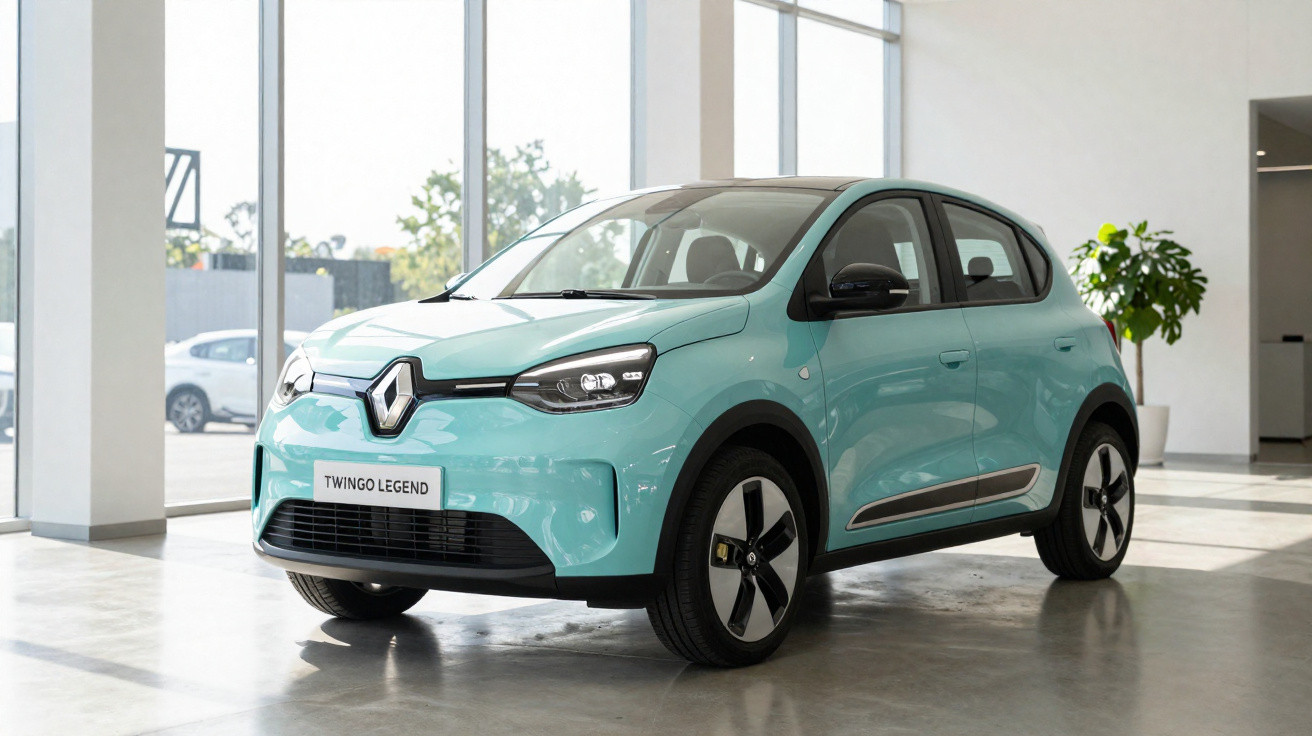
Luca de Meo, Chief Executive of Groupe Renault, has recently told the French publication L’Automobile that the Renault Twingo - the smallest car in the French brand’s line-up - will not be replaced by a successor.
The current Renault Twingo is set to remain on sale for a few more years. It has only just gained its latest and first-ever fully electric version - which we have already driven - but once this model bows out, Renault will not introduce a direct replacement.
That outcome was already easy to anticipate from the roadmap shown below, which outlines what Renault intends to launch up to 2025.
Renault’s model plans through 2025
As the plan makes clear, Renault’s biggest attention will be on the C and D segments, where margins are higher. Among the vehicles expected are the Arkana; the production version of the Mégane eVision; a new generation of Kadjar - including a seven-seat variant - and what looks very likely to be a production interpretation of the Morphoz concept for the D segment.
One segment down, in the B segment - currently home to the Clio and the Zoe - Renault is due to introduce the new Renault 5 in 2023, and it will be electric-only. By 2025, another fully electric model is planned for this class too, although its identity remains unclear: could it be a new generation of Zoe?
More telling still is the absence of any scheduled launches in the A segment - the class where the Renault Twingo sits - at least up to 2025.
Renault Twingo without a successor. Why?
The logic is the same as Renault’s heavier investment in the C and D segments: profitability. In those larger classes, Renault can achieve the returns it needs; in the A segment of city cars, it increasingly cannot - particularly under today’s conditions. That is the point Luca de Meo makes to L’Automobile, and he also expresses regret that withdrawing from the segment appears unavoidable.
It is worth remembering that the current-generation Renault Twingo was developed alongside Daimler, and that joint work also resulted in the Smart fortwo and forfour. However, the next generation of Smart’s smaller models will be developed and manufactured in China, through a partnership with Geely - the group that owns, among other brands, Volvo and Lotus.
The pressure on segment A city cars
When you factor in the shifts taking place across the car industry, it becomes difficult to make a business case for a city car, where prices are usually kept low rather than high.
On the one hand, there are stringent emissions regulations that significantly raise powertrain costs - or, in the case of electric models, batteries that remain exceptionally expensive (the Twingo Electric costs more than €20,000, for instance). On the other, tougher safety requirements expected in 2022–2023 will make it compulsory to add further equipment, pushing costs up again. As a result, the smallest cars on the market are left “between a rock and a hard place”.
In practice, manufacturers face three routes: raise prices until they overlap with the segment above; share development and production with another car maker to gain economies of scale; or leave the market entirely. It is this last route that more and more brands are choosing.
The Renault Twingo is not alone in being left without a successor: the Peugeot 108 and Citroën C1 will not be replaced either. The Škoda Citigo has already been discontinued, and for now there appears to be no clear future for its close relatives, the Volkswagen up! and SEAT Mii. Even the segment leader, Fiat, is likely within a few years to be reduced to the new electric 500 (which is far from an affordable option), with no replacement planned for the combustion-engined 500 and Panda - while, by contrast, developments are expected in the segment above.
Source: L’Automobile.
Comments
No comments yet. Be the first to comment!
Leave a Comment