
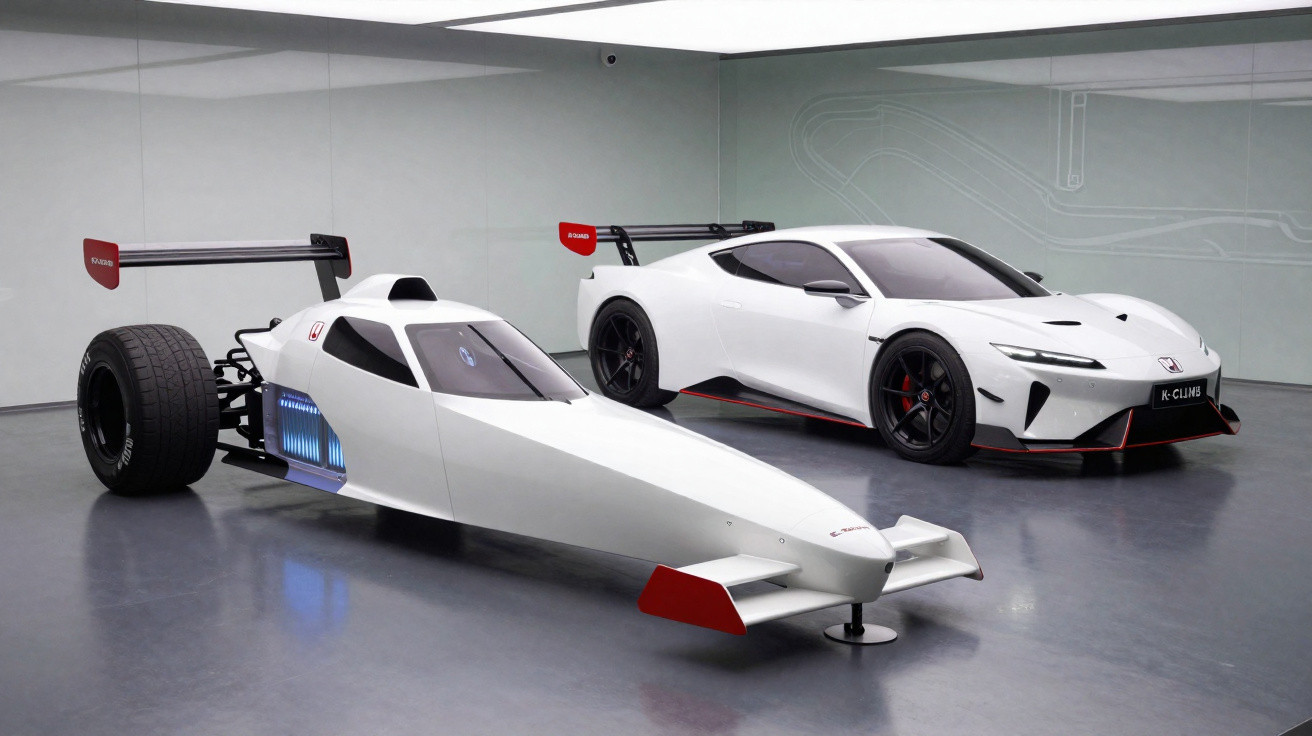
The Honda e-Drag and the Honda K-Climb - both unveiled at the Tokyo Auto Salon, which is being held virtually this year - are designed to prove just how much a serious diet can boost performance without needing to increase power.
Why electric cars end up so heavy
A diet is exactly what the Honda “e” is crying out for. Even though it’s compact - very much like a typical B-segment car - the Honda “e” tips the scales at more than 1500 kg, which is plainly excessive. That isn’t a problem unique to Honda’s small EV; it’s an issue shared by electric cars in general.
So, why are they so heavy? The answer is obvious: the battery pack. It adds hundreds of kilograms compared with an equivalent car with an internal combustion engine, and that extra mass influences everything from performance to efficiency.
Honda e-Drag: a weight-loss plan for the 402 m
That’s where the Honda e-Drag comes in. Picture taking a Honda “e” to a drag strip. With just 154 cv (though it delivers an instant 315 Nm of torque) and well over a tonne and a half to shift, it’s hardly the ideal candidate for covering 402 m as quickly as possible.
The most straightforward way to sharpen its modest performance is clear: remove as much ballast as you can.
That is exactly the approach Honda took to turn the “e” into the e-Drag. The cabin has been completely stripped out, then fitted with two Kirkey racing bucket seats and a roll cage. On the outside, the roof is now made from carbon fibre and, although the prototype doesn’t yet show it, carbon fibre is also set to appear on additional body panels. This includes a single-piece front section that will combine the bonnet, bumpers and wings.
To round off the lightweight package, Honda has given the e-Drag dedicated radial tyres for drag racing, while the 17″ wheels come from the first-generation Honda NSX - in this case from the particularly special NSX-R (NA2).
Unfortunately, because the project is still unfinished, Honda has not yet released figures showing the gains achieved so far with this intriguing build. Even so, we’re keen to see the results. Some suggest it could match the 5.8s 0 to 100 km/h of the far more powerful Honda Civic Type R - a 2.5s improvement over the 8.3s managed by the Honda “e” Advance.
Honda K-Climb, the “mini-terror” of hill climbs
With less eye-catching numbers than the e-Drag, there’s the Honda K-Climb, based on the brand’s N-One kei car, where its legally capped 64 cv benefits even more from every kilogram removed. As with the e-Drag, carbon fibre plays a major role in the K-Climb’s weight-loss strategy. The front grille, bonnet and bumpers are made from the material.
Developed specifically for hill-climb events on (very) twisty roads, it’s easy to see why the chassis is the main focus, with the aim of maximising cornering ability. It features adjustable KS Hipermax Max IV SP suspension and grippier Yokohama Advan tyres wrapped around 15″ wheels - it should take bends like no kei car ever has before.
Also worth noting are the HKS centre-exit exhaust and the roll cage, underlining the K-Climb’s serious intent as a hill-climb “mini-terror”. Honda also says aerodynamics haven’t been ignored, and we should expect further changes on the final prototype, especially to the size/design of the rear spoiler.
Choosing the final livery
Both the Honda e-Drag and the K-Climb are still in development, and the Japanese brand is giving people the chance to vote on the final livery for each model once they are completed. Visit the dedicated page for both cars (it’s in Japanese) and choose your preferred design.
Comments
No comments yet. Be the first to comment!
Leave a Comment