
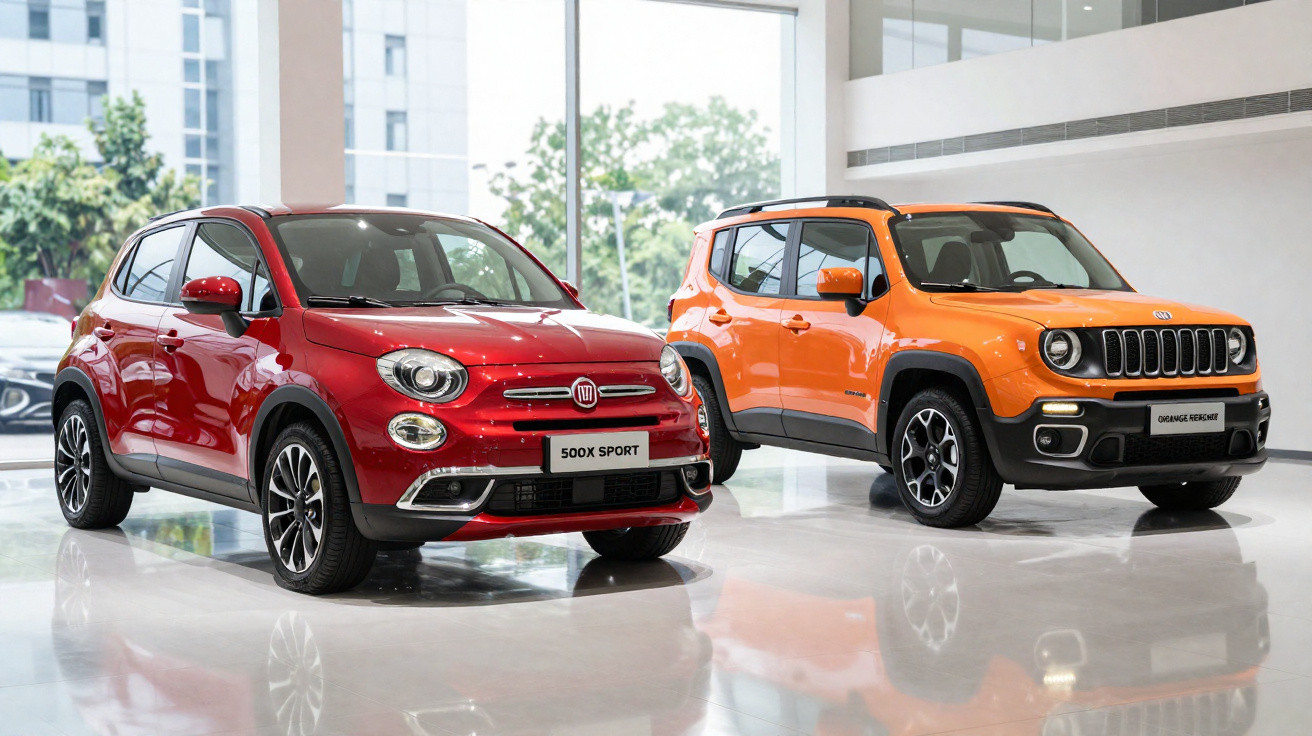
The Fiat 500X Sport and the Jeep Renegade Orange Edition share far more than most people assume: like the other versions in their respective ranges, they sit on the same platform, use the same mechanicals and are even built in the same factory.
At a glance, you would never guess it, because the exterior and interior styling could hardly be more different. With so much in common, the question is whether anything separates these two models beyond design.
To find out, we brought them together in identical specification: both running the new 1.3 Firefly Turbo with 150 cv, a six-speed automatic (dual-clutch) gearbox and two-wheel drive - the only configuration offered with this engine.
An eager Firefly and…
In the 500X and Renegade line-ups, the 1.3 Firefly Turbo with 150 cv is the most powerful petrol option. This is our second time with this still relatively new engine; after João Delfim Tomé drove it in another Renegade, I can only echo his view.
With 150 cv and 270 Nm, both the Renegade and the 500X gain the shove and performance we missed from the (interesting) 1,000 cm³ three-cylinder Firefly. At around 1,400 kg, neither is among the lightest in the segment, so the extra firepower is genuinely welcome.
Even so, some of the engine’s energy is softened by the gearbox, which could shift more promptly when compared with equivalent transmissions - something that stands out most in manual mode.
Left to its own devices, it changes gear smoothly, which fits what most buyers in this class are after.
Neither car offers driving modes - which is no bad thing - but given the more… sport intent of this 500X version, we were expecting a sharper calibration.
Only when you are more assertive with the throttle - in other words, when you press the right-hand pedal with real intent - does the gearbox consistently draw out the best from this new FCA Group engine. Otherwise, it behaves much like other dual-clutch-equipped models I have driven.
…thirsty
The 1.3 Firefly Turbo delivers plenty of usable power and performance in both cars - with the 500X Sport being fractionally quicker - but it brings appetite to match.
Whether you are in the 500X or the Renegade, if you want to properly exploit this drivetrain, fuel consumption will always sit north of 9.0 l/100 km in mixed use (urban + suburban). At motorway speeds you can dip below that figure, but only at steady, moderate cruising does the trip computer show an (still) rather thirsty 7.0 l/100 km.
How do they compare from behind the wheel?
“Ok”… I found no meaningful differences between the 500X Sport and the Renegade in terms of engine and gearbox behaviour, but on the road - despite how closely related these “siblings” are - there are differences worth noting.
Unexpectedly, it is the 500X Sport that deals better with sharper imperfections (expansion joints, manhole covers, more broken surfaces, etc.). That is surprising because you would assume the 500X Sport’s extra dynamic focus - 10% firmer spring/damper setting, 13 mm less ground clearance and recalibrated steering versus other 500X versions - would make it the more sensitive car here.
The likely explanation lies in the Renegade’s larger rolling diameter. Although both cars wore 19-inch rims (optional on the 500X Sport and standard on the Renegade Orange Edition), the overall wheel (tyre + rim) is bigger on the Renegade: 235/45 ZR19 versus 225/40 ZR 19 on the 500X Sport.
Expectations were also “turned upside down” when we realised the more focused 500X Sport is the one with lighter steering. The gap is not dramatic, but it is clearly noticeable.
The chassis changes made to the 500X Sport do not turn it into the ultimate B-SUV for keen drivers, but it does not disappoint either, and it represents a positive step forward compared with other 500X versions.
It is true that the mix of large wheels, low-profile tyres and firmer set-up makes it feel busier and more nervous in the way it rides - it remains comfortable, broadly matching the Renegade - yet it pays you back with greater bite through a sequence of corners.
Despite the Renegade’s softer tune, the front axle still responds promptly and, while body roll is more evident, it stays reasonably controlled. In more committed driving, the Jeep Renegade also benefits from the heavier steering and the extra resistance it offers.
Different, but the same?
The takeaway is that, despite clear differences between them, there seem to be more points of connection than separation - I had expected, for instance, a bigger split between the two in dynamic character. Even so, they do come across differently, including when you are driving them.
From the driver’s seat of the Jeep Renegade, you feel like you are piloting an SUV… an SUV - it always seems more… substantial. In the Fiat 500X Sport, by contrast, the sensation is of a more conventional car: less adventurous, more city-minded - and even the higher stance is not particularly obvious from behind the wheel.
That difference in perception is largely driven by design choices. The Renegade’s boxier forms - very Wrangler-like - its more upright pillars, and its greater height (outside and inside) place you more clearly in the SUV universe, even if this Orange Edition, with its mega wheels, is far happier on tarmac than on dirt.
Inside, the same impression continues. The 500X Sport’s more stylised shapes stand apart from the Renegade’s more functional cabin design. Some of that perceived robustness shows up in real use: neither feels class-leading for assembly quality, but the Renegade coped better with the punishment of Lisbon’s cobbles, with fewer interior plastic squeaks and complaints.
Those different interior design decisions also give the Renegade a small edge in day-to-day usability. For example, the infotainment screen sits in a better position than it does in the 500X. Although both share the capable UConnect system, the American model’s graphical choices make the interface more intuitive - it is clearer where you can, and cannot, press.
The 500X Sport answers back with an instrument panel that, in this particular specification, is more pleasing to look at thanks to Alcantara and leather trim (optional), plus a very good sports steering wheel that feels more satisfying in the hands.
500X cheaper to start with, but the Renegade is better equipped
As standard, the Jeep Renegade Orange Edition costs €1,750 more than the Fiat 500X Sport, but it offsets that with a stronger equipment list. Electrically folding door mirrors and the rain/light sensors, for instance, are standard on the Renegade and optional on the 500X Sport.
That said, “our” 500X Sport levelled the playing field thanks to €2,700 of options - whereas on the Renegade only the paint was optional - even if its purchase price then ends up around €500 above the Renegade.
So far, the 500X Sport is arguably the most appealing 500X: it is offered with every engine in the range, including Diesel, and it stands out both for its looks and its more polished dynamics. The Renegade Orange Edition “orange”, on the other hand, leans mainly on visual differentiation - and it is also available with the 1.0.
In the end, this comparison lands as a technical draw, with the real divider being exactly what we mentioned at the start. How do you like your SUV: closer to cars, or closer to true SUVs?
Whichever you choose, these are two models whose strengths go well beyond styling.
Comments
No comments yet. Be the first to comment!
Leave a Comment