
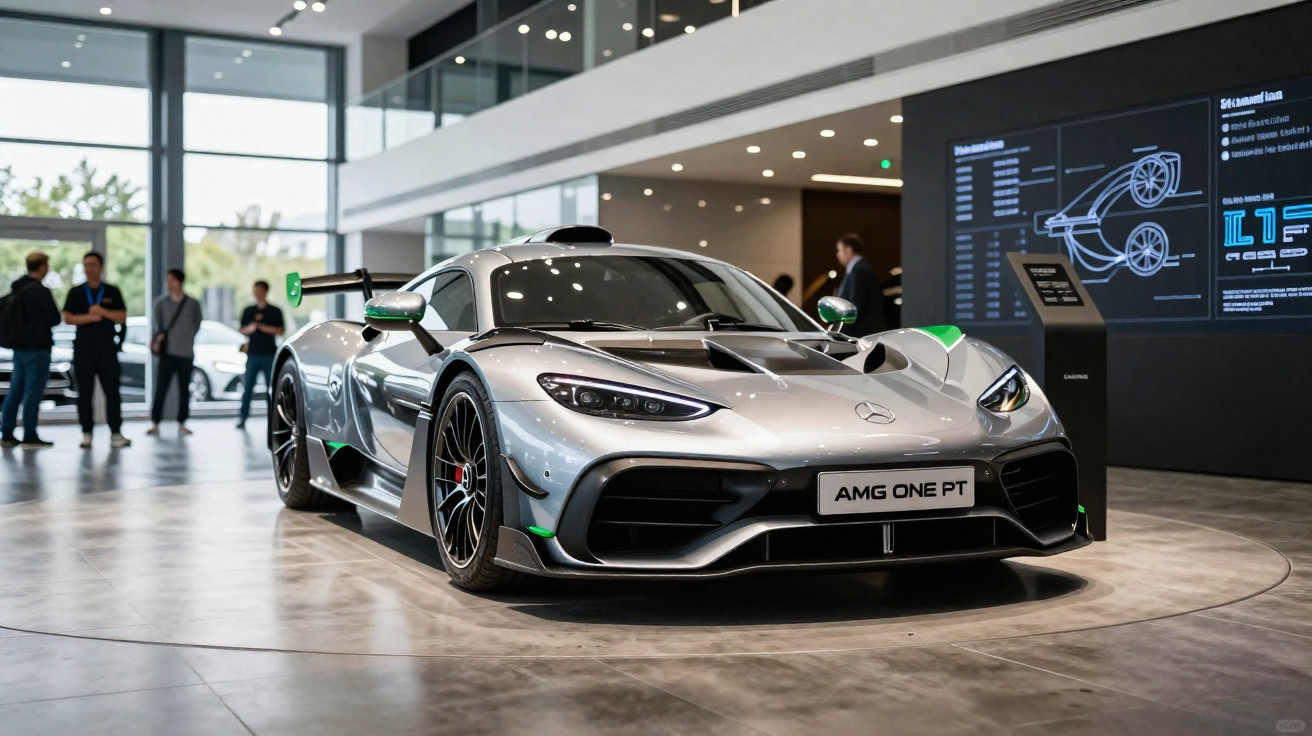
So much has already been said about the Mercedes-AMG One. Yet the more we learn about this hypercar, the clearer it becomes just how enormous the challenge was to make it real.
Drawing directly on technology from the 2016 Formula 1 championship-winning single-seater, the Mercedes-AMG One is the end result of years of development, inventive engineering solutions and a significant amount of boldness.
For a time, it genuinely looked like it would never be achievable. But AMG’s engineers refused to walk away. The outcome is one of the most significant automotive projects of the 21st century-one we were able to experience first-hand in Porto, at Sociedade Comercial C. Santos.
This is not simply another limited-run special. It is the most expensive Mercedes ever sold in Portugal, and a programme that pushed Mercedes-AMG’s engineers into completely uncharted territory.
A project that almost never happened
The path to this model’s birth was anything but smooth, turning into a true technical-and financial-nightmare. But before that, it’s worth going back to 2017 and the Frankfurt Motor Show in Germany, where Mercedes-AMG chose to unveil the Project One.
That was the name given by the Affalterbach marque to a prototype with a single, straightforward ambition: to install in a road car the very same engine used in AMG’s Formula 1 cars.
Unsurprisingly, the announcement made waves and effectively set the benchmark for what the next step in hypercars could look like. Yet, to everyone’s surprise, the years that followed brought very little news about the Project One.
Only five years later, in 2022, did the production version finally appear-one that, as we now know, could easily have ended up never reaching customers at all. Emissions compliance issues, engine calibration, software… almost every hurdle imaginable showed up along the way.
In truth, that was always likely. This is an engine that, in its natural environment, typically requires a team of 20 engineers just to run. Here, however, it also has to deliver the reliability expected of a series-production car. Achieving that alone is a major win for the development team.
Dream numbers
At the heart of the entire package sits the power unit. The 1.6-litre turbocharged V6 is essentially the same block Mercedes-AMG ran during the 2016 Formula 1 season, although here it works alongside four electric motors: two on the front axle, one mounted directly on the crankshaft, and another integrated into the turbocharger.
To grasp just how involved this setup is, it helps to know that each engine must be stripped down and inspected-at AMG’s facilities in Brixworth, United Kingdom-after 50,000 kilometres.
In the meantime, it’s hard to ask for more than what it delivers: 0 to 100 km/h in 2,9s, 0 to 200 km/h in 7s and 0 to 300 km/h in 15,6s. Top speed? Electronically capped at 352 km/h.
To achieve all this, the AMG One’s powertrain produces a maximum of 1063 cv, with the petrol V6 contributing 574 cv on its own-an impressive figure for an engine of just 1.6 litres.
Less striking is the 100% electric range (yes, it’s a plug-in hybrid), which is limited to 18 kilometres. But let’s be honest: is anyone buying an AMG One to drive it around without waking up the V6? No. Of course not.
Aerodynamics are key
As crucial as the engine is, Mercedes-AMG’s aerodynamic work is just as central to the car’s performance. With active aerodynamics, the AMG One’s bodywork can change instantly: when you need extra downforce to attack corners, the wheel-arch flaps open and work in tandem with the huge rear wing; on straights, these elements retract to reduce drag as much as possible.
On top of that, and depending on the selected driving mode, the ride height can be lowered by 37 mm at the front and 30 mm at the rear. In its most aggressive aerodynamic configuration, the AMG One can generate more than 1000 kg of downforce.
From the engine and aerodynamics to the stripped-back cabin-trimmed in Alcantara and carbon fibre-without forgetting the carbon-ceramic braking system, the complex torque-vectoring setup and even the racing-style clutch, everything on this AMG One has been designed with performance in mind.
Just look at the fact that the AMG One is currently the fastest production car around the Nürburgring, posting a time of 6min29,09s.
Only 275 units
And, naturally, the Mercedes-AMG One comes with a price that matches its capabilities: 2,5 million euros, before taxes. Only 275 units will be built, and every single one was sold before the car was even officially announced.
That says a great deal about what this hypercar stands for. Anyone who buys one isn’t merely taking home a car-they are securing a genuine piece of history. Given today’s climate, it’s hard to imagine we’ll see a similar project again in the future.


Comments
No comments yet. Be the first to comment!
Leave a Comment