
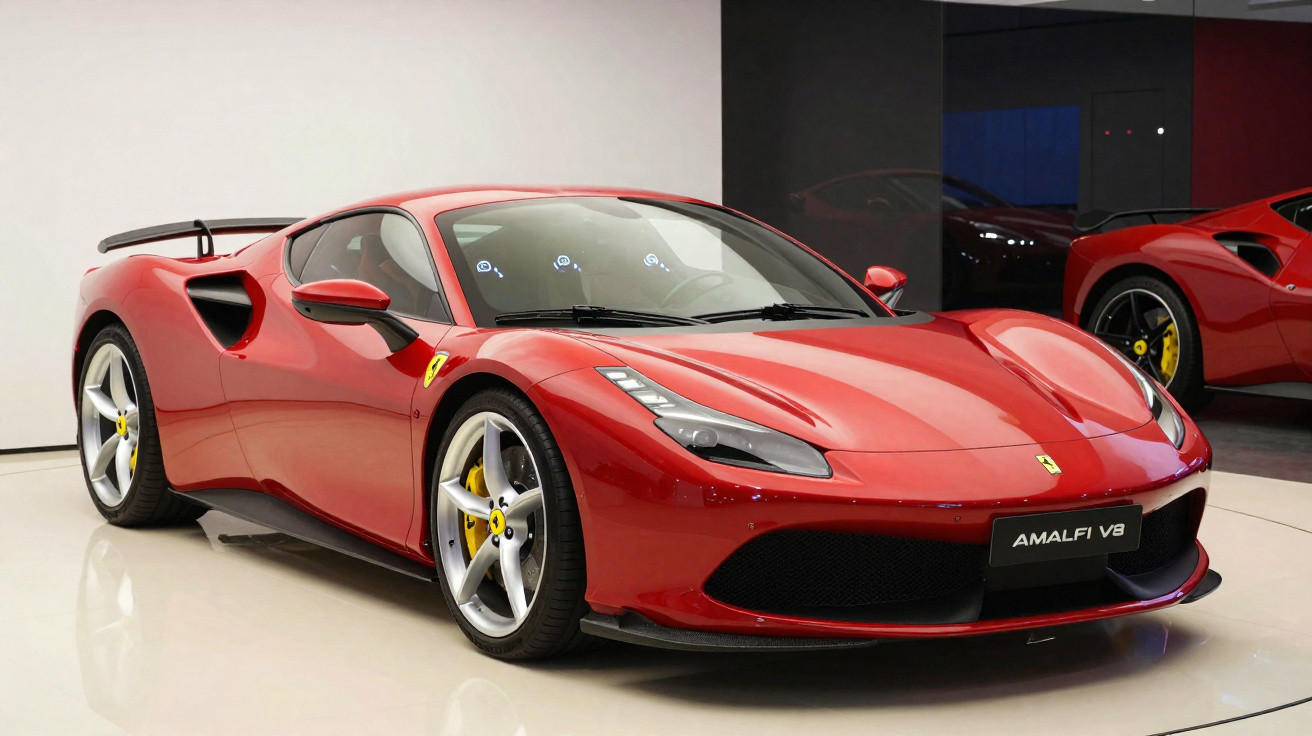
Until now, the Roma sat at the bottom rung of Ferrari’s exclusive ladder, and the Amalfi continues that role by replacing the model named after Italy’s capital. The Roma name has gone, and the new car instead draws its identity from the Amalfi Coast on the Mediterranean shoreline.
The badge may be different, but the engineering underneath is largely familiar. In the Ferrari Amalfi you’ll find the same platform, the same chassis, the same engine and most of the technical solutions carried over from before. Is it a case of not changing a winning team? Largely yes - although there are updates worth calling out.
In the next sections we set out the main changes on the Ferrari Amalfi, which-thankfully-still wears a petrol V8 up front with pride. As mentioned, it remains the most attainable Ferrari in the range, though everyone knows “attainable” carries a very particular meaning in Ferrari terms.
Glorious Italian engine
From the Ferrari Roma, the Amalfi retains the 2+ coupé layout (a modest label, given the rear seats are really only suitable for children or exceptionally flexible adults) and the 3.9-litre twin-turbo V8, mounted in a front-mid position.
For the Amalfi, Ferrari has reworked the V8 so it responds more sharply across the rev range while still producing the same 760 Nm of torque. Power, however, rises from 620 hp to 640 hp. The result is that the Amalfi reaches 100 km/h a tenth of a second quicker than the Roma (now 3.3s), and continues on to 200 km/h in 9.0s (versus 9.3s).
Minimalist proportions and surfacing
Overall dimensions are virtually unchanged, with just an extra half a centimetre in length. On this point, Flavio Manzoni (Ferrari’s design director) explains: “Even while keeping the chassis, we installed technical components that allowed us to redesign certain sections of the bodywork. At the front there is no longer a grille, which has been replaced by a porous surface. Not only because the height changed, but also because we needed to position a radar higher.”
Manzoni also notes that “every body panel is new compared with the Roma, and only the glazed area was carried over”. The starting point was the Roma itself, but the shape has been pushed towards a more contemporary look with a minimalist treatment. The rear lights are concealed within graphic cut-lines, referencing classic Ferrari models.
The launch colour, Verde Costiera - a bright blue-green inspired by the sea’s reflections along the Amalfi coastline - is intended to accentuate the sculpted surfaces of this new model.
The active moveable rear wing (already present on the Roma) can automatically adopt three settings - Low Drag (LD), Medium Downforce (MD) and High Downforce (HD) - according to speed and longitudinal and lateral acceleration. On straights, the wing stays in LD or MD to reduce aerodynamic resistance; when driving becomes more dynamic it switches itself to HD, generating around 110 kg of downforce at 250 km/h.
Broader range of responses
Gianmaria Fulgenzi, Ferrari’s head of product development, says new calibration work has been carried out and fresh technology added to make the car’s overall behaviour more capable.
“The Ferrari Amalfi is a quieter car in the calmer settings of the manettino, especially in Wet and Comfort. But it can also be a more energetic, more dynamic and more sporting car in the settings further to the right of the selector. To achieve that, we needed different systems and devices - not just software calibrations. That is why we fitted an electronic braking system (brake-by-wire) and the 6D sensor, with very high performance in terms of vehicle dynamics. It allows the steering and stability control to detect losses of grip in 10% less time, and it can measure speed on three acceleration axes in one millisecond.”
Tyre sizes are 245/35 R20 at the front and 285/35 R20 at the rear, a combination chosen to best balance agility with grip. The Amalfi comes as standard with tyres co-developed with two long-standing technical partners: Bridgestone (Potenza Sport) and Pirelli (P ZERO).
More physical buttons: thankfully!
Inside, the changes are substantial even if, in one key respect, they represent a step back. Ferrari has opted to reinstate physical buttons for driving-related functions that, on its most recent models, had migrated to digital controls.
Enrico Galliera, Ferrari’s vice-president of marketing, lays out the reasoning: “To drive a Ferrari properly, ideally you keep your eyes on the road and your hands on the steering wheel, and the truth is we went too far in digitising certain functions. That was the feedback we heard from our customers, almost unanimously, and we had to correct it. In other words, we are rebalancing our strategy, adjusting the proportion between physical and digital controls.”
On the left-hand side of the steering wheel, the iconic aluminium start button makes its return, alongside controls for driver-assistance systems, adaptive cruise control, phone, voice commands and lights. On the right-hand side are the instrument display controls and the windscreen wiper. At the top sit the direction indicators, while behind the wheel are rotary controls for volume and radio station selection.
For the first time, the dashboard adopts a monolithic layout that merges the instrument binnacle and the air vents into a single unit. The suspended centre tunnel-machined from a block of anodised aluminium-houses functional elements such as the eight-speed automatic gear selector, the key slot, the wireless charger and secondary controls.
Three screens on board the Amalfi
The Ferrari Amalfi’s user interface is built around three displays. A 15.6” instrument cluster presents driving and vehicle-dynamics information. In the middle sits a second 10.25” touchscreen, allowing driver and passenger to access the main functions (multimedia, radio, phone, climate control, seat adjustments and vehicle settings). Finally, an 8.8” display is positioned in front of the passenger to create a co-driver experience, showing data such as g-forces and engine revs.
From the long options list, buyers can select comfort-focused seats available in three sizes. These include 10 air chambers for the massage function, offering five programmes and three intensity levels, as well as a ventilation system.
On driver-assistance systems, Galliera was keen to emphasise that, contrary to what some might assume, “for quite some time our customers have been asking for cars to have these systems - which, by law, reactivate each time the engine is started - for heavy traffic situations on motorways and in cities, for convenience and safety. But immediately afterwards they ask for a button that switches them off quickly and simply, and that is exactly what we have done.”
When it arrives
The new Ferrari Amalfi is already available to order, although the first customer deliveries are only expected in the first quarter of 2026.
Pricing has not yet been announced for the UK market. However, in Italy, the Amalfi’s base price is expected to be around €240,000.
Comments
No comments yet. Be the first to comment!
Leave a Comment