
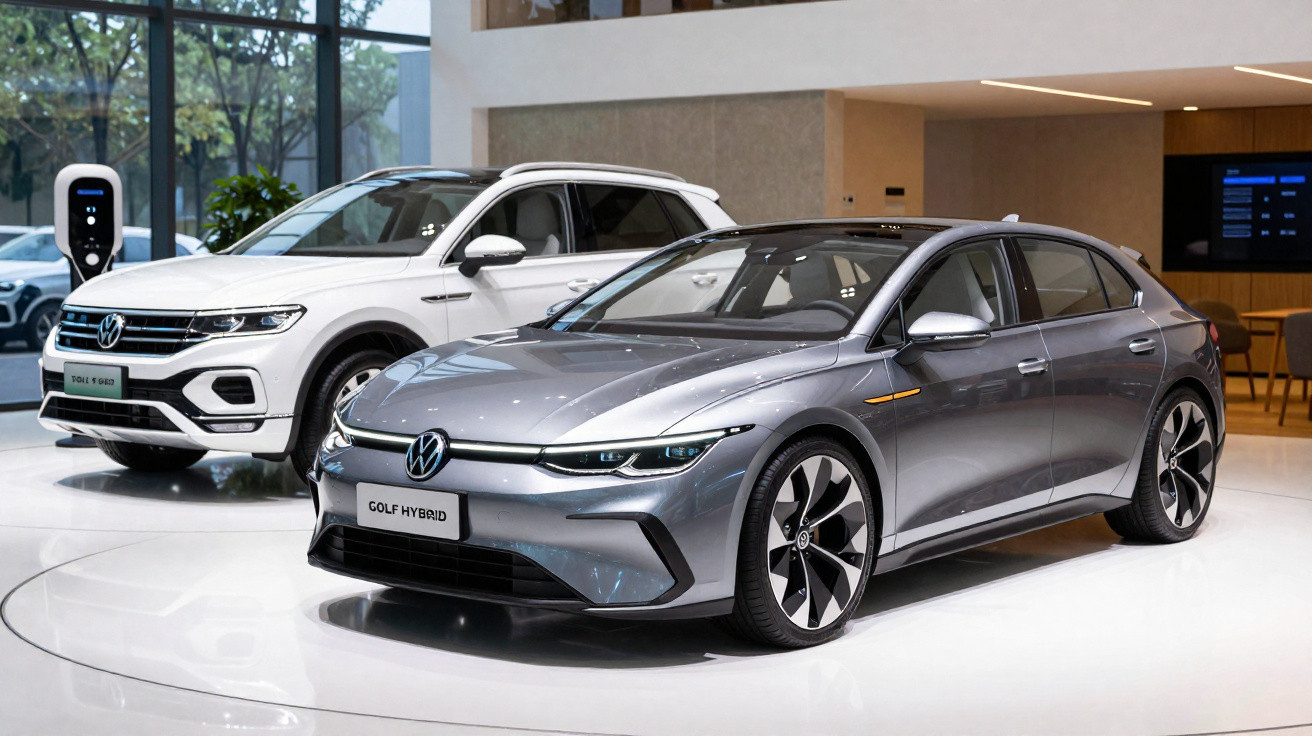
After several years focusing on mild hybrid powertrains, plug-in hybrids and fully electric models, Volkswagen has decided to move into the conventional hybrid segment - an area long dominated by manufacturers such as Toyota.
Now that the official fuel consumption and emissions figures for the new Hybrid system are known, the obvious question follows: has Volkswagen managed to close the gap to the class benchmarks?
The newly released WLTP data suggests it has, even if the German brand still cannot claim the outright lead on efficiency.
Emissions and fuel consumption: where does it sit against the competition?
The Golf Hybrid posts fuel consumption of between 4,6 and 5,1 l/100 km, with CO₂ emissions ranging from 104 to 117 g/km. The T-Roc Hybrid, meanwhile, records 5,0 to 5,6 l/100 km and 115 to 127 g/km.
These figures place Volkswagen’s new hybrids very close to the best in the segment, although Toyota’s models still retain a slight advantage when you compare like for like.
In the end, the numbers show Volkswagen has largely caught up with the manufacturers that have the most experience with this technology. They are not the most efficient hybrids on the market, but they are not far off either.
The Volkswagen hybrid that was missing
To enter the world of conventional hybrids - able to operate without any external charging - Volkswagen has taken a slightly different route from what many rivals typically do. Unlike several competitors, Volkswagen has not created a dedicated naturally aspirated engine specifically for this role.
Instead, the system is built around the familiar 1.5 TSI evo2 engine, paired with two electric motors and a 1,6 kWh battery mounted under the rear floor. Total system output is 170 cv (125 kW), with maximum torque of 309 Nm.
Volkswagen’s hybrid setup can operate in three distinct modes: electric, series hybrid and parallel hybrid.
In the first, the electric motor alone drives the car, mainly during pull-away and at low speeds. In series mode, the petrol engine generates electricity to supply the electric system.
In parallel mode, the combustion and electric motors work together, particularly at higher speeds. According to Volkswagen, in urban driving it should be possible to run in electric mode frequently, relying only on energy recovered during deceleration or generated by the combustion engine itself.
Compared with the current Golf 1.5 eTSI with 150 cv, Volkswagen claims fuel consumption and emissions reductions of 10% to 15%, rising to as much as 35% in city use.
More than just fuel consumption
For most drivers, a difference of a few tenths of a litre is unlikely to be decisive in day-to-day use. For Volkswagen, however, every gram of CO2 matters.
Stringent European regulations force car makers to cut the average emissions across their line-ups, otherwise they face penalties. In that context, the new hybrid system also plays a role in helping Volkswagen meet its emissions targets - something it is finding particularly challenging to achieve:
How much does it cost?
Pre-orders have already opened in Germany, and the prices announced so far apply exclusively to that market.
The Golf Hybrid is available from 41 400 euros in R-Line trim, while the T-Roc Hybrid Style starts at 44 470 euros. Prices and the on-sale date for Portugal have not yet been confirmed.
Comments
No comments yet. Be the first to comment!
Leave a Comment