
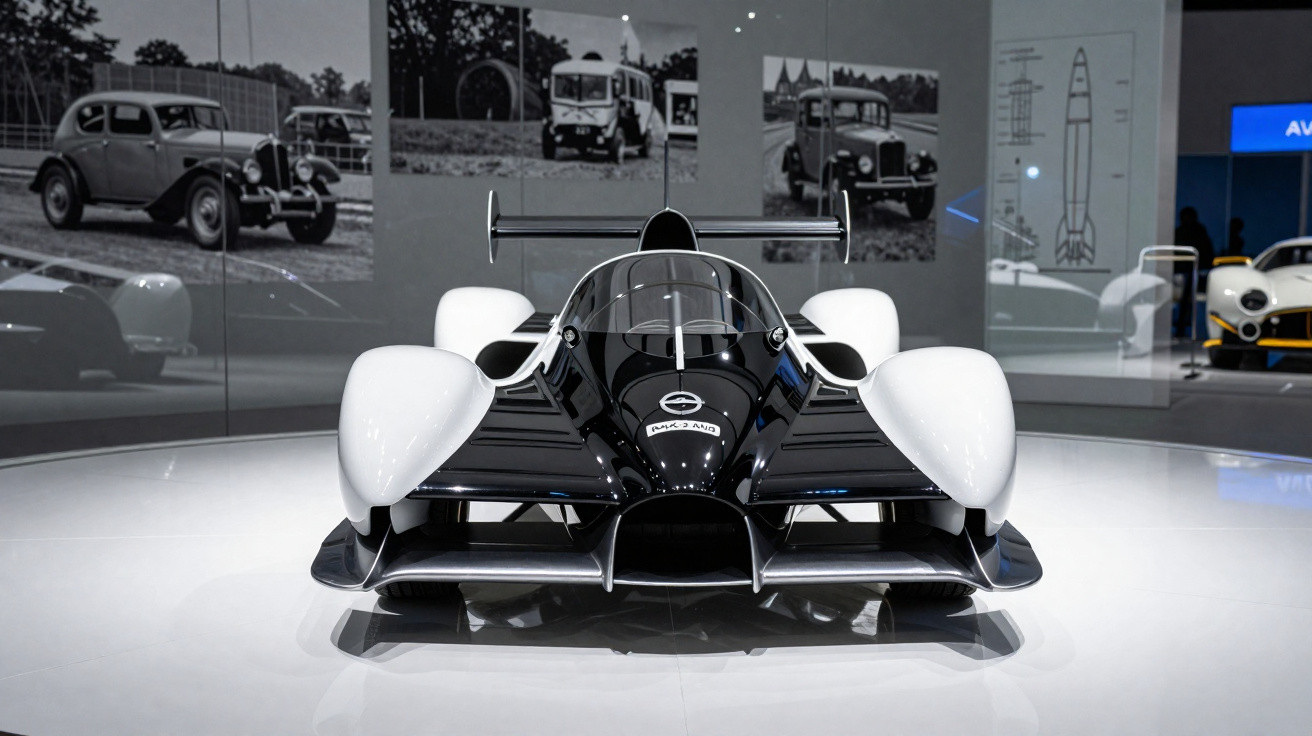
On 23 May 1928, an unconventional car raced around Berlin’s AVUS circuit at 238 km/h in front of thousands of onlookers. The Opel RAK 2 had no traditional engine, no gears and no liquid fuel: it was driven forward by 24 rockets and kept planted by small wings, while Fritz von Opel sat at the controls shielded by little more than a steel plate.
The RAK 2 turned a racetrack into a launch pad
Fritz von Opel, the founder’s grandson, developed the rocket car together with astronomer Max Valier and rocket specialist Friedrich Wilhelm Sander. Opel’s historical records describe their goal as proving that rocket propulsion could have practical uses in transport and aviation.
The run took place on AVUS, a circuit famous for its long straights. The RAK 2 covered roughly 1.8 kilometres in just 24 seconds and reached 238 km/h, setting a German land-speed record. The feat made Fritz von Opel a celebrity, widely nicknamed Rocket Fritz.
The vehicle had no engine or transmission
Built on an Opel chassis, the RAK 2 weighed about 560 kilograms and used a stretched, cigar-shaped body. Instead of an internal-combustion engine, the team fitted 24 solid-fuel rockets at the rear, triggered electrically in stages during the run.
The rockets carried around 120 kilograms of propellant and generated an estimated total thrust of six tonnes. Opel notes that Fritz von Opel was separated from the rocket pack by only a metal plate-an arrangement that underlines the extreme level of risk accepted by technology pioneers of the era.
Why did the rocket car need wings?
Because the car was lightweight and its acceleration was extraordinary for the 1920s, there was a real chance it could lose contact with the track. To stop the nose lifting, the RAK 2 was fitted with small side wings set at a negative angle, producing force that pushed the wheels down onto the tarmac.
- Aerodynamic, elongated bodywork
- A set of 24 solid-fuel rockets
- Side wings designed to improve stability
- No conventional engine or gearbox
- Recorded top speed of 238 km/h
Even with this fix, historical accounts suggest the car became alarmingly light during the run. The setup did not resemble aircraft wings used to climb, because it worked in the opposite direction. Its purpose was to create downforce and prevent the RAK 2 from quite literally turning into a projectile.
Watch the video shared by the YouTube channel OkraJoe showing the RAK 2 accelerating in action.
The project was part of a broader rocket race
The RAK 2 was not a one-off experiment. In April 1928, the earlier RAK 1 reached 100 km/h in eight seconds during tests at the Opel factory. A month after the Berlin demonstration, the rail vehicle RAK 3 achieved approximately 256 km/h, setting a world record on rails.
These trials belonged to the Opel RAK programme, regarded as one of the first organised efforts to develop rocket-powered vehicles. While the demonstrations also served as promotion for the manufacturer, they helped bring a technology that still seemed fantastical into the public eye and drew wider attention to debates about high-speed flight.
The RAK 2 foreshadowed the dreams of the space age
The rocket car was never intended for public roads or showroom floors. Its value lay in demonstrating that rockets could propel a controllable vehicle at very high speed. The experiments continued with trains, gliders and aircraft before the programme lost momentum after General Motors entered Opel in 1929.
Today, the RAK 2 stands as a symbol of a period when engineering, spectacle and danger advanced side by side. Understanding this story also means acknowledging its hazards: the feat should not be repeated, but remembered as proof that ideas that seem impossible can reshape technology when studied responsibly.



Comments
No comments yet. Be the first to comment!
Leave a Comment