
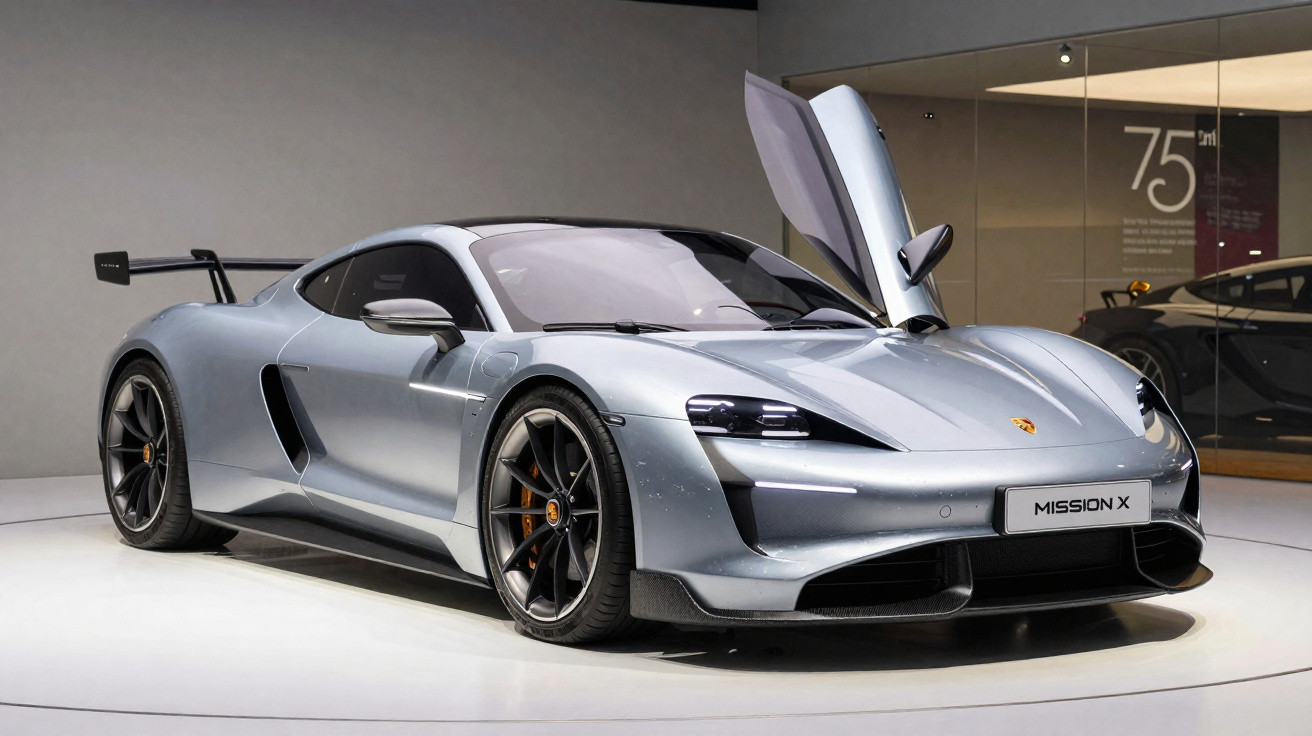
Porsche is celebrating 75 years, and it is hard to imagine a better way to mark the occasion than by pulling the covers off a new hypercar.
That is exactly what happened yesterday in Zuffenhausen at the brand’s museum, on the eve of the opening of the “75 Years of Porsche Sports Cars” exhibition, as Porsche officially lifted the curtain on the Mission X.
The Porsche Mission X has been introduced as a concept, and the German manufacturer has not - yet - committed to putting it into production.
Targets set - and they are ambitious
Even so, what stands out is that Porsche has already laid down a set of clear targets for the Mission X, should it decide to build it.
The first goal would, predictably, be to make the Mission X the fastest road-legal car around the Nürburgring Nordschleife. For now, that benchmark belongs to the Mercedes-AMG One, with 6min35,183s.
The second target is for the Mission X to achieve a power-to-weight ratio of roughly 1 kg/cv. That could prove especially demanding, largely because the Mission X is a 100% electric hypercar - we will come back to that…
Third, Porsche wants it to generate more downforce than the current 911 GT3 RS. In other words, it would need to produce well beyond the 860 kg at 285 km/h(!) delivered by the most extreme 911.
Finally, given that it is electric, Porsche is aiming for the Mission X to charge at roughly twice the speed of the Taycan Turbo S. The Taycan Turbo S has a maximum charging power of 270 kW and, to beat that, the Mission X relies on a 900 V electrical architecture (the Taycan runs 800 V).
Porsche Mission X numbers? There aren’t any
Porsche has said virtually nothing about the technical specifications of what is expected to be the next chapter in a lineage that began with the 959, continued with the Carrera GT, and later included the hybrid 918 Spyder.
The only figures shared so far relate to its dimensions - notably compact, in fact - plus the targets Porsche has set out.
Still, it is possible to do a little “back-of-the-envelope” maths. Because it is fully electric, the Mission X will face the same issue as every EV: high mass.
So how much could the Mission X weigh? One useful comparison is another electric prototype from the brand, the Mission R, unveiled in 2021.
The Mission R was quoted at 1500 kg - a high number, but relatively low for a high-performance electric machine. If we use that as a reference point, and apply the Mission X goal of a 1 kg/cv ratio, that implies power in the region of 1500 cv.
Can Porsche really make the Mission X that light? We can also look at the Lotus Evija and Rimac Nevera, two of today’s electric hypercars.
The Evija claims 1680 kg, while the significantly heavier Nevera comes in at 2300 kg. Both are paired with outrageous power outputs: 2000 cv and 1914 cv, respectively.
The 900 V architecture could play a role in the Mission X’s final kerb weight. If ultra-fast charging is on the table, Porsche may opt for a smaller battery, which would reduce mass.
Whatever the final figures end up being, the one certainty is that if it reaches production, the Mission X will be the most powerful road-going Porsche ever - by a wide margin.
Inspired by Le Mans prototypes
With no concrete performance data to discuss, for now we can only take in the exterior and interior design of the Porsche Mission X.
Its stance and proportions are not far removed from what we expect of a combustion-engined supercar or hypercar. That is because Porsche has “packaged” the batteries behind the two occupants, in the position where a conventional internal-combustion engine would typically sit.
Most striking is the glazed canopy that defines the cabin volume, inspired by the Porsche 917 - one of the most iconic racing cars ever, and a winner of the 24 Hours of Le Mans. That 917 influence continues in the doors, which are hinged to the A-pillars and the roof, opening forwards and upwards.
Inside, the car is just as distinctive. The asymmetrical layout and colour treatment are designed to place the driver at the centre of attention.
The driver and passenger seats (in carbon fibre) are finished in different colours, while the motorsport influence is obvious in the yoke-style steering wheel design (open at the top) with paddles, and in the inclusion of a six-point harness.
Porsche has also fitted the Mission X with several cameras, inside and out, activated by pressing the “REC” button on the multifunction control panel - so not a single frame of a fast lap on track is missed.
Will it reach production?
Porsche has not confirmed whether the Mission X will be built for the road, but the track record of “Mission” prototypes suggests there is a strong chance we will see it on the street in the years ahead.
The very first, the Mission E, became the Taycan, while the Mission E Cross Turismo arrived as the Taycan Cross Turismo and Sport Turismo. The Mission R mentioned earlier will lead not only to a racing car, but also previews the electric successors to the 718 Cayman and 718 Boxster.
If we look at the usual gap between concept reveal and production model, then around 2027 we should be able to bring you all the details on the production Mission X.

Comments
No comments yet. Be the first to comment!
Leave a Comment