
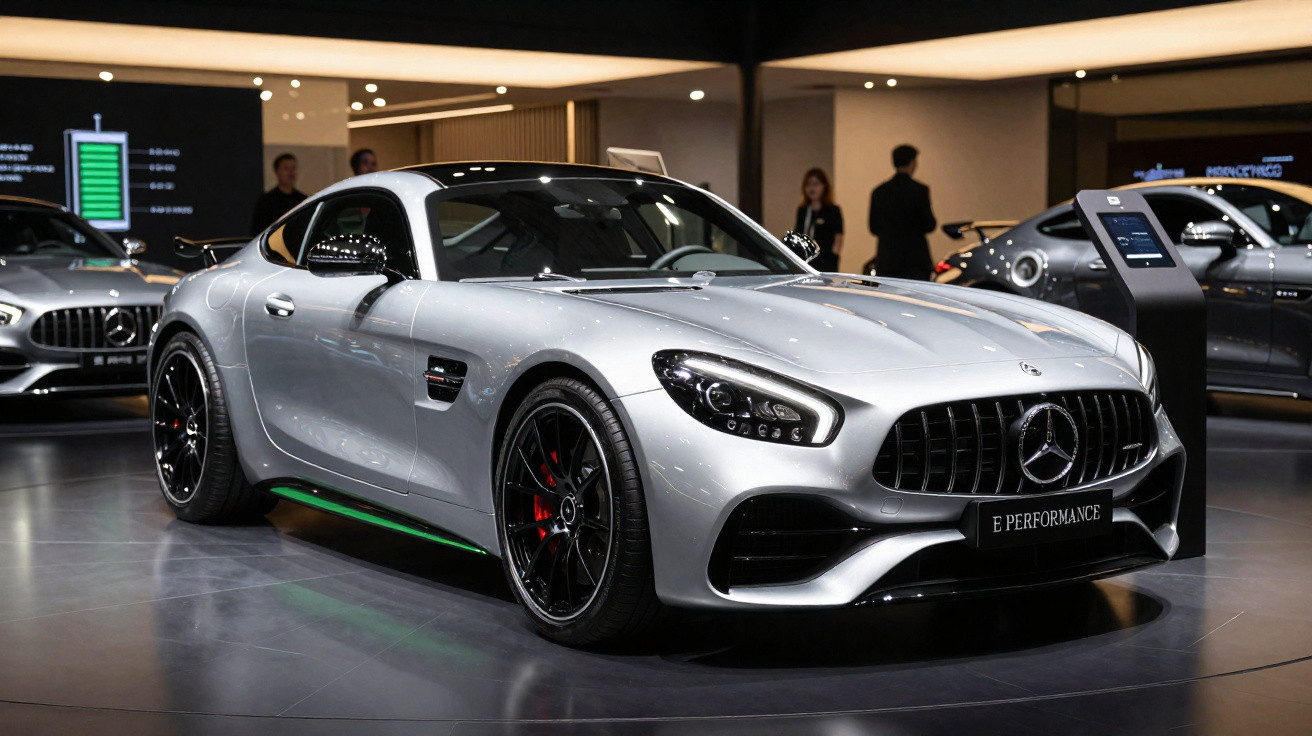
The Mercedes-AMG One hypercar (which effectively brings Formula 1 car technology to the road) is now lending its core engineering principles to the next wave of AMG plug-in hybrids, which will carry the E Performance badge. These will start with the V8-powered GT 4 Doors, and will also include the successor to the Mercedes-AMG C 63, which will use the same modular system. AMG’s engineering leadership outlines the technical foundations of two high-performance plug-in hybrids that will be on the road as early as 2021.
One by one, the most entrenched strongholds of brands worshipped by millions of petrolheads (in other words, enthusiasts obsessed with petrol engines, usually with a sporting edge) are giving way as vehicle electrification becomes an irreversible reality.
AMG is now close to introducing its first fully electric model (later this year), built on the new EVA (Electric Vehicle Architecture) platform, as well as its first high-performance plug-in hybrid (PHEV) models under the E Performance label. In the PHEV case, key ideas come directly from the One (due to reach its first customers within a few months) and are being carried over to the Mercedes-AMG GT 4 Doors and the C 63, both also due to arrive in 2021.
Of course, the hypercar was conceived for a very different mission. It uses five motors: two electric motors on the rear axle working alongside a 1.6 V6 1.6-litre engine (taken from the F1 W07 Hybrid), plus two more electric motors at the front. The result is maximum output of more than 1000 cv, a top speed of 350 km/h, 0 to 200 km/h in under six seconds (quicker than a Bugatti Chiron), and-fittingly-a price tag of more than 2,8 million euros.
As for the first all-electric AMG models-set to be unveiled this year-only a few details are known so far. They will use two motors (one permanent-magnet synchronous motor per axle, therefore four-wheel drive), a 22 kW on-board charger, and DC charging up to a maximum of 200 kW. They are also expected to deliver performance on a par with AMG’s 4.0 V8 biturbo models, including a 0 to 100 km/h sprint well below four seconds and a top speed of 250 km/h.
Paradigm shift
To keep pace with the times, AMG has upgraded its headquarters in Affalterbach, adding a test centre for the high-voltage battery and electric motors, along with a competence centre dedicated to producing plug-in hybrid powertrains.
At the same time, cooperation with the Mercedes-AMG F1 Petronas engineers has been intensified so that this technology transfer can happen as directly and effectively as possible.
“AMG wants to keep up with the way times are changing by electrifying its range without giving up its positioning. We will continue to build high-performance cars, and we will also use this as an opportunity to win over a younger customer base and a higher proportion of female customers,” CEO Philipp Schiemer tells me in an exclusive Zoom interview, where the key technology concepts are also presented with help from Jochen Hermann, AMG’s Chief Technical Officer (CTO).
The first major innovation in AMG’s forthcoming plug-in hybrids concerns where the electric motor is placed. As Hermann explains: “unlike conventional PHEVs, in our new system the electric motor is not installed between the petrol engine (ICE) and the transmission, but instead on the rear axle, which brings several advantages. I would highlight these: weight distribution between the front and rear becomes more balanced-up front, in the AMG GT 4 Doors, we will already have the 4.0 V8 and the nine-speed AMG Speedshift gearbox-while the electric torque is used more efficiently because it is delivered faster, allowing power to turn into acceleration almost instantly (without having to pass through the gearbox). And energy distribution via the locking differential to each wheel on the rear axle happens more quickly, so the car puts its power down sooner, clearly improving its agility in corners.”
Two motors, two gearboxes
The rear electric motor (a permanent-magnet synchronous unit delivering a maximum of 150 kW or 204 cv and 320 Nm) is integrated into the so-called Electric Drive Unit (EDU), which also includes a two-speed gearbox and an electronic locking differential.
An electric actuator engages 2nd gear no later than 140 km/h, corresponding to an electric-motor speed of around 13 500 rpm.
High-performance battery
One particular point of pride for AMG’s engineers is the new high-output battery (also mounted on the rear axle). It comprises 560 cells and can supply 70 kW continuously, or 150 kW at peak (for 10 seconds).
It was developed in-house with extensive support from Mercedes’ Formula 1 team, Hermann says: “the battery is technically close to what Hamilton and Bottas’s car uses, it has a capacity of 6,1 kWh and weighs just 89 kg. It achieves an energy density of 1,7 kW/kg, which is roughly double what conventional plug-in hybrids’ high-voltage batteries can manage without direct cooling.”
In simple terms, the AMG 400 V battery’s high output comes down to that direct cooling: for the first time, each cell is cooled individually because it is permanently surrounded by a refrigerant based on an electrically non-conductive liquid. Around 14 litres of refrigerant flows from top to bottom through the entire battery, passing every cell (with the help of a high-performance electric pump) and also circulating through an oil/water heat exchanger directly connected to the battery.
This makes it possible to keep the temperature stable and consistent at 45 ºC, regardless of how many times the battery is charged and discharged. That consistency is not achieved with conventional cooling systems in hybrid setups, where batteries lose performance.
As AMG’s CTO puts it, “even during very fast laps on track, where acceleration (which discharges the battery) and acceleration (which charges it) are frequent and violent, the energy storage system maintains its performance.”
As in Formula 1, the “electric push” is always available thanks to a powerful energy recuperation system and because there is always an energy reserve for full-throttle or intermediate acceleration, even when the battery state of charge is low. The system includes the familiar driving modes (Electric up to 130 km/h, Comfort, Sport, Sport+, Race and Individual), which vary powertrain and transmission response, steering feel, damping and sound. They can be selected via the controls on the centre console or the buttons on the steering wheel.
The four-wheel-drive system also features AMG Dynamics, which uses sensors to monitor speed, lateral acceleration, steering angle and slip angle, then adjusts the car’s set-up depending on what is most suitable moment by moment. It operates through the Basic, Advanced, Pro and Master programmes, which combine with the driving modes listed above. Separately, energy recuperation offers four levels (0 to 3), reaching a maximum recovery of 90 kW.
Mercedes-AMG GT 4 Doors E Performance, the first
Mercedes-AMG has not yet published the full technical specification for the upcoming Mercedes-AMG GT 4 Doors E Performance, but it is already known that maximum system output will exceed 600 kW (that is, above 816 cv) and peak torque will top 1000 Nm. That, in turn, should translate into 0 to 100 km/h in under three seconds.
The on-board charger, meanwhile, will be 3,7 kW. No electric-only range has been announced for any of these plug-in hybrids; all that has been confirmed is that the priority is performance support rather than covering long distances with zero emissions.
Mercedes-AMG C 63 will also be E Performance
“You can expect a successor to the C 63 with the same plug-in hybrid system that will be as dramatic and dynamic as today’s V8 model,” Philipp Schiemer promises, even if four cylinders have been “lost”.
That is because the combustion engine will be the 2.0 l inline-four (M 139), which remains a world champion for output in its class and, until now, has only been fitted transversely in Mercedes-AMG’s compact “45” model family. Here, however, it will be installed longitudinally in the C-Class as well-something that has never happened in this model line.
At present, what is known is that the petrol engine will deliver more than 450 cv, which should be combined with the electric motor’s 204 cv (150 kW) for a total output that should not be below the current top C 63 S version’s 510 cv. Performance should be no worse either, with German engineers promising under four seconds for 0 to 100 km/h (vs 3,9 s for today’s C 63 S).
Another production-car world first (though already used in F1 and in the One)-and in this case a first across the industry-is the electrically assisted exhaust-gas turbocharger applied to the 2.0 l engine.
As Jochen Hermann explains, “the e-turbocharger gives you the best of both worlds-namely the agility of a small turbo with the peak power of a large turbo-while eliminating any trace of response delay (so-called turbo-lag). Both the four- and eight-cylinder engines use a 14 cv (10 kW) motor-generator that starts the petrol engine and powers auxiliary units (such as air conditioning or headlights) in situations where, for example, the car is stopped at a traffic light and the high-voltage battery has no charge left to feed the vehicle’s low-voltage network.”

Comments
No comments yet. Be the first to comment!
Leave a Comment