
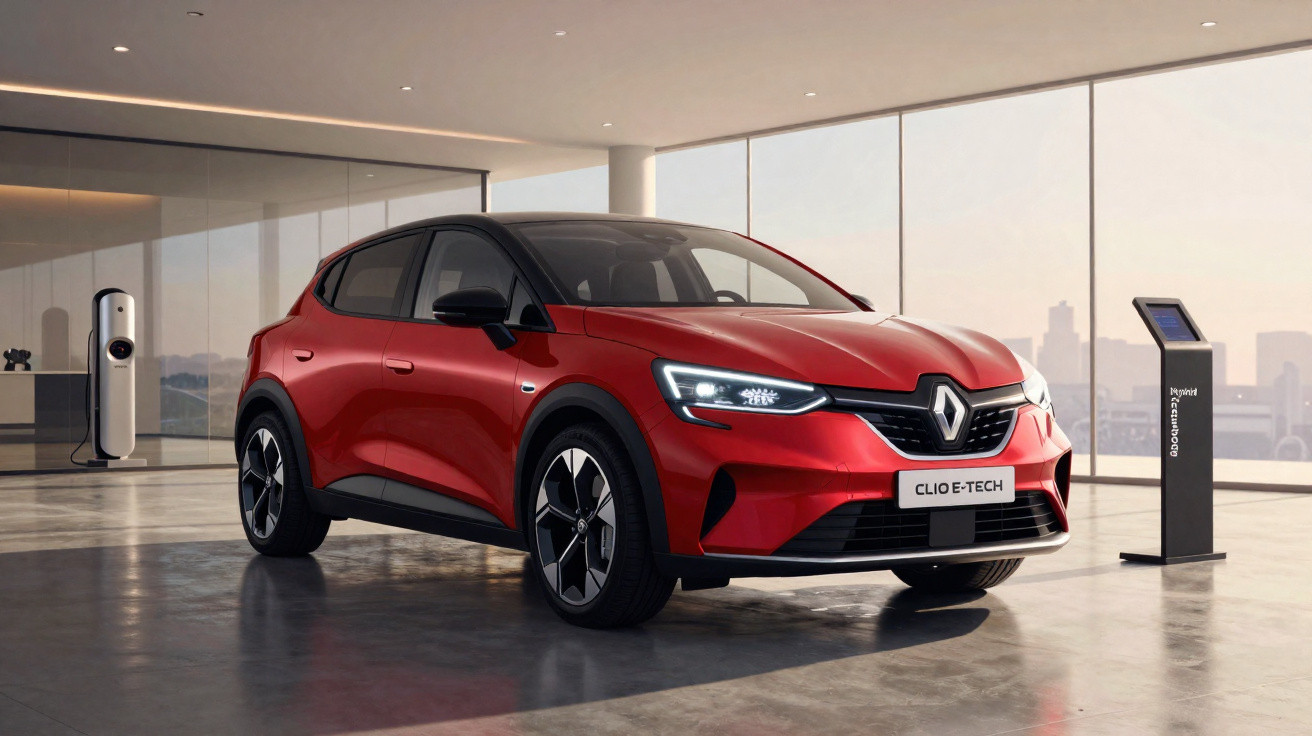
In town, the Renault Clio E-Tech hybrid can pass for an electric car - but when you press on, you may wish it behaved more like a “pure” petrol model.
Few cars have made as strong an impression as the Renault Clio, at least here: in Portugal alone, the Clio has already surpassed half a million units sold.
Even after more than three decades on our roads, this French supermini shows no sign of slowing down. It was also refreshed recently, gaining extra strengths to help it compete in a market increasingly dominated by SUVs.
Compared with the outgoing Clio, the changes are not dramatic. Still, Renault’s tweaks are largely positive - with the added bonus that the entry price has dropped.
In the video, Guilherme Costa walks through everything that has changed with this Clio update, inside and out.
After that first encounter in Brussels, Belgium, this French supermini has already been through Razão Automóvel’s garage - including one of the range’s most interesting engines, the LPG version. Read André Mendes’ review:
No two without three… This time it was my turn to try another appealing option: the hybrid that Renault calls the Clio E-Tech Full Hybrid. It’s time to find out whether the praise we gave it last time still holds up.
A complex hybrid, but an efficient one
With this refresh, the hybrid system continues to rely on a naturally aspirated 1.6-litre four-cylinder engine, which on its own produces 94 hp. It is paired with two electric motors: one dedicated to traction, delivering 36 kW (49 hp), and another acting as a motor/generator, rated at 15 kW (25 hp).
Together, this “marriage” delivers a maximum of 145 hp - exactly the same as before - although the system’s software has been updated to increase efficiency and improve charge management, especially on the motorway.
We will come back to that, but first it’s worth highlighting the multi-mode automatic gearbox that “manages” this hybrid setup and makes it one of the most complex on the market.
Drawing on solutions inspired by Formula 1, this transmission uses four ratios linked to the petrol engine and two assigned to the electric motor, allowing a total of 15 possible combinations.
Because there is no clutch or synchromesh, coordinating all of this falls to the motor/generator (the smaller electric motor) and to software developed in partnership with Alpine’s Formula 1 team.
The other “secret” of the Renault Clio E-Tech hybrid system is, of course, the 1.2 kWh battery, mounted beneath the boot floor.
In town it feels like an electric car
However complicated it may look on paper, the hybrid system is straightforward in use, because it prioritises electric running whenever it can.
That is why Renault claims this hybrid Clio can spend 80% of urban driving time powered solely by the electric motor, without “help” from the petrol engine.
This works in the city because there are plenty of opportunities to recover energy (deceleration and braking), and because the “B” function - which increases regeneration on lift-off - is far stronger than we are used to seeing in this type of hybrid.
When required - whether because the system needs to charge the battery (even while stopped at traffic lights, for example) or because you press the accelerator more decisively - the petrol engine wakes up and joins in, almost always very smoothly.
In fact, it’s one of the highlights of this hybrid Clio: the transition between electric and petrol power is handled so well that, at times, it is nearly imperceptible.
Told to save
Naturally, spending so much time assisted by the electric motor helps fuel consumption. On an urban route, with Eco mode activated and the “B” function selected, I achieved 3.6 l/100 km.
On the motorway - here always without the “B” function - but still in Eco mode, at around 120 km/h, I recorded consumption figures below six litres.
Across this test as a whole - roughly 300 km - on mixed roads, albeit with a bias towards motorways and dual carriageways, I managed an average of 4.8 l/100 km. That is a very appealing result, placing this hybrid in the territory usually associated with diesels.
What about comfort?
As tradition dictates, the Clio continues to deliver comfortable manners, even when the tarmac is less than perfect. On the motorway, there is a strong sense of stability throughout, which adds to the feeling of security on board.
That said, I do think motorway sound insulation could be better, even though the noises that make their way into the cabin are far from excessive.
It’s not a sports car…
Despite the Alpine “spirit” that identifies this version, this Renault Clio E-Tech hybrid is nowhere near a sports car. Even so - and again in keeping with tradition - it is dynamically capable.
The 0–100 km/h time of 9.3s won’t turn heads, but it doesn’t need to. Because once the road gets twisty, the Clio showed plenty of composure, and the steering offers good feel and accuracy without being overly assisted.
Even if you carry too much speed into a bend, the suspension still keeps lateral body movements well controlled. If you provoke the rear - in classic French “front-wheel-drive” fashion - you can get it to rotate and help you corner even more effectively.
In this area, and while underlining the strong work done on the chassis, suspension and steering, there are two less positive points to mention: petrol-engine noise and the transmission.
When you raise the pace and ask for more, especially in Sport mode, the naturally aspirated petrol engine is almost always called upon, and it becomes clear it needs to run at higher revs - which makes it noisier. And that sound is not always particularly pleasant.
Then there is the gearbox: in town it behaves smoothly and impressively, but on secondary roads - when you are trying to enjoy the Clio’s dynamic strengths - it can sometimes hesitate, leaving you wishing for some (manual) control over what is going on.
How much does the Renault Clio E-Tech cost?
As mentioned earlier, it deserves praise that Renault has improved the Clio in almost every respect and still reduced prices, moving against the wider direction of the industry.
With prices starting at €19,400, the Renault Clio is one of the few offerings in the Portuguese market that remains below the €20,000 mark - so much so that it even prompted an episode of Auto Rádio, a Razão Automóvel podcast supported by PiscaPisca.pt. You can catch up with that episode below:
However, despite the Clio’s competitive entry price, the hybrid version featured in this test is only available from €28,200. The test car, in Esprit Alpine trim - with a sportier look - and fitted with a few options, pushes the price up to €31,276.
I know it is “just” a Clio that costs more than €30,000 - something that, a few years ago, would only have happened with an R.S. version.
Still, once you factor in running costs - heavily influenced by fuel consumption - the Renault Clio E-Tech Full Hybrid can be a very compelling choice, especially for those who drive mostly in town.
Comments
No comments yet. Be the first to comment!
Leave a Comment