
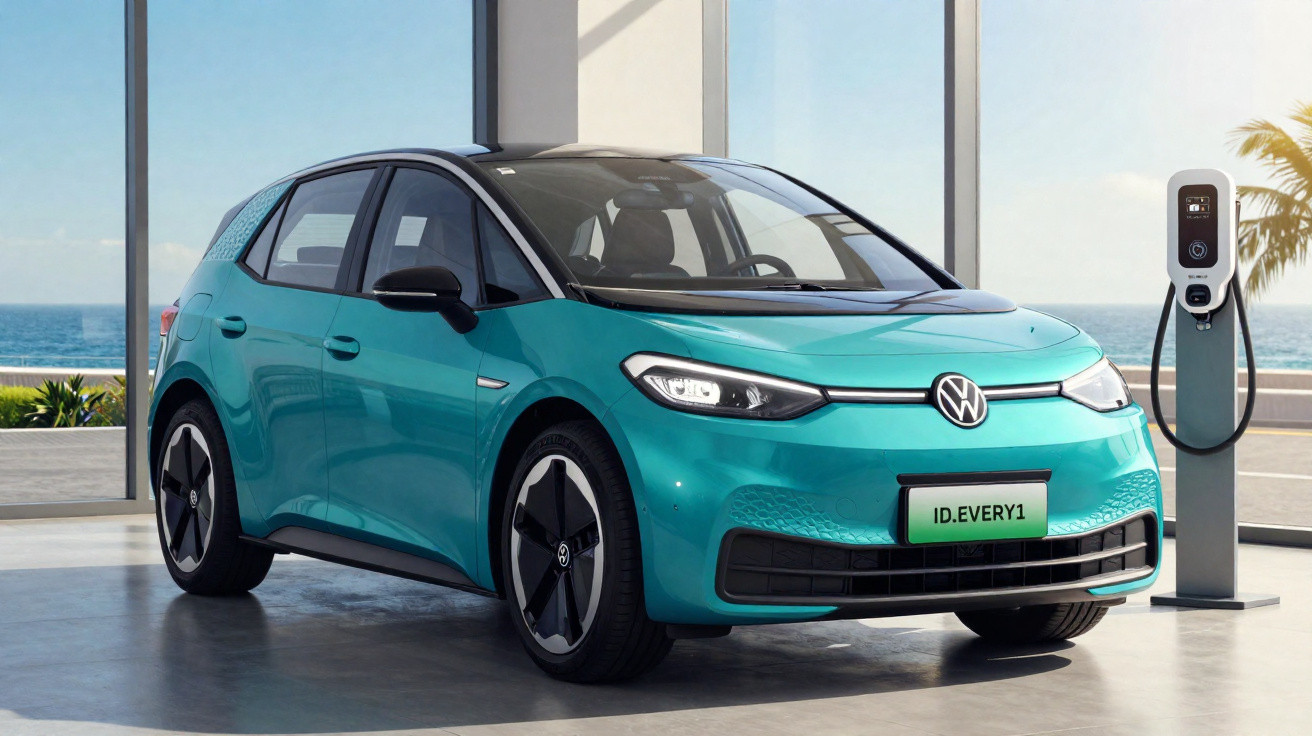
Still dealing with the scars left by Dieselgate a decade ago, Volkswagen set about creating an entirely electric model line-up, with the ID.3 as its first standard-bearer.
A dedicated platform (MEB), distinctive styling and notably spacious cabins were meant to be its key strengths. However, high prices, limited range, uninspiring exterior design and an overly pared-back dashboard concept meant sales failed to meet the German brand’s expectations. It also did not help that the market itself did not expand as much as it should-or could-have done.
A run of intensive meetings on the top floor of the Wolfsburg headquarters produced fresh strategies and new faces, including design chief Andy Mindt. A long-serving in-house designer brought back from Bentley, he was tasked with applying a principle familiar across many industries: without a past, there is no future.
Electric cars for everyone
Within just a few weeks he unveiled the ID.2all concept, which at last generated excitement both inside and outside Volkswagen, because it clearly carried the brand’s styling DNA-reinterpreted for the modern, electric era.
That car is set to become Volkswagen’s electric entry point at around €25,000, with proportions comparable to the Polo, and a planned market launch in 2026.
The new Volkswagen ID.EVERY1 is smaller (and is intended to take over from the electric up!) and will use the same front-wheel-drive MEB platform as the ID.2all-unlike the other ID models, which are rear-wheel drive. The two cars share Volkswagen’s determination to reach every kind of customer in the future: the names 2All (for all) and Every1 (everyone) make the ambition clear.
The target is for the electric range to achieve sales volumes more in line with what is expected of Volkswagen. To put it in perspective, the Golf sold 216,000 units in Europe in 2024, while the ID.3 managed only 54,000-four times fewer. In Europe’s top 50 best-selling cars, there are six Volkswagens with combustion engines, and not a single model from the ID range.
Part of that commercial flop is, of course, down to the cost of electric powertrain technology-something Volkswagen wants to start addressing with a proposed entry price around €20,000.
And the push will be significant: by 2027 (in just two years), nine new Volkswagens are due to be launched, four of them compact models built specifically on this front-wheel-drive MEB platform.
Volkswagen is not alone in the race to make affordable EVs: one of the ID.EVERY1’s key rivals is due to arrive a year earlier-the Renault Twingo.
Small, but versatile - Volkswagen ID.1
At 3.88 m long, the ID.1-expected to be the model’s final name-will sit between the 3.6 m up! (production ended in 2023) and the 4.07 m Polo (the ID.2All measures 4.05 m). It is claimed to offer generous room for four adults, along with a 305-litre boot.
Short body overhangs, a substantial width (1.81 m) and a relatively low glasshouse give it the stance of an “urban warrior”. It appeals immediately thanks to shapes and proportions Volkswagen has used for decades, evident in the position and design of the windscreen and rear window, the bumpers, and the rear pillar.
Inside, the dashboard layout is defined by a digital instrument display directly in the driver’s line of sight-though not as small or as basic as in the earliest ID cars-and a large infotainment touchscreen, complemented by physical buttons for temperature control and the audio system.
The cabin’s flexibility is further underlined by the console between the front seats: it can serve as a conventional armrest or slide back for second-row passengers, with shelves integrated into its structure.
The seats can also be set in different positions and folded or reclined to cover as wide a range of uses as possible. In other words, despite its compact footprint, this model is set to be anything but short on versatility.
Minimum range? 250 km
As for the drivetrain, details remain limited. What is known is that it is front-wheel drive, the electric motor delivers 70 kW (95 hp), top speed will be 130 km/h, and the minimum range will be 250 km. Battery capacity has not yet been disclosed.
The Volkswagen Group will also build these compact electric models for its Škoda and CUPRA brands. The programme is led by the Spanish industrial hub, split between the Martorell plants (where the more conventional five-door models will be made) and Pamplona (assembly lines for the crossover versions).
Electric Made in Portugal?
Alongside the production centres in Spain, there has also been speculation that this Volkswagen ID.1 could be built in Portugal, at Volkswagen Autoeuropa’s Palmela factory.
At this stage, however, the only confirmed point is that some small panels will be manufactured in Portugal to be integrated into the assembly of the various models produced at the two industrial sites in Catalonia and the Basque Country.
Comments
No comments yet. Be the first to comment!
Leave a Comment