
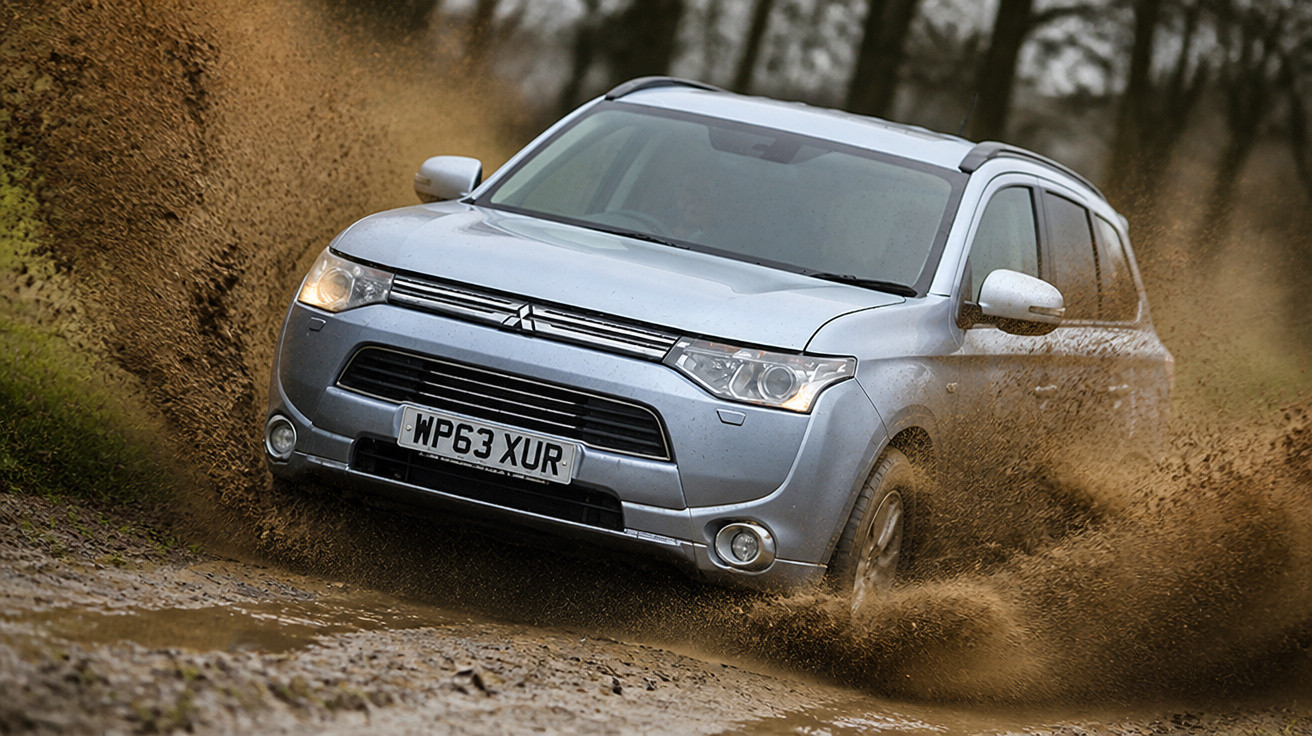
Overview: Mitsubishi Outlander PHEV
It’s a mud-plugging Mitsubishi SUV that also doubles as a would-be green poster boy. This Outlander is a plug-in hybrid that’s more soft-edged than hardcore, yet it arrives with headline claims of 148mpg and CO2 emissions of only 44g/km.
It’s a practical, family-leaning SUV that seats five without fuss, and those numbers look almost too good to be true - because, in everyday use, they don’t perfectly match reality.
Price and real-world fuel economy
Even so, the Outlander PHEV can still return respectable figures away from the test cycle. In normal driving you ought to see a straightforward 40mpg, helped along by the pairing of electric motors with a 2.0-litre petrol engine.
If most of your driving is made up of shorter runs - especially the sort you can do mainly on battery power - your average economy can climb noticeably higher.
How the plug-in series parallel hybrid system works
Mitsubishi describes the Outlander PHEV as a plug-in series parallel hybrid, which sounds like jargon until you split it up.
Plug-in: the Mitsubishi can be connected to the mains to charge the battery, giving a (somewhat theoretical) ‘electric-only’ range of 32.5 miles.
Series parallel: the petrol engine and the electric motors can either combine to drive the wheels, or one can be disconnected and used to top the battery back up. The car constantly chooses what to prioritise based on how it’s being driven. Picture a Toyota Prius, but with a stronger bias towards electric running, and you’re close.
In practice, that means you can leave home in the morning on full electric drive and cover roughly 30 miles on EV only. Once the charge is used up, the petrol engine steps in to keep you moving while also replenishing the batteries. EV range anxiety, largely dealt with.
Does it deliver on the road?
Up to a point, yes. On short trips that begin with a full battery, the Outlander can produce some eye-opening ‘economy’ read-outs. Even with normal driving and the air conditioning running, we never saw it fall below 60mpg.
With two electric motors - one driving each axle - it remains a four-wheel drive SUV, and it’s still quite happy towing little Ginny and the nag to the local gymkhana.
However, as something you’d grow truly fond of, the Outlander is less convincing. The battery pack adds 200kg to the kerb weight, and the result is a ride that isn’t as composed as the diesel version.
The 2.0-litre petrol engine is another weak link. When it cuts in, it doesn’t deliver the shove you’d expect, and it sounds strained and wheezy the moment you lean on it. After the smoothness of electric running, the Outlander’s combustion engine feels distinctly old-school.
So should you buy one?
That depends on your use case. If you don’t cover big mileages and you want to do your bit for the planet without giving up range or practicality, the Outlander PHEV adds up.
The pricing helps, too. Once the government subsidy is included, the hybrid costs exactly the same as the diesel Outlander: £28,249. Put simply, going green doesn’t bring a price penalty.
It’s also one for company car drivers to consider seriously. With its low tax bands, it can save company car users a fortune over three years - as much as £11,500 versus certain rivals.
The Outlander hybrid theory, then, is excellent. The execution? Not quite. Yet.
6/10
Comments
No comments yet. Be the first to comment!
Leave a Comment