
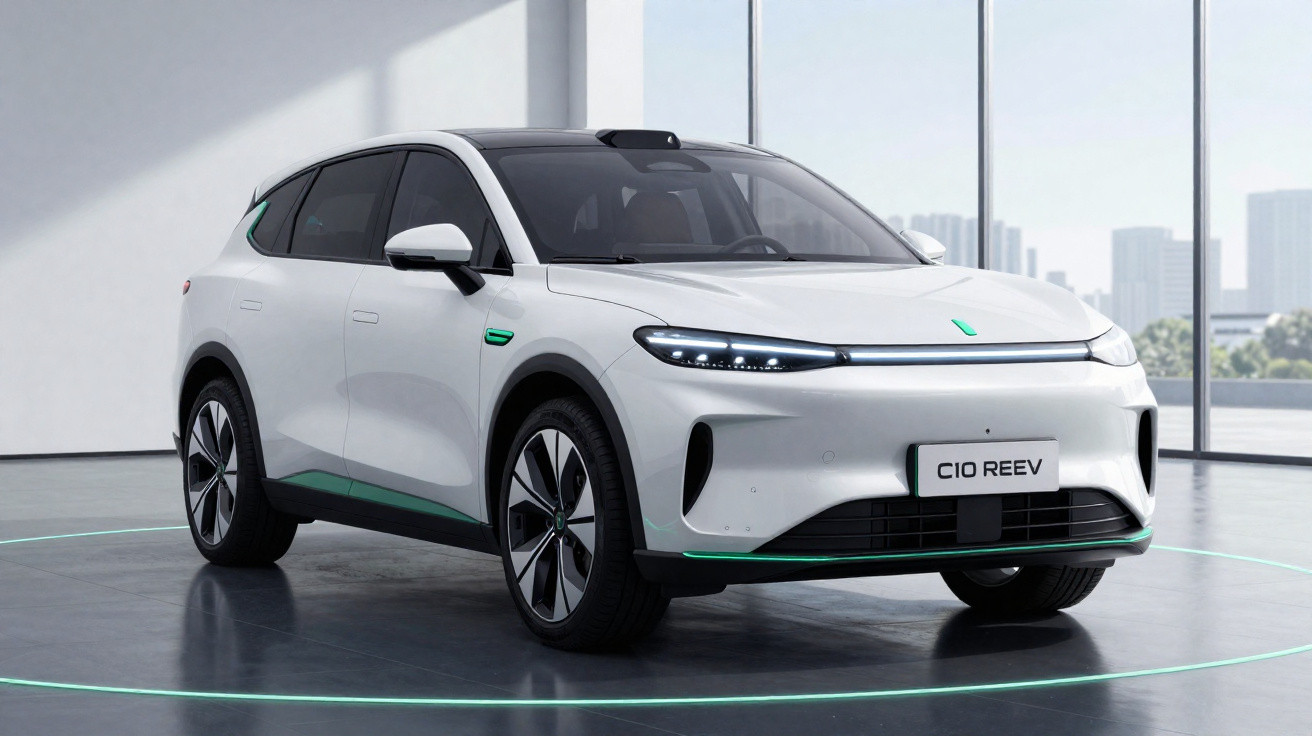
Although the Leapmotor C10 is only just making its way to Portugal, it isn’t unfamiliar to us - we first got behind the wheel last year.
It debuted as a fully electric SUV, but if its 420 km (WLTP) driving range doesn’t cover every journey, the Chinese brand now has an alternative: the C10 REEV, with up to 970 km of range.
To deliver that jump - more than double - Leapmotor didn’t fit a larger battery. Instead, it added something else entirely: a petrol engine. That’s what the REEV badge stands for - Range Extender Electric Vehicle - effectively making the C10 an electric car with a range extender.
The 1.5-litre petrol engine (as a generator)
The range extender is a naturally aspirated 1.5-litre, four-cylinder petrol unit producing just 88 hp. It only steps in once the 28.4 kWh battery has run out of charge, and its role is strictly to generate electricity.
So, of the 970 km quoted by the brand, only 145 km is driven in purely electric mode.
Confused? We explain
Despite having a combustion engine on board, the C10 REEV is still driven exclusively by its electric motor - in other words, only the electric motor turns the wheels. The petrol engine exists solely to produce power to top up the battery whenever needed.
Leapmotor C10 REEV energy management modes
The Leapmotor C10 REEV offers four energy-management modes - EV+, EV, Fuel and Power+ - which mainly differ in how strongly they prioritise “zero emissions” driving.
In EV+, as the name suggests, the system relies on the battery’s stored energy as if the petrol engine wasn’t there at all. The engine only starts once the battery drops below 9%.
In EV mode, the petrol engine cuts in earlier, when the battery falls below 25% state of charge.
In the other two modes - Fuel and Power+ - the combustion engine takes centre stage. In Fuel mode, the C10 REEV only keeps the engine switched off while the battery is above 80%. In Power+ mode, the petrol engine runs continuously.
Even with an extra engine compared with the fully electric C10, the Leapmotor C10 REEV keeps the same drivetrain figures: 160 kW (218 hp) and 320 Nm of peak torque. The brand quotes emissions of 10 g/km and fuel consumption of 0.4 l/100 km.
Charging options for the 28.4 kWh battery
The petrol engine isn’t the only way to replenish the battery. You can also charge the SUV from an external charger:
- Alternating current (AC) - up to 6.6 kW;
- Direct current (DC) - up to 65 kW; restores half of the electric range in just 18 minutes;
- Petrol engine - can keep charging the system while driving (up to 50 kW maximum output).
Beyond that, the C10 REEV shares the same features as the fully electric version.
When will it arrive?
The Leapmotor C10 REEV is due to reach Portugal later this April. Final pricing hasn’t been confirmed, but it is expected to sit above the electric C10.

Comments
No comments yet. Be the first to comment!
Leave a Comment