
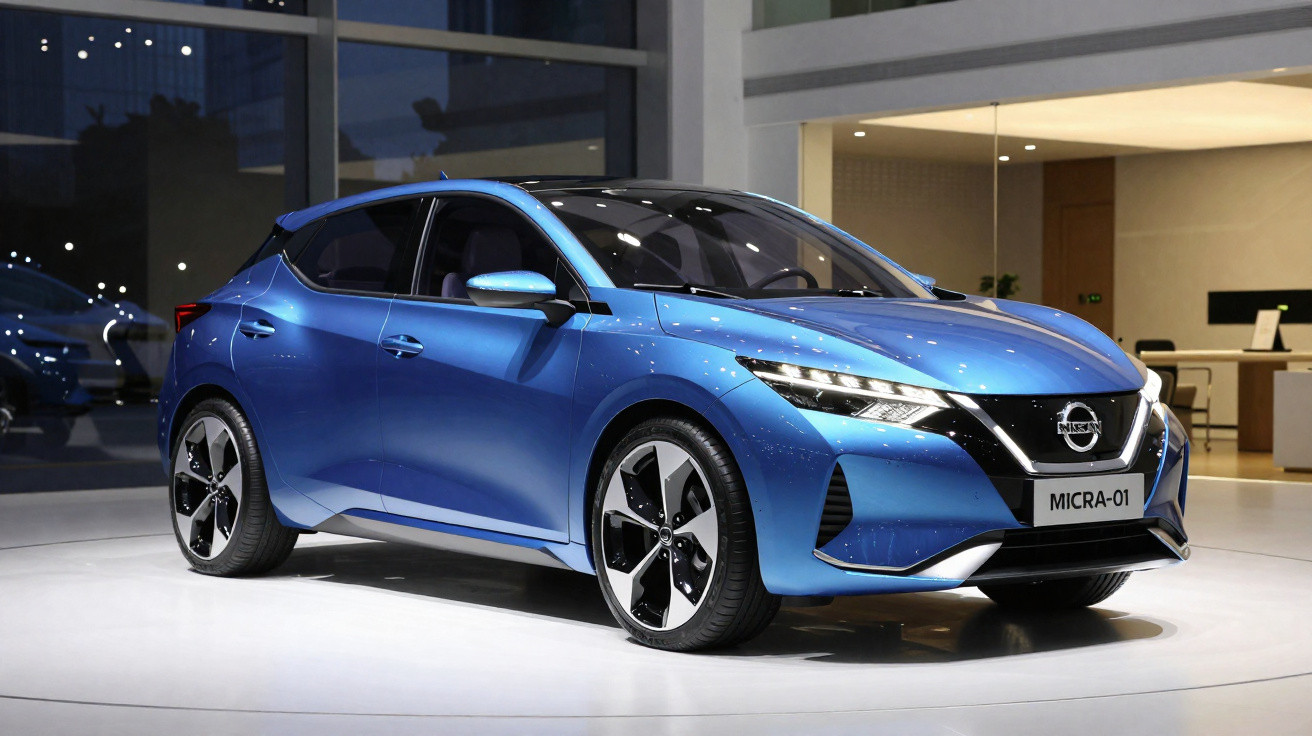
The new Nissan Micra can’t completely disguise its French origins. And that may be its biggest drawback.
The Micra is one of the cornerstones of Nissan’s line-up: it first arrived more than 40 years ago and has already clocked up over six million sales. That’s not bad at all.
For this new, sixth-generation model, Nissan has reworked the Micra we all know with help from Renault, because the latest Micra sits on exactly the same technical underpinnings as the Renault 5 electric.
On the one hand, that’s great news, because the Renault 5 E‑Tech is a genuinely well-sorted product. On the other hand, it inevitably restricts what Nissan can do. You can see it in the distinct exterior design, but the brand hasn’t been able to avoid an interior that’s essentially traced from its French “cousin”.
That’s the trade-off for taking full advantage of the synergies Nissan has with its Alliance partner, Renault. Without that cooperation, it would have been difficult to develop a B‑segment model this quickly and with this level of cost control.
It looks like a Micra
Ever since I first saw the new Micra in the metal, I’ve been spotting cues that remind me of the third-generation model launched in 2003, best known for its oval-shaped front headlights.
At this level, Nissan deserves credit: it has clearly done everything it can to ensure this isn’t a textbook case of badge engineering. At least on the outside…
The Micra looks chunkier and more crossover-like, although inside it suffers from the same issue as its French relative: rear passenger legroom.
It lacks identity
The Renault 5’s interior hardly needs an introduction and it’s among the best in the class. It mixes “premium” touches (at least in better-equipped trims) with straightforward usability, a modern ambience, and an infotainment system that’s genuinely pleasant to operate. That makes this starting point appealing.
The problem is that Nissan has done very little to make the cabin feel distinct. Apart from the steering wheel badge, the seat and dashboard trims, and one or two small details, everything is essentially identical.
As a result, it’s impossible to forget how closely related these two cars are. And because the Nissan Micra arrived later, it ends up paying the higher price for that familiarity.
For anyone who has never sat in a Renault 5, this may never be an issue. But I’ve driven Renault’s electric supermini several times over the past few months, and it did feel a bit jarring. Given the Micra’s heritage, I expected a bolder cabin that better matched the car’s exterior.
Tight on space
For all the reasons above, the Micra shares the Renault 5’s main weakness: interior space. People in the front seats are well catered for, but rear passengers get the short end of the stick.
Space in the back is limited, and anyone taller than 1.75 m will struggle to avoid brushing their knees against the front seatbacks and their head against the roof.
Even so, as long as the front passenger seat isn’t pushed all the way back, it’s still possible to fit a child seat with an ISOFIX base, which always needs extra room.
The story is similar in the boot, which tops out at 277 litres. If you want a closer look at the Micra’s interior, I’d encourage you to watch (or rewatch) the video I made during the model’s global unveiling.
Two battery options
Just like the Renault 5, the Micra can be configured with two different battery packs: a 40 kWh unit paired with a 90 kW motor (122 hp) and 225 Nm; and a 52 kWh battery that’s only available with the 110 kW motor (150 hp) and 245 Nm.
The smaller battery is rated for up to 310 km of range (WLTP). The larger one - the version we drove for this test - is quoted at up to 408 km on a single charge.
During my time with the Micra, the best I managed to “extract” was roughly 350 km. Naturally, that figure will always depend on how much motorway driving you do.
Small, light and agile
From the moment you set off in the Micra, you notice how light the controls feel and how nimble it is. In a small electric car like this, that makes a real difference.
The 0–100 km/h sprint takes 8s and top speed is capped at 150 km/h. The figures suit it well. I never found myself wishing for more power or extra performance. In fact, I could write several lines explaining why I think launching compact EVs with several hundred horsepower is a trend that makes no sense whatsoever. But we’ll leave that for another time…
All of this means the Micra is enjoyable to drive: it doesn’t shy away from tighter corners or more abrupt direction changes. It always seems comfortable with whatever you ask of it dynamically, which is a clear plus. I only wish the steering had a bit more weight and feedback.
I also get the sense the damping is slightly firmer than in its French cousin, though it never becomes uncomfortable, even on 18-inch wheels. And of course, the battery weight - mounted under the cabin floor - helps the whole package feel securely planted on the road.
It also delivers a level of refinement and comfort you don’t often find in this segment, even for rear passengers, as there’s independent rear suspension.
What about the price?
Already on sale in Portugal, the Nissan Micra starts at €26,589 for the 40 kWh version and €32,089 for the 52 kWh battery variant.
If we set aside the cheapest Renault 5 version with 95 hp - which isn’t offered in Nissan’s line-up - pricing between the two is broadly aligned. Even so, the entry-level Micra is around €1,150 cheaper than an equivalent Renault 5, a pattern that doesn’t carry over to the 150 hp models, where the R5 has a pricing advantage (around €850).
That’s a lot of numbers for a fairly straightforward takeaway: nobody will choose one over the other purely because of price. It will have to come down to the exterior styling, which is ultimately the biggest point of differentiation.
And soon there will be many more names to consider, given this is one of the market’s most competitive segments: for example, the new CUPRA Raval or the Volkswagen ID.Polo, not to mention the Kia EV2 or the established Peugeot e‑208.
You can even widen the shortlist to cars in the segment above that can rival some of these on price, such as the MG4 or the new GAC Aion UT, which we’ve just tested on video.
On the Micra’s side, you get a very capable chassis, keen agility, and one of the best infotainment systems on the market. Against it, there’s only modest range and a notably cramped cabin, especially in the rear.
Weighing it all up, when I look at what Nissan is asking for the range-topping version, it feels higher than ideal. That could dent Nissan Micra sales because, despite the weight of history behind the name, it faces the question every potential buyer will ask: why not simply buy a Renault 5?
Comments
No comments yet. Be the first to comment!
Leave a Comment