
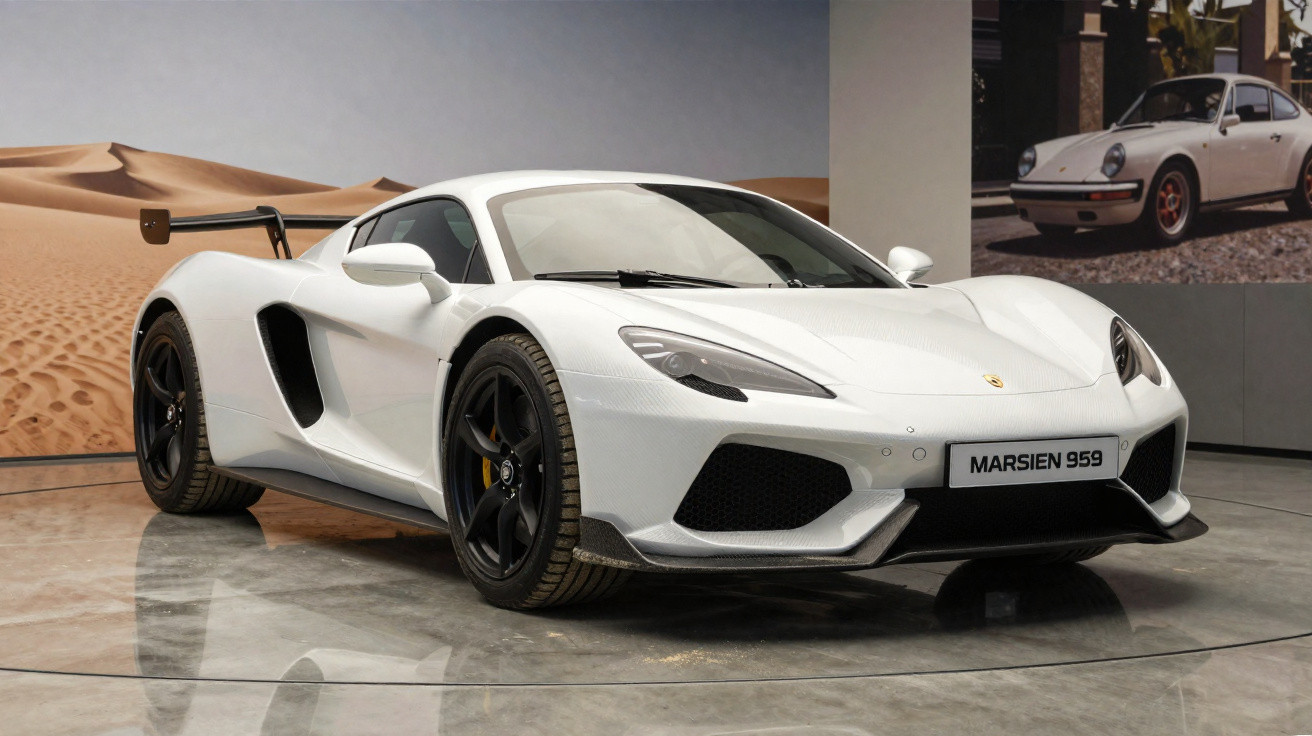
The legendary name “Gemballa” is back, and it returns with a machine that is hard for any car enthusiast to ignore. Called the Marsien, it takes its cues from the Porsche 959 that won the 1986 Rally Dakar and, at the same time, stands out as one of the most extreme 911-based builds ever.
The project comes from Marc Philipp Gemballa, who is not connected to the Gemballa tuning company founded by his father, Uwe Gemballa. This “super 911” borrows its name (in French) from the Red Planet (Mars), a reference to the “Martian” dunes of the United Arab Emirates desert where it was developed.
With the intention of carrying on his father’s legacy, Marc Philipp chose to make his debut with an off-road-focused car developed from a Porsche 911 Turbo S (992).
Design: Gemballa Marsien carbon bodywork with Porsche 959 cues
Penned by Alan Derosier, the body is made entirely from carbon fibre. From the 911 Turbo S, only the glass and the front headlights were kept; everything else on the exterior is brand new.
The futuristic look is defined above all by the dramatically widened wheel arches, the huge air intake in the bonnet and, of course, the integrated rear wing.
Those visual signatures immediately evoke the Porsche 959-one of the most significant supercars of the 1980s and a direct rival to the iconic Ferrari F40-yet here every decision was taken with off-road driving in mind.
Engineering: KW suspension, RUF power and performance
To deliver the required capability, Marc Philipp Gemballa worked with KW on a bespoke suspension set-up with electronic control, allowing the Marsien’s ground clearance to be adjusted between 120 mm (lowest setting) and 250 mm.
The centrepiece is the engine: a 3.8-litre flat-six modified by RUF, offered with two outputs-750 and 830 hp (and 930 Nm).
In the higher-power version, the extra boost comes via recalibration of the two turbochargers. The eight-speed PDK transmission also had to be strengthened to cope with the increase (an extra 180 hp and 130 Nm) compared with the standard Porsche 911 Turbo S (992).
The titanium exhaust, created specifically by Akrapovic, is neatly integrated into the rear bumper.
The published figures match the car’s intent: a 330 km/h top speed and 0–100 km/h in 2.6s. However, those numbers are only achievable on road tyres. With the optional off-road package fitted (and its all-terrain tyres), top speed is limited to 210 km/h.
And the price?
Production of the Marsien will be highly exclusive, capped at just 40 cars (with more than half already sold), each with a base price of 495 000 euros.
And that is before taxes, and before adding the cost of the donor car, the Porsche 911 Turbo S, which in the Portuguese market starts at 270 597 euros.
Comments
No comments yet. Be the first to comment!
Leave a Comment