
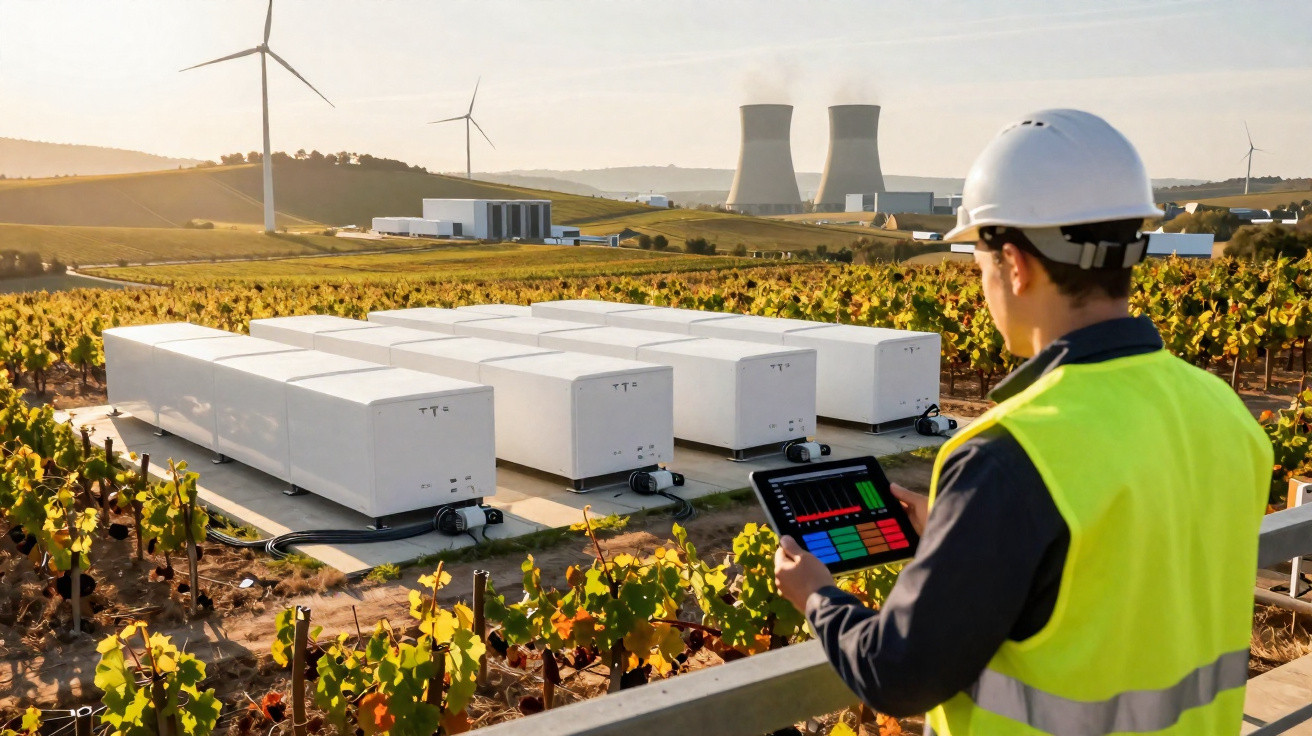
At first glance, the site could be mistaken for an industrial estate: neat lines of white containers set on open ground outside the Champagne capital. But behind the fencing near Cernay-lès-Reims, Tesla equipment and a rapidly expanding energy firm are preparing to see just how much grid-scale batteries can change the way a national electricity system is run.
A giant battery lands in Champagne country
TagEnergy, a renewable energy developer operating across Europe, has purchased 140 Tesla Megapacks for what is set to become France’s largest grid battery so far. Due to enter service in early 2026, the facility will provide 240 megawatts (MW) of power and 480 megawatt-hours (MWh) of storage.
Put simply, the installation can supply 240 MW for roughly two hours continuously. Based on TagEnergy’s estimates, that is approximately enough to meet around 20% of the Marne department’s electricity demand-an area with more than half a million residents-during brief peak periods.
This single site will act as a shock absorber for the French grid, stepping in during sudden peaks and dips in supply.
Its position close to major transmission corridors is no accident. Batteries only add real value when they can absorb or inject electricity extremely quickly at the right point in the network. Connected to high-voltage infrastructure near Reims, the Megapack site can react within seconds to instructions from France’s grid operator.
Why France is betting on batteries now
France’s electricity system leans heavily on nuclear generation, which is low-carbon but not as nimble as gas-fired plants. Meanwhile, more wind and solar capacity is being built, particularly in the north and west. Together, these trends increase the need for resources that can keep supply and demand balanced from minute to minute.
Grid-scale batteries like this typically provide three core services:
- Frequency control: keeping the system close to 50 Hz by instantly injecting or absorbing power.
- Peak shaving: discharging during evening surges so fewer fossil-fuel generators need to start.
- Renewable smoothing: storing surplus wind and solar when output is strong, then releasing it when generation drops (for example, when clouds move in or the wind eases).
For French decision-makers, this supports two priorities: lowering greenhouse gas emissions and reducing dependence on imported fossil fuels, particularly gas. Batteries do not produce electricity, but they help the system make smarter use of low-carbon generation-limiting curtailment and reducing the need to fall back on coal and gas.
Tesla’s quiet second act: energy, not just cars
Tesla is best known for electric vehicles, but energy storage has become one of its quickest-growing lines of business. At the heart of that push sits the Megapack: a container-sized battery unit designed for utilities and large infrastructure projects.
Tesla’s dedicated Megafactory is able to build around 40 GWh of storage each year-capacity that was barely available in the market only a few years ago. A second Megapack plant in Shanghai, expected to begin production soon, underlines Tesla’s view that worldwide demand for large-scale batteries will continue to climb rapidly.
Tesla’s hardware gives TagEnergy access to a proven industrial product, while Tesla gains a flagship site in a key European power market.
This is not Tesla’s first grid battery project, but it carries particular symbolic weight. France is the EU’s second-largest economy and an international reference for electricity systems dominated by nuclear power. If large batteries can be integrated smoothly into that kind of grid, it strengthens the argument for similar deployments elsewhere-especially in countries trying to combine dependable baseload with variable renewable generation.
How the Tesla Megapack project will work
From the outside, a Megapack looks like a very large shipping container. Inside are thousands of lithium-ion cells, plus power electronics, fire protection and control equipment. Near Reims, TagEnergy will aggregate 140 units into one coordinated installation connected to the high-voltage network.
| Project element | Details |
|---|---|
| Location | Cernay-lès-Reims, Marne, northeastern France |
| Technology | Tesla Megapack lithium‑ion battery system |
| Installed power | 240 MW |
| Storage capacity | 480 MWh |
| Number of units | 140 Megapacks |
| Commissioning target | Early 2026 |
Operationally, the battery will charge when electricity is plentiful or inexpensive-often during bright, windy periods-and discharge when prices jump or when the grid operator needs fast-acting stability services.
That revenue model depends heavily on fluctuating prices. The greater the gap between low-price and high-price periods, the more a battery can earn through arbitrage and grid services. France’s increasing share of intermittent renewables, together with nuclear units being taken offline for planned maintenance or unexpected outages, typically widens those swings.
What this means for French consumers and the grid
Households in the Marne will not find a separate “Tesla battery” item on their electricity bills. Any effects should be indirect: fewer last-minute imports from neighbouring countries during tight periods, slightly less severe wholesale price spikes, and stronger resilience if a major plant fails unexpectedly.
Big batteries will not eliminate price shocks or blackouts on their own, yet they can make both less frequent and less severe.
For RTE, France’s transmission system operator, the site adds a resource that can be controlled with exceptional precision. Batteries can move from zero output to full output in seconds; many conventional power stations need minutes-or even hours. That speed is particularly valuable for frequency stabilisation after sudden events, such as a major industrial load disconnecting or a large power station tripping offline.
Environmental gains – and the caveats
The aim is to cut indirect emissions across the French power system by reducing the use of fossil-fuel back-up plants. When a gas unit runs only a handful of hours each year, its emissions per unit of useful service are high and its operation is costly. Batteries can fill that role by delivering stored low-carbon electricity instead of burning fuel at short notice.
Even so, lithium-ion batteries raise their own environmental issues, including mineral extraction, emissions from manufacturing, and end-of-life handling. TagEnergy and Tesla will need strong recycling pathways to recover materials such as lithium, nickel and cobalt once the project reaches the end of its 15–20 year lifespan.
Local authorities are also scrutinising noise, visual impact and fire safety. Modern Megapack sites incorporate layered fire detection and suppression, spacing between units, and remote monitoring. Nevertheless, it is understandable that residents watch closely whenever major energy infrastructure is built near their community.
A glimpse of France’s future energy mix
The scheme near Reims sits within a wider direction of travel. TagEnergy has indicated it intends to speed up both solar deployment and storage development in France from 2025. The rationale is clear: as more wind and solar farms connect to the grid, batteries become more valuable by controlling when that electricity is delivered.
In policy discussions, this reflects a change in emphasis. For a long time, debates centred almost entirely on generation choices-nuclear versus renewables, gas versus coal-while storage received far less attention. Large battery sites demonstrate that flexibility can be treated as core infrastructure in its own right, much like transmission lines or substations.
Key terms: MW, MWh and why they matter
Because projects of this scale can seem intangible, a brief explanation is useful:
- Megawatt (MW) measures power-how much electricity the battery can supply at any given moment.
- Megawatt-hour (MWh) measures energy-how much it can supply over time before it is depleted.
With 240 MW and 480 MWh, the Reims battery could, in everyday terms, provide 240,000 homes using 1 kW each for about two hours. Alternatively, it could run at half that output for roughly four hours. Grid operators choose how to deploy that flexibility based on market signals and real-time system requirements.
Scenarios: how the Tesla battery might be used on a tough winter day
Picture a cold, still evening in January-conditions that often put the French system under pressure:
- Midday: Nuclear stations operate steadily while solar output peaks. Prices drop. The battery charges to full.
- Early evening: People arrive home and switch on heating and cookers. Demand rises sharply. The battery begins discharging at high power, reducing the need to start additional gas turbines.
- Sudden plant failure: A nuclear reactor trips unexpectedly. Frequency becomes unstable. The battery immediately ramps up to help steady the system while other generators respond.
On evenings like this, the financial and climate advantages reinforce each other: fewer emergency imports, less gas burned, and more value extracted from low-carbon electricity produced earlier in the day.
If the installation near Reims performs as expected, France’s energy conversation may gradually move beyond a simple “nuclear versus renewables” divide and towards a more practical challenge: how to choreograph a complex mix of low-carbon resources, with storage and flexibility playing a central role. The Tesla Megapacks outside Reims are likely to be an early-and closely watched-test of that new equilibrium.

Comments
No comments yet. Be the first to comment!
Leave a Comment