
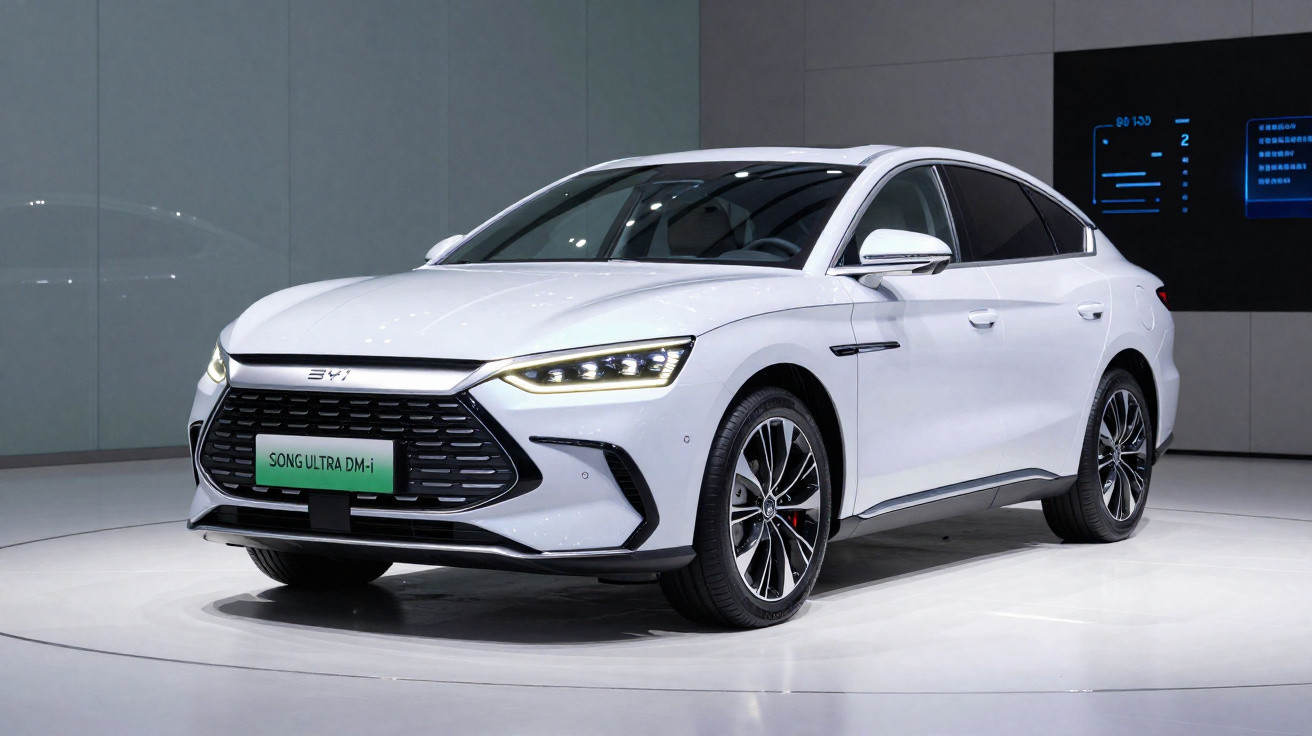
In China, hybrid cars can deliver an all-electric range up to four times higher than the best models sold in Europe. BYD is broadening its fifth-generation DM-i “Super-hybrid” line-up, claiming 1,845 km of combined range and 310 km of electric-only driving.
At an event in Shenzhen, BYD also shared several updates on its “God’s Eye” driver-assistance and autonomous driving programme, including new accident-related guarantees and the start of mass production for 4 nm chips designed to support future level 3 and level 4 automation. Alongside that, the Chinese manufacturer introduced the Song Ultra DM-i, a hybrid SUV positioned with extremely aggressive pricing (€16,000 to €20,000) and able to cover up to 1,845 km from a full tank plus one recharge.
Last month, BYD unveiled the fully electric version of this SUV, the first model in the “Dynasty” range to adopt “Flash” charging, compatible with chargers delivering up to 1,500 kW.
BYD “God’s Eye” autonomous driving: new guarantees and 4 nm chips
The Shenzhen announcements underline BYD’s push to harden its autonomous driving roadmap. The company highlighted additional guarantees in the event of an accident, while confirming that 4 nm silicon has reached production-hardware intended to underpin higher levels of automated driving, specifically levels 3 and 4.
Hybrid: BYD launches the Song Ultra DM-i in China, and the Dolphin G in Europe
With the Song Ultra DM-i, BYD is bringing its fifth-generation DM-i (Super-hybrid) powertrain to a wider audience. On BYD’s own CLTC figures (a more lenient cycle than Europe’s WLTP), it can travel 310 km in 100% electric mode. The recipe is straightforward: BYD effectively fits an EV-sized battery into a hybrid. Buyers can choose either a 26.6 kWh pack on the most affordable version, or a larger 38 kWh battery on other variants.
To market the car’s long-distance ability, BYD also discussed fuel consumption once the battery is completely depleted. It states 3.3 L/100 km on the Song Ultra DM-i, again using the CLTC test. Even if real-world European use would likely return higher figures, the claim points to very strong efficiency-helping explain how the model can reach 1,845 km in total with a full tank and a recharge.
A second BYD model in China offers comparable numbers: the Sealion 6 DM-i, also limited to the Chinese market and introduced earlier this year. It was the first to combine a 38 kWh battery with a 1.5 L petrol engine. Pricing is similarly cut-throat, starting at €17,000. For Europe, no launch has been confirmed; instead, the brand is concentrating on rolling out a small hybrid (the Dolphin G), closely related to the Dolphin Surf.
Europe: plug-in hybrid electric range still tops out at around 130 km
Across Europe, the strongest hybrid offerings remain a step behind on electric-only range. The best cars now comfortably exceed 100 km in 100% electric driving, but they still do not go beyond 130 km. At the top of the chart sits Mercedes with the GLC, which uses a 31.2 kWh gross battery. The Class C and Class E 300 e round out the line-up with 115 km and 118 km of electric-only range respectively (WLTP).
Which hybrid has the longest 100% electric range? The XPeng G6 EREV, with 400 km
Globally, the leader is Chinese too-but it is not BYD. XPeng, better known for fully electric cars, has released an EREV version of its G6 SUV. It is rated for 430 km without engaging the combustion engine (CLTC). To reach that benchmark, XPeng has installed a 55.8 kWh battery-larger than the packs found in many fully electric models.
Beyond its headline range, the XPeng G6 EREV also stands out for charging performance. Thanks to an 800V architecture, it can regain 314 km of range in 12 minutes, with peak charging power of up to 350 kW. Where it falls short of BYD’s Song Ultra DM-i is on total combined range, at 1,704 km.

Comments
No comments yet. Be the first to comment!
Leave a Comment