
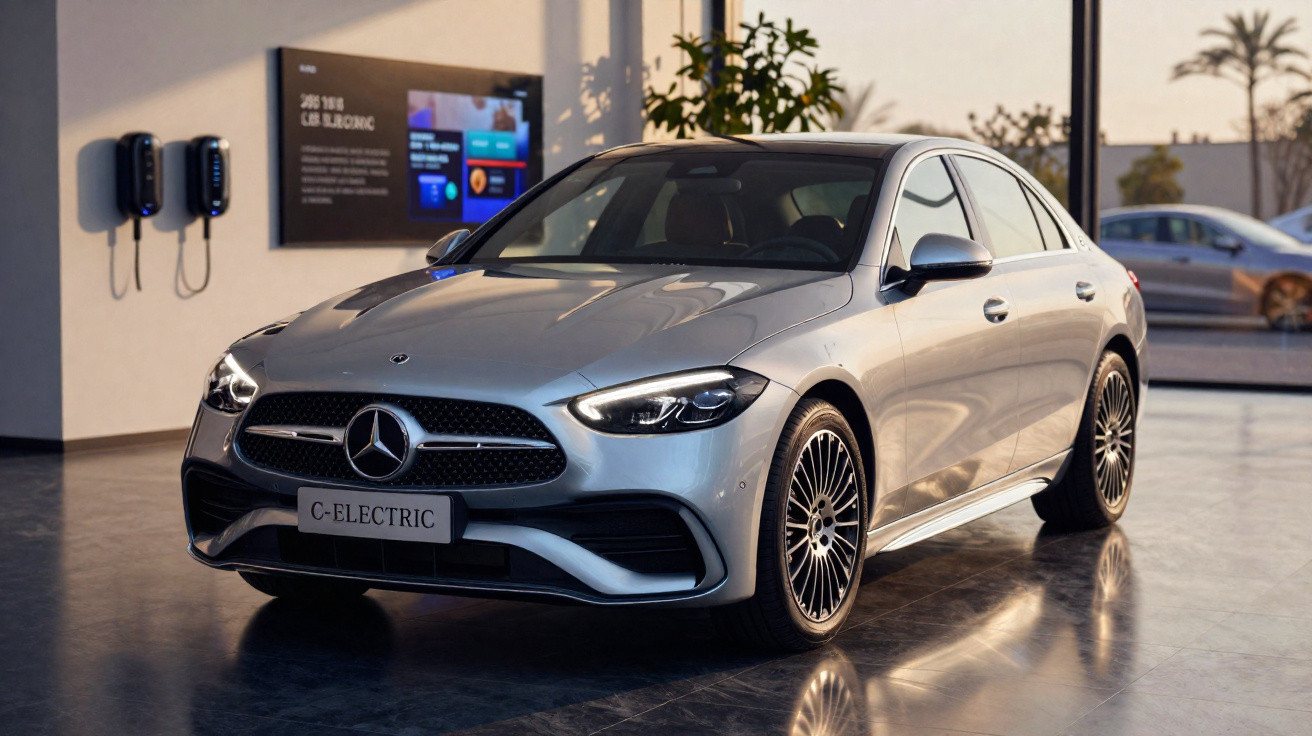
We drove the new electric Mercedes-Benz C-Class and discovered why it marks a new era for the three-pointed star.
For the first time in its history, the Mercedes-Benz C-Class is electric. That fact alone is enough to pull focus-this is, after all, one of the German brand’s most historically significant models.
Yet this new C-Class stands for something bigger still, because it reflects the direction Mercedes-Benz is now taking with EVs, as it gradually acknowledges the commercial disappointment of the EQ family.
As we saw with the GLC, the new electric C-Class is much closer in design to its internal-combustion equivalent, which will continue to be sold alongside it-keeping an offer that can satisfy two clearly different types of buyer.
It will only reach the Portuguese market over the coming months in C 400 4MATIC form, claiming up to 760 km of range, but we have already driven it. Take a look:
A completely new generation
The current combustion-engined C-Class will stay in production (it will be updated in 2028), but this new C-Class is an entirely fresh generation-conceived and engineered from the ground up to be 100% electric. And you can feel that in almost every area.
The clearest example is aerodynamics, which was one of the project’s headline priorities. The outcome? A drag coefficient (Cx) of just 0.22, which naturally brings very positive benefits for range. But we will come back to that.
First, it is worth focusing on the exterior, because this model signals a return towards the visual cues of the combustion C-Class. Even so, it has ditched the traditional three-box body in favour of a coupé-inspired fastback silhouette.
The detail that has generated the most conversation is the large front “grille”, embellished with 1050 LED elements, giving the C-Class a far more distinctive “face” than we saw on the EQE and EQS.
At the rear, the spotlight falls on the black panel that links the twin tail-lamps, plus the two projectors shaped like the three-pointed star, which lend this model a more futuristic, tech-led look.
Another noteworthy point is the boot opening: despite the fastback profile of this saloon, it still uses a conventional lid rather than a full tailgate incorporating the rear window, as you get, for instance, on the Audi A5. You can see all of this in detail in the studio video:
A necessary evolution
Inside, the differences versus the combustion C-Class are even more striking. Material quality and finishing precision sit at a higher level, effectively drawing a line under the criticism many customers levelled at previous generations.
Gloss-black plastics are a good example: Mercedes-Benz has moved away from that approach entirely, leaning more heavily on wood and aluminium.
Unsurprisingly-and just as I highlighted the first time I spent time with this model-the technology centrepiece is the optional 99 cm-wide HyperScreen, which turns the C-Class dashboard into one continuous digital panel.
I know this huge display still divides opinion, but the graphical performance, the responsiveness of the MB.OS operating system, and the way the functions are integrated put it among the best infotainment systems available today.
It is one of the cabin’s strengths, but I have to admit I missed having physical buttons for a few basic controls, rather than having to go through the large central screen-particularly for the climate functions, as we have, for example, in the S-Class.
Mercedes-Benz explains this split in solutions by pointing to each model’s target audience. After covering several kilometres behind the wheel, I have to say that decision does not stack up. Especially because it affects not only usability, but also safety.
To the cabin’s visual impact you also need to add the huge panoramic roof, which can turn opaque in milliseconds and simulate a starry sky with 162 light points. It is a talking point, as is the excellent Burmester 4D sound system-an option I am sure will impress anyone who values high-fidelity audio.
Space is plentiful, but one detail needs attention
Mercedes-Benz presents its new EV as the most spacious C-Class ever, and that is clear both in rear passenger room and in boot space.
Starting with the rear seats: even for someone my height (I am 1.81 m), it feels very generous. There is just one drawback: your knees sit in a higher, less natural position, caused by the battery placement beneath the cabin floor.
The boot, on the other hand, offers 470 litres of capacity, which compares well with the combustion C-Class, which has up to 455 litres (in the non-electrified versions).
The electric C-Class extends that advantage substantially thanks to a second storage area at the front (frunk), adding 101 litres to the total.
The real test
For now, Mercedes-Benz has only revealed the C 400 4MATIC, which sits at the top of the range-at least until the Mercedes-AMG versions arrive.
In this version, which we drove during this first contact in Helsinki, the C-Class uses two electric motors-one per axle to deliver all-wheel drive-producing a combined 360 kW (489 hp) and 800 Nm of maximum torque.
Those figures translate into a 0–100 km/h sprint in a dead-on 4s. It is sports-car quick, more than enough for everyday driving, and it makes overtaking feel extremely safe and relaxed. Top speed is limited to 210 km/h.
Range is not an issue
The new electric C-Class also deals convincingly with the range question. Thanks to a battery with 94.5 kWh of usable capacity, it claims up to 760 km between charges-an amount no one can really call short. Even so, its biggest rival, the BMW i3, manages 140 km more, although its battery is larger too.
That said, Mercedes-Benz is preparing to launch a more affordable rear-wheel-drive variant next year (C 250), which will lift range to values above 800 km.
As I mention in the video, I think the German brand missed a strong opportunity by not launching straight away with that highest-possible range version and the most competitive price point.
But, at the risk of repeating myself, range is not the problem here. During this first contact I was genuinely impressed by efficiency: on national roads and in town I managed consumption in the region of 15-16 kWh per 100 kilometres, rising to around 18 kWh/100 km on the motorway.
That is a strong showing when you consider this is a large model measuring 4.88 m long and weighing more than 2400 kg. Despite the weight, the electric Mercedes-Benz C-Class always feels quick and readily responsive.
Those traits make the driving experience different from what you get in the combustion C-Class. Of course, if you push the car hard on a twisting road or even on track, you do end up feeling the mass. That is true. But it is equally true that, in daily driving, it barely matters.
That is why, in my view, this electric C-Class has far more going for it than the combustion C-Class. It seems obvious-even if it is not flawless. I have already mentioned the unnatural knee position for rear passengers; and I can add that the driving position is also higher than in the combustion C-Class, for the same reason.
How much does it cost?
The new electric Mercedes-Benz C-Class is already available to order in C 400 4MATIC form, with prices starting at 70 600 euros. It is not cheap-far from it-but it lines up with the C 400 e 4MATIC (plug-in hybrid).
Given that Portugal’s new-car market is dominated by company buyers, this EV also brings a set of tax advantages to the table, making it more appealing.
Without a crystal ball, I can still say with considerable confidence that the electric C 250, due in 2027, will come with a more competitive price, more range and, very likely, even stronger tax benefits. In theory, it should give this model even more prominence.
In this first dynamic drive, it delivered very encouraging signs from what is one of Mercedes-Benz’s most important launches in recent times.


Comments
No comments yet. Be the first to comment!
Leave a Comment