
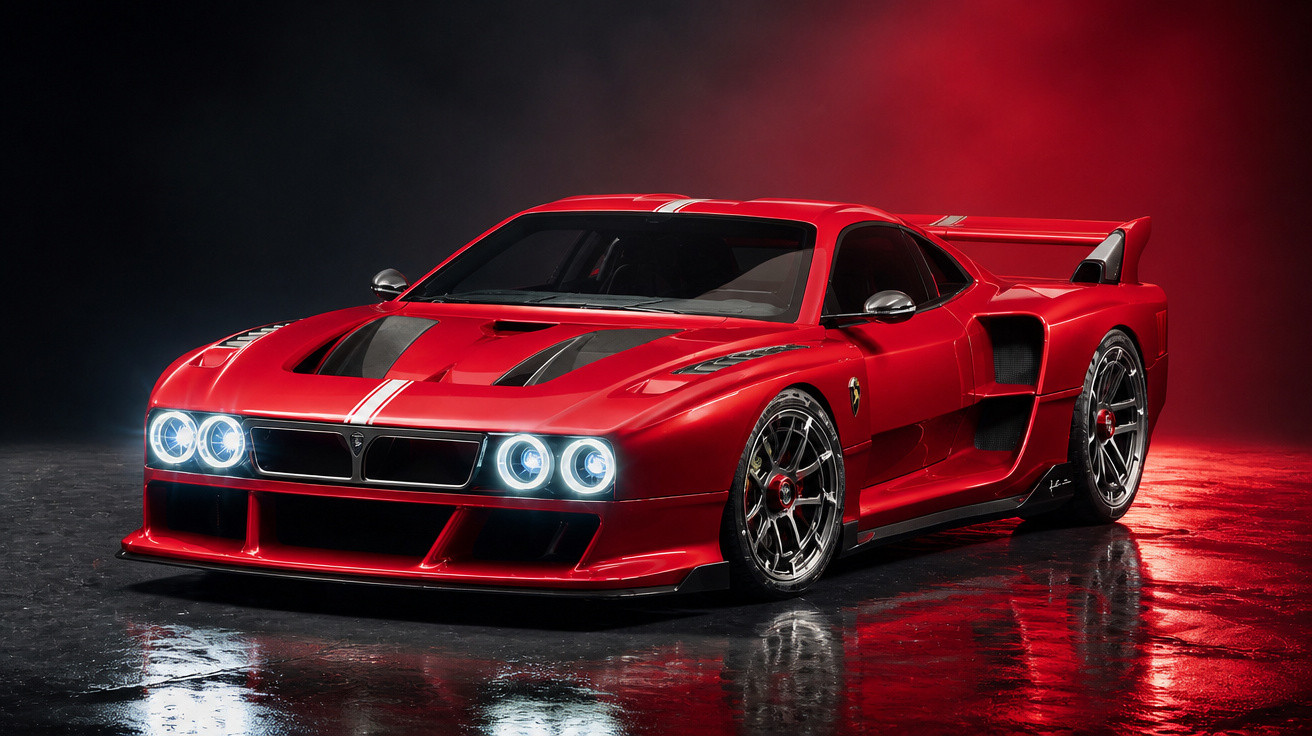
Some collaborations instantly feel like all-timers – up there with Aerosmith x Run-D.M.C, Louis Vuitton x Supreme… perhaps even Top Gear x Twiglets (RIP Stiglets). Christian von Koenigsegg is not the sort to give away the beating heart of his company on a whim, so the Italian hypercar you’re looking at – the Kimera K39 – clearly isn’t messing about.
What the Kimera K39 is
If you’ve been paying attention, you’ll know Kimera has form here. Its first pair of cars – the EVO37 and EVO38 – are restomods (hence the ‘EVO’ suffix) created as modern tributes to the Lancia 037 Group B rally car. Both are outstanding, with the EVO37 notably charging to a Top Gear Performance Car of the Year win in Portugal last summer.
The K39, though, is a different proposition altogether: a clean-sheet hypercar built around a carbon-fibre monocoque, driven by a V8, sending power to the rear wheels, and paired with a manual gearbox.
While the vibe remains old-school, hairy-chested motorsport, the reference point shifts away from rally stages and towards road-and-track pace, drawing on 1980s endurance racing. The key visual and technical muse is the 1981 Lancia Beta Montecarlo Turbo Group 5 – the technical forerunner and engineering springboard for the later Lancia 037 Group B rally car. The V8 choice, meanwhile, is a wink at the 1983 Lancia LC2, Lancia’s response to the then all-conquering Porsche 956.
The Koenigsegg 5.0-litre twin-turbo V8 deal
At the centre of this headline-grabbing partnership sits the K39’s 5.0-litre twin-turbo V8. Output is quoted at 986bhp and 1,200Nm of torque, with an 8,250rpm red line. It’s been gently toned down compared with the donor unit’s potential in the Koenigsegg Jesko, where it can deliver close to 1,600bhp when running on E85 ethanol.
Because the K39 is intended to be smaller, lighter and more agile, the engine package is tailored accordingly: reduced capacity for the turbos, faster-responding Agera-derived turbos, bespoke software, and a reworked intake. It’s also engineered to produce its very un-modest 986bhp on standard 95 octane pump fuel. The target mass is said to match the EVO38 at roughly 1,100kg – despite packing about 400bhp more.
On paper, the arrangement looks like a classic win-win. Kimera gains a top-tier powerplant without swallowing the R&D bill, plus the cachet of that Ghost Squadron marking on the engine cover. Koenigsegg, in turn, earns extra money from technology it has already funded. Which naturally raises the question: why hasn’t Koenigsegg done something similar before?
“To give out our heart like this to another product is a very emotional journey and it's the first time we’ve done it," said Christian von Koenigsegg. "It comes down to who is behind the project? What is their motivation? What is the car? We wouldn’t have done this if we didn’t feel this close connection with Luca and a great belief in Kimera's ability to succeed with this product.”
And does that mean Koenigsegg might start supplying V8s to any would-be hypercar brand that asks nicely? “In the future, there might be more opportunities for us to do this with other brands, but we don't take this lightly. Maybe this will be the only one, maybe there will be more, but everything needs to fit and feel right and be aligned for this kind of thing to happen. In general, we have an idea to spread our technology a little bit wider than just to our cars, but up until now we’ve prioritised our own needs.”
Chassis, design and what comes next
Outside of the engine story, the technical picture is still fairly hazy – the cars shown so far are models assembled for a world debut at Villa d’Este. Kimera founder and CEO Luca Betti says a running example, complete with a finished interior, will appear at Car Week in California this August, with first customer deliveries pencilled in for early next year.
For now, the K39 is set to launch with a seven-speed Cima manual gearbox, although a sequential paddleshift transmission is apparently under consideration. Suspension is in-board pushrod at both ends (as on the EVO38), and the structure is described as an ultra-stiff carbon-fibre monocoque – though the supplier remains to be confirmed. Dallara is advising on the aerodynamic package. Braking hardware is currently steel discs, with carbon-ceramics being developed behind the scenes. The machined aluminium wheels measure 508mm at the front and 533mm at the rear, shod with Pirelli Trofeo RS tyres, and the bodywork is carbon throughout.
As for the styling, subtle isn’t part of the brief. Up front, the link to the EVO pair is unmistakable: Lancia-homage quad lamps and a broad, split grille. The pop-up headlights – equal parts brilliant and bonkers – sit behind the LED rings and, in a moment of proper theatre, rise to occupy the centre of each circle. The grille is fully open, channelling air through and over the ‘S-duct’ bonnet, while slatted vents in the GT3 RS mould pull pressure from the front wheelarches. The defining flourish, however, is those boxy arches bursting through the body, making it look as though a slim car has been swallowed by a wider, angrier one.
Air intakes in the rear quarter windows supply the engine, while two larger side intakes feed the cooling system alongside an additional inlet integrated into the rear wing upright – a clear nod to the Beta Montecarlo Turbo’s eccentric spoiler arrangement. The tail is almost shockingly sheer and clean: twin round lamps, a central Koenigsegg exhaust, and a deep diffuser tucked beneath.
Then there are the four slashes behind the rear wheels. Ring any bells? This may be the nearest thing yet to a modern-day Ferrari F40 in spirit – not just in its stance, but in the recipe: a boost-heavy V8, a manual gearbox, unapologetically analogue you’re-on-your-own attitude, and Luca’s own admission that he’s an F40 obsessive.
The cabin remains the biggest unknown. With a bit of coaxing (and, apparently, some bribery), Luca did share sketches hinting at what’s coming: a manual transmission with exposed linkage, a dashboard that echoes the EVO37’s shape but adopts a more layered, multi-level layout, and a prominent rev counter perched on the steering column – a respectful tip of the hat to the Lancia Beta Montecarlo Turbo’s (rather less plush) interior.
Kimera’s plans extend beyond road blasts and track days, too. The company also wants to take the K39 up Pikes Peak, aiming for 2027 (though that timeline could slip given how much is on the to-do list). The competition version is, fittingly, even more extreme and is called the K39 Pikes Peak. Only 10 particularly brave customers will be able to buy this track-only oddity, which comes with a surfboard-like front splitter, a roof-mounted ram-air intake, and a rear wing the size of a Boeing A380.
Final production volume is still to be confirmed, but expect a tiny run – probably more than 50, fewer than 100 – and around 20 are already spoken for at the time of writing. Pricing is very much POA, although you shouldn’t expect much change from £2m once you’ve allowed yourself a little enthusiasm on the options list.
So, is it sensible to hand over that sort of money to a former restomod specialist now turning fully-fledged hypercar maker? Considering how spectacularly capable, beautifully built, robust and characterful the EVO37 and EVO38 are, we’d be all in. And honestly, it’s not hard to see why Christian was keen to get involved at ground level with a company that looks like it could be the next big thing.
19 minutes 22 seconds
Comments
No comments yet. Be the first to comment!
Leave a Comment