
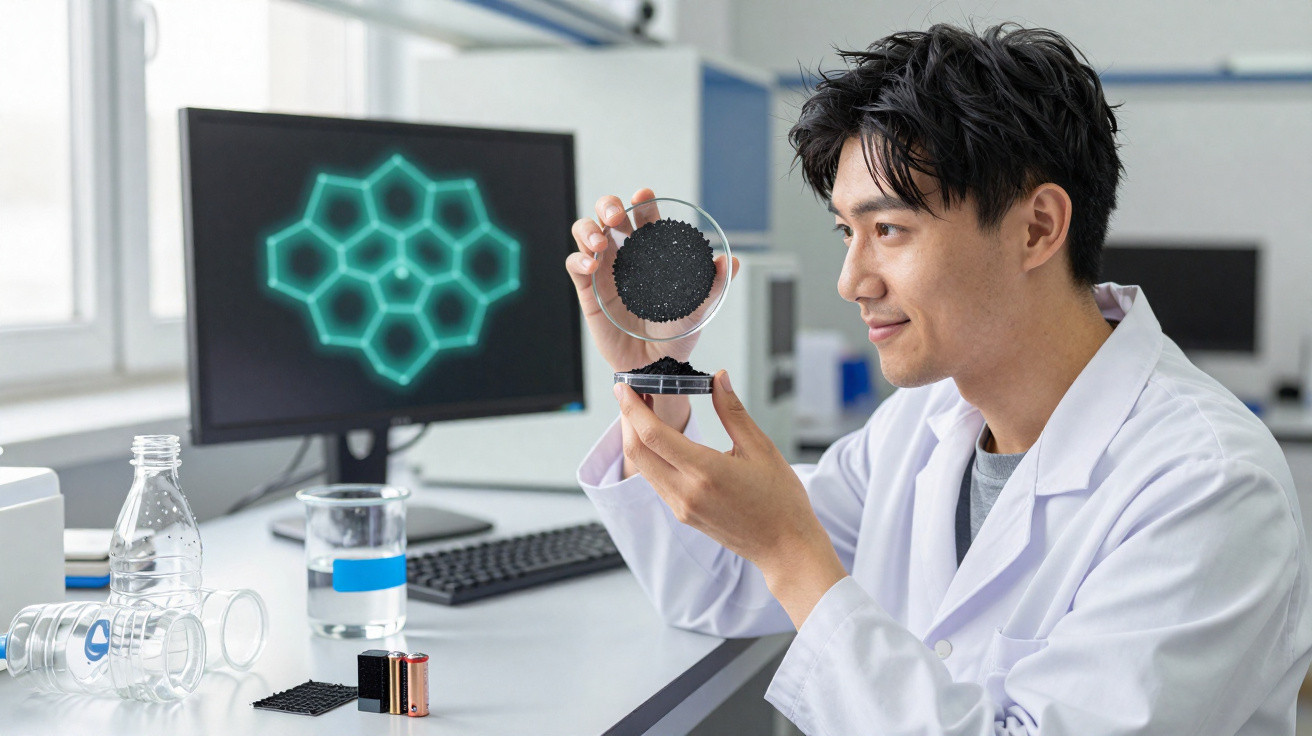
Plastic bottles are binned in their millions every day after a single use, typically seen as worthless beyond a recycling box or a landfill site.
At the same time, the need for batteries continues to surge as electric vehicles, smartphones, laptops and renewable energy storage roll out more widely.
On the face of it, these challenges do not look connected: one is an escalating waste stream, while the other is a tightening supply of vital materials.
However, new research from Pennsylvania State University (Penn State) indicates that one problem could help tackle the other.
In the study, scientists converted thrown-away PET plastic bottles into high-grade synthetic graphite that exceeded the performance of the natural graphite used in most lithium-ion batteries.
If the approach can be expanded beyond the lab, yesterday’s drinks bottles could become a meaningful input for tomorrow’s batteries.
Where two challenges collide
Around 300 million tonnes of plastic are produced globally each year, and roughly half is designed for single use.
PET is one of the most common contributors, used extensively in drinks bottles and food packaging.
Yet only a modest fraction is genuinely recycled. Much of it is incinerated, downcycled into lower-value products, or deposited in landfill.
In parallel, appetite for graphite is rising sharply. The U.S. Department of Energy (DOE) classifies it as a critical mineral, and it is the anode material in almost all lithium-ion batteries.
An electric vehicle can use up to 70 kilograms (about 150 lb) of graphite per car. Projections also indicate that demand for battery-grade graphite may be four times higher by 2030.
Why PET bottles are difficult to graphitise
Producing high-quality graphite from PET is more challenging than it first appears. By weight, the polymer contains about 33 percent oxygen, and that oxygen creates serious issues during high-temperature processing.
When PET thermally decomposes, the oxygen promotes extensive cross-linking between carbon fragments. Rather than forming tidy graphite layers, the material becomes a disordered, turbostratic char.
Even pushing temperatures beyond 1,800 °C (around 3,270 °F) does not resolve the structure.
Historically, the typical solution has been to introduce metal catalysts such as iron, nickel or cobalt.
While effective, these catalysts can contaminate the product. Removing residual metals requires additional chemical processing-an especially important drawback for battery-grade graphite, where purity is paramount.
Using graphene oxide instead
The Penn State researchers chose a different strategy that avoids metal catalysts entirely. They mixed shredded PET with a very small dose of graphene oxide and then applied a precisely managed heat-treatment process.
Graphene oxide consists of single-atom-thick carbon sheets decorated with oxygen-containing groups. In this role, the sheets act as a structural guide, encouraging free carbon atoms to arrange into well-ordered stacks as the plastic carbonises.
“Most people think of a plastic bottle as waste once they’re done using it,” said Shakshi Sekar, lead author of the study.
“Our work shows that the same material can become a valuable resource for producing graphite, which is essential for modern battery technologies,” Sekar said.
Plastic-derived graphite outperforms natural graphite
The researchers found that the optimum additive level was small. The best-performing graphite was produced with only 2.5 percent graphene oxide by weight, using material with a low oxygen content.
Under those conditions, the crystallites became notably large and well aligned. Crystal width reached about 114 nanometres, while stacking height measured about 27 nanometres.
Each figure exceeds typical natural graphite values of roughly 100 and 24.6 nanometres. Compared with untreated PET char, the crystal width increased by about 228 percent and the stacking height by around 200 percent.
“We’re not simply finding a use for waste plastic,” Sekar said.
“We’re creating a valuable material that could help support the growing demand for batteries and clean energy technologies,” Sekar said.
How the template effect works
Oxygen groups on graphene oxide appear to be central to the effect, although their position on the sheet is crucial. Oxygen located at the edges helps initiate lateral crystal growth, expanding the width of each graphite domain.
By contrast, oxygen on the flat basal plane encourages cross-linking that supports coherent alignment as layers develop. That same planar sp2 surface also draws carbon into parallel stacks via pi–pi interactions.
Pure graphene, which lacks oxygen altogether, operates through a related but slightly different two-part pathway. Its active edges promote sideways growth, while its clean surface steers vertical stacking.
Cleaner graphite from plastic without metal catalysts
For industrial adoption, the avoidance of metals could be the most significant advantage. With no catalyst present, there is no iron or nickel residue to remove later.
“By avoiding metal catalysts, we can produce cleaner graphite while reducing chemical use and waste generation,” Sekar said.
This streamlined route could reduce both the cost and the environmental impact associated with manufacturing battery materials.
Conventionally producing one tonne of battery-grade graphite uses about 11,000 megajoules of energy and emits roughly five tonnes of carbon dioxide.
One process, two useful carbon products
The method also offers a second, notable benefit. Depending on which additive is used and at what loading, the same approach can generate both graphitic carbon and hard carbon.
Graphitic carbon is well suited to lithium-ion anodes-the standard choice in phones and electric vehicles. Hard carbon, which is non-graphitic, is valued for sodium-ion batteries aimed at lower-cost grid-scale storage.
In other words, a single waste stream could supply two distinct energy-storage pathways, making the technique attractive in a market with varied requirements.
Reframing plastic waste
Significant work remains before the technology can move from the laboratory into production. The researchers still need to validate large-scale manufacturing and evaluate how the material performs in real battery cells.
Even so, the implication is striking: a material routinely treated as rubbish began to function as a feedstock for advanced technology.
“If waste plastic can become a feedstock for advanced energy materials, it changes how we think about recycling,” Sekar said.
“Instead of viewing plastic as a disposal problem, we can see it as a resource that helps support clean energy technologies.”





Comments
No comments yet. Be the first to comment!
Leave a Comment